
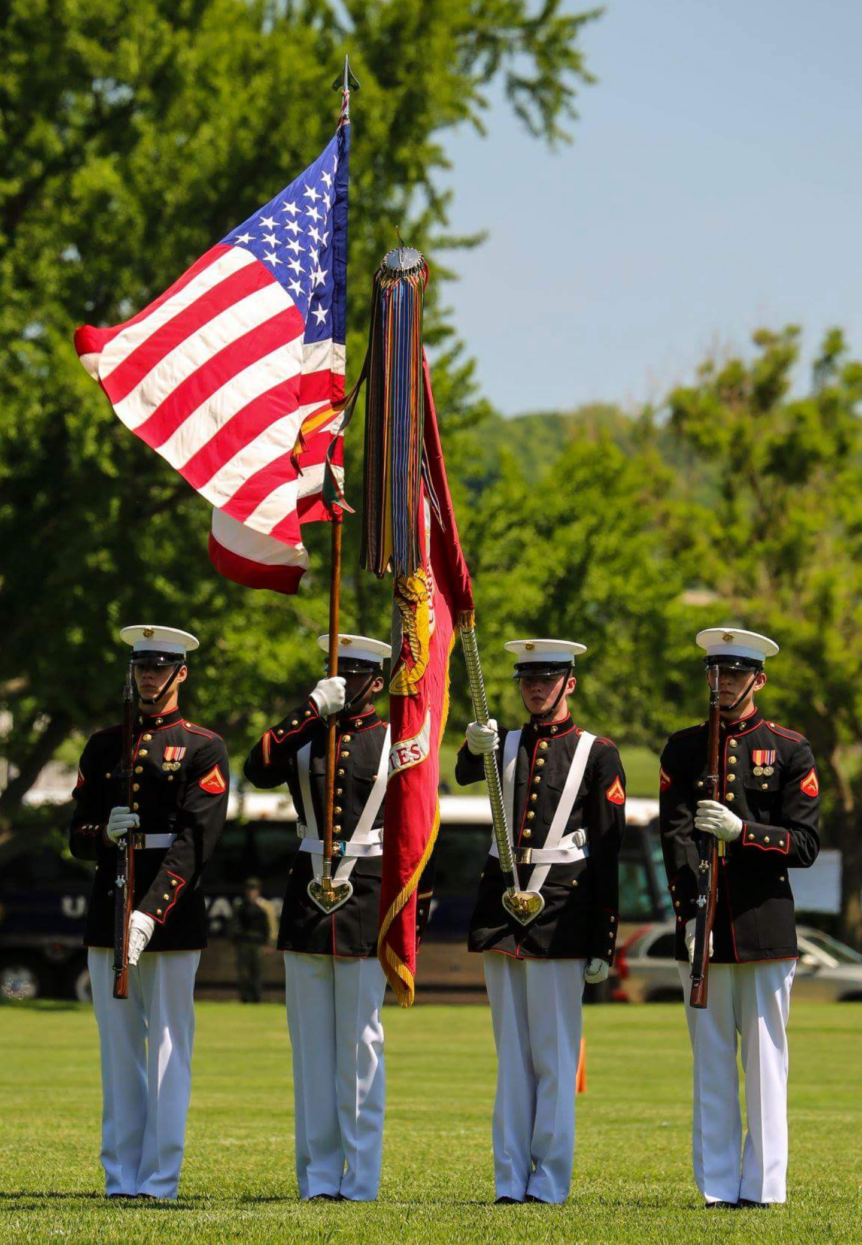
Doctrinal Clarification for Collegiate Competition and beyond
Purpose
This article provides doctrinal clarification derived from Marine Corps Drill and Ceremonies procedures regarding:
- Orientation of the color staff and spearhead
- Execution of the colors salute by organizational colors
- Proper application of these principles within a USMC-led joint color guard (e.g., Marine Corps and Navy, Air/Space Force, and Coast Guard)
The intent is to ensure uniform visual execution, doctrinal fidelity, and competitive consistency for collegiate teams preparing for national competition procedures for a joint color guard operating under Marine Corps standards. This also applies to Active Duty and Reserve Color guards in the same situation.
Doctrinal Foundation
Marine Corps drill establishes a clear distinction between:
- The normal staff orientation at order or carry, and
- The natural rotation that occurs only during execution of a colors salute.
At the prescribed vertical position, the flat face of the spearhead is oriented to the front.
No alternate static orientation is authorized.
When an organizational color renders a salute, the bearer:
- Straightens the right arm,
- Lowers the staff in a natural arc, and
- Allows the staff to rotate naturally, resulting in the edge of the spearhead facing downward as a consequence of gravity and flag attachment—not deliberate manipulation.
Therefore:
The “edge-forward” or “cut-the-cake” appearance is not a position.
It is an effect produced by the salute.
Any deliberate pre-rotation of the staff to achieve that appearance outside the salute is non-doctrinal.
Flag Attachment, Staff Sleeve Orientation, and Natural Rotation Differences
Construction-Based Distinction
Marine Corps organizational colors are mounted differently from Army and Air/Space Force colors:
- Marine Corps Colors
- Staff sleeve hem terminates at the edge of the spade
- Seam is oriented to the bearer’s left at Carry
- When the staff is lowered and naturally rotates during a colors salute, the flag hangs cleanly without wrinkling or binding
- Navy and Coast Guard Colors
- Staff sleeve hem terminates at the front of the battle-axe
- Same for the halberd and spread eagle
- The ball and flat truck do not have a specific part to their design, so the staff orientation would still be to the front
- The reasoning behind this is when posting the colors in stands, the finial’s face must face the audience and having the seam in the opposite direction of the audience would present a bad look
- Seam is oriented to the front of the bearer at Carry
- Mechanical rotation of the staff is not authorized
- In Joint Color Guards under Marine Corps Direction, the staff finial is the spade and rotated at Present
- Staff sleeve hem terminates at the front of the battle-axe
- Army and Air/Space Force Colors
- Staff sleeve seam is centered on the face of the spade
- Seam is oriented to the rear of the bearer at Carry
- Mechanical rotation of the staff is not authorized
- In Joint Color Guards under Marine Corps Direction, the staff finial is the spade and rotated at Present.
This difference is intentional design, not doctrinal disagreement.
Application to Joint Color Guards Under Marine Corps Control
In USMC-led joint color guards, judges shall distinguish between:
- Commanded finial orientation, and
- Bearer-induced staff manipulation
Key adjudication principles:
- Navy and Coast Guard color bearers shall not mechanically rotate the staff at any point.
- At Present, ARMS, when operating under Marine Corps commands, the spade finial is oriented per Marine Corps geometry, regardless of service.
- Marine Corps colors may exhibit natural staff rotation due to construction and seam placement.
- Navy and Coast Guard colors are not deficient if no rotation occurs, provided:
- The staff is lowered naturally
- The finial faces correctly
- No wrist or hand manipulation is used
Judging emphasis:
Evaluate command compliance and natural motion, not visual imitation of Marine Corps color behavior.
Artificial rotation, forced wrist action, or attempts to “match” Marine Corps drape using non-Marine Corps equipment constitute technique errors.
Prescribed Staff Behavior
1. At Order or Carry
- Staff remains vertical.
- Flat face of the spearhead oriented forward.
- No intentional rotation.
2. During the Colors Salute
Organizational color bearers shall:
- Lower the staff naturally.
- Permit natural rotation of the staff.
- Allow the edge of the spearhead to face downward as a result, not a command action.
- Maintain identical timing across all organizational colors.
3. Upon Completion of the Salute
All organizational colors shall:
- Return the staff to vertical.
- Restore the flat face of the spearhead to the front.
- Re-establish complete visual uniformity.
Competitive Implications for Collegiate Teams
Judging panels evaluating military color guards consistently assess three doctrinal factors:
1. Fidelity to Service Drill Manuals
Any intentional spearhead rotation outside the salute indicates misunderstanding of Marine Corps procedure.
2. Uniformity of Organizational Colors
If only one service color salutes or rotates:
- The formation appears visually incorrect, and
- The execution is doctrinally indefensible.
3. Natural vs. Artificial Motion
Judges trained in military visual standards can immediately detect:
- Forced rotation, versus
- Gravity-produced rotation during a proper salute.
Artificial manipulation is typically scored as technique error.
Recommended Standard for National Competition
For any collegiate color guard operating under Marine Corps procedural authority, the defensible competitive standard is:
- National Color:
- Remains vertical.
- There are times when the staff is brought to an angle, this is not a “dip” in salute, it is a utilitarian position to enable the color bearer to navigate through a low clearance area like a doorway.
- All Organizational Colors:
- Execute the colors salute together.
- Lower naturally.
- Allow natural spearhead rotation only during the salute.
- Recovery:
- All staffs return to flat-forward vertical alignment simultaneously.
This method:
- Aligns fully with Marine Corps drill doctrine
- Produces correct ceremonial appearance
- Eliminates ambiguity in joint-service execution
- Maximizes competitive scoring defensibility
Conclusion
The critical doctrinal understanding is simple:
The spearhead does not define the salute.
The salute defines the spearhead’s appearance.
When collegiate teams preserve this distinction, they achieve:
- Doctrinal correctness
- Visual precision
- Competitive credibility
Those three outcomes remain the enduring standard of Marine Corps ceremonial discipline.
If you would like, the next logical step is a one-page competition quick-reference sheet or a judges’ scoring note that aligns this doctrine directly with caption scoring.
Judges’ Note
Staff Orientation and Colors Salute Execution in USMC-Led Joint Color Guards
National Collegiate Military Color Guard Competition Guidance
Purpose
This note provides adjudication guidance for evaluating:
- Staff and spearhead orientation
- Execution of the colors salute by organizational colors
- Uniformity within USMC-led joint color guard formations
The objective is to ensure consistent doctrinal interpretation, visual standardization, and defensible scoring across judging panels.
Doctrinal Anchor (Marine Corps Procedure)
Marine Corps drill establishes two distinct conditions:
1. Vertical Staff Positions (Order / Carry)
- Staff is vertical.
- Flat face of the spearhead oriented forward.
- No intentional rotation is authorized.
2. Colors Salute by Organizational Colors
During the salute, the bearer:
- Lowers the staff in a natural arc.
- Allows natural gravitational rotation of the staff.
- Result: edge of the spearhead faces downward as an effect, not a commanded position.
Key doctrinal principle for judging:
“Cut-the-cake” appearance is not a position.
It is evidence that a correct salute is occurring.
Any deliberate pre-rotation or maintained edge-forward orientation outside the salute is non-doctrinal.
Joint Color Guard Interpretation Under Marine Corps Control
Within a USMC-led joint formation:
- Each service color functions as an organizational color.
- Organizational colors render honors to the National Color, not to each other.
- All organizational colors must salute simultaneously.
- The National Color never salutes.
Failure to apply this uniformly creates both:
- Visual inconsistency, and
- Doctrinal error.
Primary Adjudication Criteria
I. Doctrinal Fidelity
Judges shall confirm:
- Flat-forward spearhead at vertical positions
- No artificial spearhead rotation
- Natural rotation occurring only during the salute
Common Errors
- Edge-forward at carry or order
- Forced wrist rotation to “show” the edge
- Marine Corps color saluting alone in joint formation
These indicate manual misinterpretation.
II. Uniformity of Organizational Colors
Evaluate:
- Simultaneous initiation of salute
- Identical staff angle and pathway
- Consistent natural rotation across all service colors
- Simultaneous recovery to flat-forward vertical
If one color differs:
→ Score as ensemble visual error and ceremonial non-uniformity.
III. Natural Motion vs. Artificial Manipulation
Highly trained judges distinguish:
| Correct | Incorrect |
| Gravity-produced rotation | Wrist-forced rotation |
| Smooth continuous arc | Mechanical or segmented motion |
| Identical ensemble timing | Independent or staggered movement |
Artificial manipulation is scored as:
Technique error → lowers execution and overall effect.
Scoring Implications by Caption
Execution / Technique
Deduct for:
- Non-vertical flat orientation at carry/order
- Visible forced rotation
- Uneven salute angles
- Timing discrepancies
Military Bearing / Ceremonial Correctness
Deduct for:
- National Color saluting
- Single-service salute in joint guard
- Non-uniform recovery
Overall Effect
Improper spearhead behavior produces:
- Visual distraction
- Loss of ceremonial authority
- Reduced credibility of military style
This directly lowers effect and authenticity scores.
Standard for Maximum Credit
A top-scoring USMC-led joint color guard will demonstrate:
- National Color
- Remains vertical
- All Organizational Colors
- Initiate salute together
- Lower naturally
- Exhibit natural spearhead rotation only during salute
- Recovery
- Simultaneous return to vertical
- Flat face forward restored uniformly
This represents:
- Full doctrinal compliance
- Complete ensemble uniformity
- Highest ceremonial authenticity
Final Adjudication Principle
Judges should remember:
- The spearhead’s appearance is diagnostic evidence, not stylistic expression.
- Correct visual outcome must always be traced to:
- Proper Marine Corps procedure.
- Anything else is interpretation, not doctrine, and must be scored accordingly.