

The second in the series, let’s review the US Army’s standards:
- Army: TC 3-21.5, AR 600-25, & AR 840-10
The Guards
There are always two guards.
Equipment
Decades ago, each of the services used their military police to form color guards. The guards were sometimes armed with handguns, but usually used rifles if an infantry unit.
Swords, sabers and fixed bayonets are not authorized for a color guard. How do we know this? Because the TC shows exactly what is authorized. One caveat to this is mounted color guards. Only mounted teams (1st Cavalry Division is one of about five in the Army) are authorized to use swords and are sometimes dressed in historic uniforms.
Rifle guards have worn web belts since the early days of the service. Pictures in the TC show all members of the color guard with web belts.
Color Bearers
First, I want to give the order of precedence. Same goes for flag precedence.
3. PRESCRIBED PROCEDURE
By virtue of the authority vested in the Secretary of Defense, under the provisions of reference (b), and pursuant to agreement with the Secretary of Transportation and the Secretary of Commerce, members of the Armed Forces of the United States and Merchant Marine midshipmen shall take precedence in the following order when in formations:
3.1. Cadets, United States Military Academy.
3.2. Midshipmen, United States Naval Academy.
3.3. Cadets, United States Air Force Academy.
3.4. Cadets, United States Coast Guard Academy.
3.5. Midshipmen, United States Merchant Marine Academy.
3.6. United States Army.
3.7. United States Marine Corps.
3.8. United States Navy.
3.9. United States Air Force.
3.10. United States Coast Guard.
3.11. Army National Guard of the United States.
3.12. Army Reserve.
3.13. Marine Corps Reserve.
3.14. Naval Reserve.
3.15. Air National Guard of the United States.
3.16. Air Force Reserve.
3.17. Coast Guard Reserve.
3.18. Other training organizations of the Army, Marine Corps, Navy, Air Force, and Coast Guard, in that order, respectively.Provided, however, that during any period when the United States Coast Guard shall operate as part of the United States Navy, the Cadets, United States Coast Guard Academy, the United States Coast Guard, and the Coast Guard Reserve, shall take precedence, respectively, next after the Midshipmen, United States Naval Academy, the United States Navy, and the Naval Reserve.
DoD Dir 1005.8 (1977) with a Memorandum update (2016)
The Army uses the guidon manual for the flagstaff with minor adjustments (e.g., not pushing the flagstaff forward but pushing the guidon staff forward at Parade Rest) to account for the flag. The team is addressed as “Colors” as in, Colors, HALT!
Equipment.
Belts are mandatory on all team members. Colors harnesses are mandatory for the color bearers- even if not used (e.g. indoors with low clearance). Why? because the pictures show them and the text mentions them.
In addition to the uniform, the Color guard should be provided white polyester dress gloves, uniform neck scarves, and a white, black, or olive drab flag carrier. The flag carrier could be a single or double leather or web strapped harness with a brass [colored] or chrome cup.
TC 3-21.5 paragraph 15-13.
With the above information, you can choose a color for the colors harness (“flag carrier”) and then match that color for the belts and slings.
The Team Commander.
For veteran groups, first responders, and cadets the position is called the commander. For Soldiers, the position is the Color Sergeant.
15-4 Color Guard
The senior (Color) sergeant carries the National Color and commands the Color guard. He gives the necessary commands for the movements and for rendering honors.
TC 3-21.5
The Command Sergeant Major (or representative) may command the team from in front of and facing the team for the uncasing and casing sequences only or the team commander can do that (see paragraph 15-6). The only other time a CSM may command the team from outside the formation is during a formal dining-in. At no other time does anyone command the team other than the team commander (see note at the end of paragraph 15-8).
Minimum Mandatory flags and their positions.
Notice that the American flag is NEVER carried in the middle of two or more flags and always to the right.
15-2. THE COLOR AND COLORS
The National and organizational flags [minimum mandatory flags – DM] carried by Color-bearing units are called the National Color and the Organizational Color.
TC 3-21.5
When it comes to battle streamers AR 840-10 states:
- The U.S. Army Ceremonial flag, displayed by Army organizations, is always displayed with all streamers. [This means all Army units that are authorized to have the Army flag must display and carry it with battle streamers. -DM]
- Joint commands and agencies commanded by a general or flag officer or higher are authorized the Army flag (ceremonial (4’4″x5’6″) or display (3’x4′)) with or without streamers. [This means when working in a joint environment, the streamers are optional. -DM]
- AROTC units are authorized to display and carry the Army Field Flag. [Because this flag is less expensive that purchasing all the streamers.]
- AJROTC units cannot display or carry the Army flag. Only the AJROTC Institutional Flag is authorized.
f. The National Color is given the honor position and is carried on the marching right of positional and organizational Colors (positions – DM). The United States Army flag is carried to the immediate left of the National Color. The organizational Color of the senior headquarters sponsoring the ceremony is carried to the left of the Army flag [this would be the AJROTC flag – DM].
AR 600-25
2-4 a (2) When the flag of the United States is carried in a procession with other flags, the place of the flag of the United States is on the marching right.
AR 840-10
b. National flags listed below are for indoor display and for use in ceremonies and parades. For these purposes, the flag of the United States will be of rayon banner cloth or heavyweight nylon, trimmed on three sides with golden yellow fringe, 2 1/2 inches wide. It will be the same size or larger than other flags displayed or carried at the same time. (Emphasis mine)
AR 840-10 paragraph 2-3. b.
Saluting.
Below states the only times that the USAF colors may be dipped. You don’t just dip the colors every time Present Arms is called. Cadets: read here for complete information on carrying and dipping protocols.
15-3. Salutes a. The organizational Color salutes (dips) in all military ceremonies while the National Anthem, “To the Color,” or a foreign national anthem is being played, and when rendering honors to the organizational commander or an individual of higher grade including foreign dignitaries of higher grade, but in no other case. The United States Army flag is considered to be an organizational Color and, as such, is also dipped while the National Anthem, “To the Color,” or a foreign national anthem is being played, and when rendering honors to the Chief of Staff of the United States Army, his direct representative, or an individual of equivalent or higher grade, but in no other case.
TC 3-21.5 and AR 600-25 state the same thing
1-4. Flags. The organizational color or standard will be dipped in salute in all military ceremonies while the United States National Anthem, “To the Color, ” or a foreign national anthem is being played, and when rendering honors to the organizational commander, an individual of higher grade including foreign dignitaries of higher grade, but in no other case. The United States Army Flag is considered to be an organizational color and as such is also dipped while the United States National Anthem, “To the Color,” or a foreign national anthem is being played, and when rendering honors to the Chief of Staff of the United States Army, his direct representative, or an individual of higher grade including a foreign dignitary of equivalent or higher grade, but in no other case.
AR 600-25
Eyes Right is executed While marching from Carry and when static at Carry and Order. The rifle guards do not execute Present Arms because the command is Eyes, RIGHT! and not Present, ARMS!
Spacing and Staffs.
15-4. Color Guard
b. The Color guard is formed and Marched in one rank at Close Interval, the bearers in the center. They do not execute Rear March or About Face.
f. When in formation with the Color company, and not during a ceremony, the Color bearers execute At Ease and Rest, keeping the staffs of the Colors vertical.
15-14. POSITION OF THE COLORS AT THE CARRY
At the Carry, rest the ferrule of the staff in the socket of the sling. The socket is below the waist and adjusted to ensure that the finials of all Colors are of equal height (Figure 15-7). Grasp the staff with the right hand (even with the mouth) and incline it slightly to the front with the left hand securing the ferrule in the socket. The left hand may be positioned immediately below the right hand to more firmly secure the Colors on windy days.
TC 3-21.5
Carrying non-military flags.
The following means that your team cannot carry flags like the POW/MIA, Military Order of the Purple Heart, or any other non-government or military flag. State and territory flags are authorized.
Chapter 1, 1-7
f. Carrying of nonmilitary organizational flags. U.S. military personnel in uniform or in civilian clothing acting in an official capacity will not carry flags of veterans’ groups or other nonmilitary organizations; however, commanders may authorize military personnel to carry State and territorial or national flags during military ceremonies.
AR 840-10
Foreign national, state, and territory flags.
4-1, 6, (b) When displayed or carried with flags of U.S. Army echelons, foreign nationals, or State flags, the order of precedence is the U.S. flag, foreign national flags, State flags, U.S. Army flag (ceremonial or display), and flags of Army echelons.
7-14, e. U.S. military personnel may carry flags of foreign nations in official military ceremonies when an official of that nation is present in an official capacity and is one for whom honors would normally be rendered.
AR 840-10
Flags.
2-3 b. National flags listed below are for indoor display and for use in ceremonies and parades. For these purposes, the flag of the United States will be of rayon banner cloth or heavyweight nylon, trimmed on three sides with golden yellow fringe, 2 1/2 inches wide. It will be the same size or larger than other flags displayed or carried at the same time.
AR 840-10
(1) 4-foot 4-inch hoist by 5-foot 6-inch fly. This size flag will be displayed with the U.S. Army flag, organizational flag of ACOMs, positional colors (table 3–1), the Corps of Cadets’ color, the 1st Battalion, 3d Infantry color, the 4-foot 4-inch by 5-foot 6-inch chapel flag and the individual flag of a general of the Army.
(2) 3-foot hoist by 4-foot fly. This size flag will be displayed with the Army Field flag, distinguishing flags, organizational colors, and institutional flags of the same size. It will also be displayed within the offices listed in c below when no other positional or organizational flags are authorized.
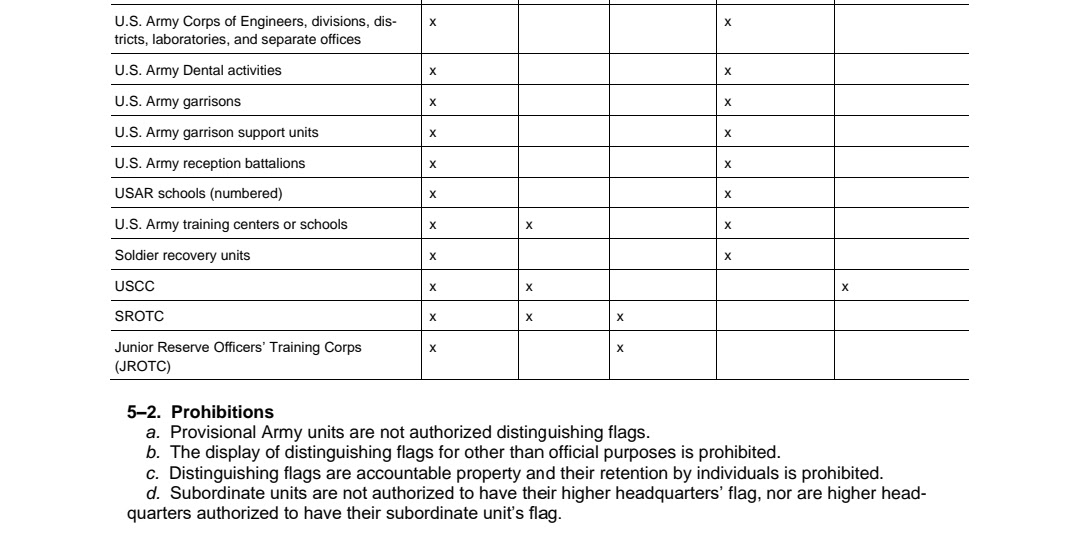
Note. Army JROTC programs are not authorized to display or carry the Army departmental color. This prohibition comes from paragraph 5-1 and Table 5-1. Below are two screen shots of the Table.

Flagstaffs.
There is a big bone of contention with some regarding this information. The brown staff is not authorized. Only the two-part guidon staff made of light ash wood is authorized. Why? because all flagstaffs are the same and the pictures in TC 3-21.5 of the guidon manual and even the drawings of the flagstaff manual show only the two part guidon staff with silver metal upper and lower ferrules and middle screw joint.
8–1. Flagstaff
AR 840-10
The flagstaff is the staff on which a color, distinguishing flag, or guidon is carried or displayed. Authorized flagstaff lengths for the following size flags are as follows:
a. Flagstaffs of national flags are the same length as flagstaffs of accompanying flags in paragraphs 5–1 b, c, and d.
b. Flagstaffs for President of the U.S. flag are 10 feet, 3 inches and 7 feet, 9 inches.
c. Flagstaffs for positional colors, distinguishing flags, and organizational colors are 9 feet, 6 inches or 8 feet. The flagstaff for all flags in a display will be the same length.
d. Flagstaffs for general officers flags are 8 feet.
e. Flagstaffs for guidons are 8 feet.
Finials.
The top of a flagstaff. Notice what this says below. No eagle, no ball, no spike, no nothing except the flat silver spade.
8-2, The flagstaff head (finial) is the decorative ornament at the top of a flagstaff. This does not restrict the display of a State flag from a staff bearing a State device when national and other State flags are displayed from adjacent flagstaffs; however, the Army does not provide such devices.
AR 840-10
b. Spearhead (the spearhead is the only device used with Army flags).
Comments 4
Sir, in what regulation does it state Brown or Mahogany Flagstaff with brass or gold finials are not authorized? I always referenced Flagstaffs are for indoor ceremonial or decorative displays and Guidons are for drill and ceremony which are white oak with silver finials and ferrules. I looked in many regs to include the AR840-10, AR 600-25, pamphlet 600-60, TC 3-21.5, the heraldry website and GenAI and no where does it state in writing brown/mahogany/brass vs white/silver staff are authorized or not authorized. Maybe you can find me a paragraph and line somewhere in a regulation stating the colors and hardware of the staffs?
thanks for your time!
Author
I have covered this hundreds of times in parts. Here is a full explanation:
Short Answer. There is no regulation that says: “Brown or mahogany flagstaffs with brass or gold finials are not authorized.” And there doesn’t need to be. Guidon and colors flagstaffs are exactly the same.
Military doctrine does not work by listing every prohibited commercial or decorative variant. It works by authorizing specific items through specification, supply system control, and heraldic standardization. Anything outside those specifications is, by definition, non-standard and unauthorized for official ceremonial use.
How Authorization Actually Works in Army Doctrine
1. Positive Authorization, Not Prohibitive Lists
U.S. military regulations operate on positive authorization, not exclusionary language.
When AR 840-10, DA Pam 670-1, TC 3-21.5, and service heraldry manuals describe:
•the authorized staff,
•the authorized finial,
•the authorized ferrules,
•the authorized finish, and
•the authorized usage context,
they are defining what is allowed. Anything outside that definition is not authorized—whether or not it is explicitly forbidden.
This is standard doctrine across uniforms, flags, weapons, and ceremonial equipment.
2. What AR 840-10 Actually Authorizes
AR 840-10 does not provide a color-comparison table of every commercially available pole on the market. Instead, it:
•Defines official colors, guidons, and organizational flags
•Assigns responsibility to The Institute of Heraldry (TIOH) for their design, manufacture, and specifications
•Establishes that authorized items are procured through official channels and conform to heraldic standards
Once authority is delegated to TIOH, their specifications become the regulation, even when those specifications are not repeated verbatim inside AR 840-10.
3. Institute of Heraldry (TIOH)
This is where most people stop too early.
TIOH specifications—referenced by regulation—define:
•Material (white oak)
•Finish (natural / light finish)
•Hardware (silver-colored finials and ferrules for guidons)
•Construction (taper, ferrule placement, staff length)
Those specifications are not optional, and they are not decorative suggestions. They are the authoritative standard.
A brown-stained or mahogany pole with brass or gold hardware:
•Is not produced under TIOH specification
•Is not issued through the military supply system
•Is not described in any service heraldry catalog
•Therefore cannot be authorized, regardless of how common it is commercially
Guidons vs. Decorative Flagstaffs
Guidons
•Are tactical and ceremonial command devices
•Used for drill, formations, and movement
•Must be lightweight, standardized, and uniform
•Use white oak staffs with silver-colored hardware
•Are controlled heraldic items
Brown/Mahogany Poles with Brass or Gold Finials
•Originate from interior décor, civilian parade displays, or civic presentation stands
•Are marketed for lobbies, council chambers, memorial displays, and fraternal organizations
•Are not designed for drill or movement
•Have no military heraldic authority
•Are never referenced in doctrinal drill manuals because they are outside the system entirely
They are not “forbidden.” They are simply not part of the military equipment ecosystem.
Why You Will Never Find the Sentence They’re Looking For
There is no paragraph saying “brown poles are unauthorized” for the same reason there is no paragraph saying:
•“Camouflage ball caps are unauthorized with the dress uniform”
•“Gold sneakers are unauthorized for parade formations”
•“Plastic rifles are unauthorized for armed drill”
The regulation tells you what is authorized. The supply system enforces it. Heraldry standardizes it.
Doctrine assumes professional literacy.
TC 3-21.5 and service drill manuals:
•Assume authorized equipment is being used
•Do not re-litigate heraldry or supply specifications
•Focus on employment, not procurement
This is why you won’t find a pole color debate inside drill movement chapters. That debate is already settled upstream.
The Core Doctrinal Principle
Military ceremonial equipment is authorized by specification, not by absence of prohibition. When regulations and heraldic authorities define a specific staff, material, finish, and hardware, that definition excludes all non-standard commercial variants—even when those variants are widely available or culturally familiar.
Final Clarifying Statement
The persistence of brown/mahogany poles with brass finials in color guards is not evidence of authorization.
It is evidence of:
•civilian carryover,
•misunderstanding of heraldic authority,
•and the assumption that “if it’s not forbidden, it must be allowed.”
That assumption is explicitly incompatible with military doctrine.
Question about flag order that I feel like I should know but it’s been 15 plus years since I’ve participated with the US Navy Ceremonial Guard Colors Platoon so maybe I’m just losing my mind or out of the loop.
I work at a small regional university that hosts an Army ROTC battalion. Normally a squared away bunch. Recently I’ve noticed at home football games the ROTC color guard is marching with a three flag color set: National, state and the institution flag. The problem is they’re marching with the National flag in the middle: State first, National second, intuitional third. This can’t be right and it bothers me to no end. I’d like to file a complaint but really need to know my understanding is still accurate, maybe things have changed?
Any guidance would be greatly appreciated.
Author
Hi Sir,
You are not losing your mind, you are 100% correct.
The American flag is NEVER carried carried in any other place than the marching right (the position of honor) in line formation or the front in column formation. The Army uses TC 3-21.5, Drill and Ceremonies; AR 840-10, Flags, Guidons, Streamers, Tabards, and Automobile and Aircraft Plates. The Army is authorized to Carry state and unit colors (the institutional flag could be considered a unit color, quite possibly), but they should be carrying the Army departmental flag or Army Field Flag right next to the state.
Please lodge a complaint with the AROTC department as soon as possible.
DM