

I wanted to explain the two types of doctrinal authority in the US military and use the flag spreader debate as a case study.
One of the most persistent points of contention in drill and ceremonial practice is not what regulations say, but how silence in regulation is interpreted. Few topics illustrate this better than the modern debate over the use of flag spreaders.
Some organizations argue that flag spreaders are now authorized because a prior prohibition was removed. Others point to the absence of any restriction as justification for their use. Still others cite civilian ceremonies as precedent. All of these arguments stem from a single misunderstanding: not all organizations operate under the same authority model.
This article explains why silence in regulation produces different conclusions in different contexts—and why those conclusions are not interchangeable.
Department of Health display at the top of the page.
Two Doctrinal Authority Models
U.S. military and ceremonial organizations operate under two fundamentally different interpretive frameworks:
1. Prescriptive (Enumerated Authority) Doctrine:
“If it is not stated, it is not authorized.”
2. Permissive (Residual Authority) Doctrine:
“If it is not prohibited, it may be allowed.”
Understanding which model applies is essential before drawing conclusions from what a regulation does—or does not—say.
The Flag Spreader Case Study
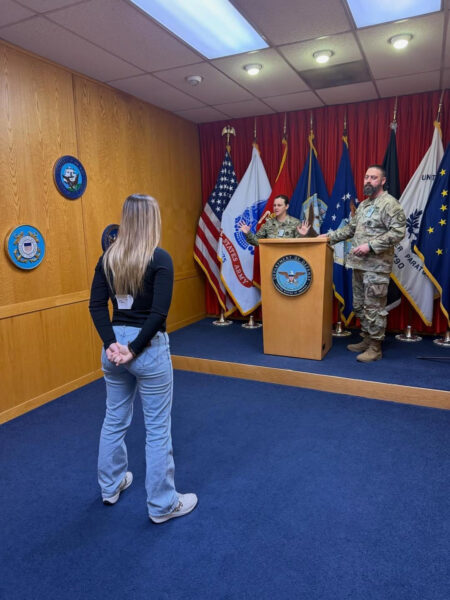
The Army: Removal of a Prohibition Does Not Equal Authorization
Earlier versions of AR 840-10 explicitly stated that flag spreaders were not authorized. That sentence was later removed. This revision has led many to conclude that the Army therefore authorized their use. (that does not give you permission, White House staff, but read on)
This conclusion is incorrect under Army doctrine.
The Army operates under a prescriptive authority model. Authorization is conveyed through:
- Explicit description
- Standardized illustration
- Doctrinal integration into formations and methods
Removing a prohibition does not affirmatively authorize an item. It merely removes a sentence. Under a prescriptive system, authority must still be positively established.
Flag spreaders remain:
- Undescribed
- Unillustrated
- Unintegrated into Army color guard doctrine
As a result, they remain unauthorized, regardless of their appearance elsewhere.
The Department of the Navy and the United States Coast Guard operate under a permissive authority model.
Their ceremonial regulations:
- Define boundaries rather than exhaustive procedures
- Rely heavily on command discretion
- Expect variation based on environment and mission
Under this model, if a ceremonial item:
- Is not prohibited
- Does not violate tradition, dignity, or safety
- Is approved by command
It may be considered permissible, even if not explicitly described.
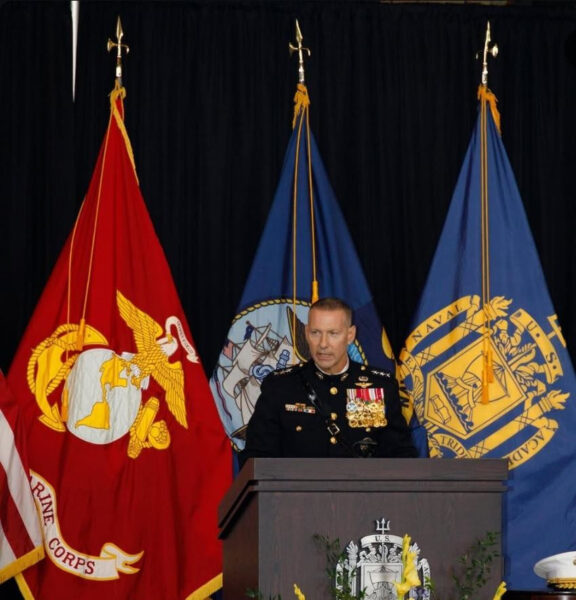
Thus, a Navy or Coast Guard unit may reasonably conclude that flag spreaders are allowed—not because they are authorized in writing, but because they are not restricted.
This logic is internally consistent within naval doctrine, but it does not transfer to prescriptive systems.
The Marine Corps Clarification
Although administratively part of the Department of the Navy, the Marine Corps does not share the Navy’s permissive interpretive model for drill and ceremonies.
Marine Corps doctrine:
- Is prescriptive
- Relies on enumerated authority
- Does not grant permission through silence
Marine Corps Orders (e.g., MCO 5060.20) are concise by design, but that concision does not imply flexibility. Items and practices not described or doctrinally integrated are not authorized.
The Marine Corps therefore aligns doctrinally with:
- The Army
- The Air Force
- The Space Force
Not with the Navy, despite shared departmental lineage.
This brings up a very good question. If flag spreaders must be authorized for the Marine Corps and are not specifically addressed in MCO 5060.20 or MCO 10520.3, then why does the Flag Manual have the following image in it?
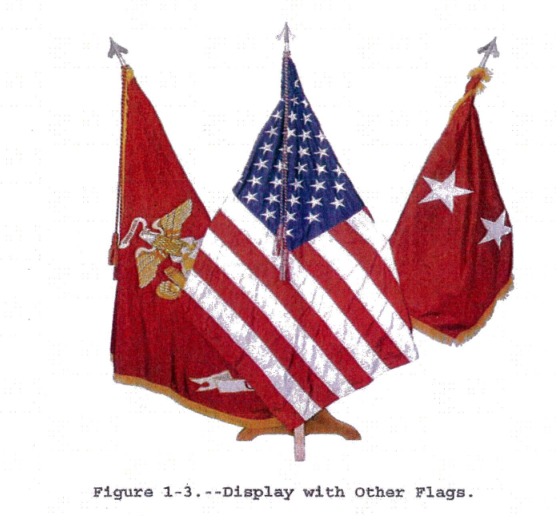
For this subject, let’s ignore the atrocious display of the GO flag on the right and the fact that the USMC is draped over the foot of the stand. The national should not have the flag spreader. End of discussion.
Civilian Federal Organizations: Where Permissive Authority Applies
A separate—but frequently conflated—category is civilian federal organizations.
Entities such as the Office of the President, executive departments, and federal agencies with ceremonial details are civilian-run organizations, even when they employ military-style uniforms, formations, or terminology. These organizations are not governed by military drill and ceremonies doctrine unless they formally adopt it by policy.
Default Authority Model: Permissive
Civilian federal organizations generally operate under a permissive authority model:
- Practices are allowed unless prohibited by law or policy
- The U.S. Flag Code applies, but is advisory and non-prescriptive
- Internal leadership and protocol officers determine standards
Under this framework, items such as flag spreaders may be optional or discretionary, provided they do not conflict with law, policy, or the dignity of the event.
Example: Department of Homeland Security
The Department of Homeland Security (DHS) provides a clear example of how civilian agencies may reasonably adopt naval ceremonial standards.
DHS includes the Coast Guard, which:
- Operates under a permissive doctrinal model
- Has established ceremonial traditions compatible with discretionary authority
As a result, DHS ceremonial elements may logically choose to:
- Align with Coast Guard or Navy ceremonial standards
- Apply permissive reasoning to equipment and presentation
- Allow items such as flag spreaders if approved internally
This alignment is administrative and cultural, not doctrinally mandated—and it does not create authority outside DHS.
Example: Department of Transportation
The Department of Transportation (DOT) offers a similar case.
DOT oversees the US Merchant Marine, whose traditions:
- Are maritime in nature
- Align more closely with naval customs than land-based military doctrine
Again, this choice is valid within the civilian context, but it does not establish precedent for military or cadet units.
Why Civilian Practice Does Not Create Military Authorization
A common error is assuming that civilian ceremonial use legitimizes military adoption.
It does not.
Civilian permissibility:
- Does not override military doctrine
- Does not transfer across authority models
- Does not convert silence into authorization in prescriptive systems
A practice may be appropriate for a civilian agency and still be unauthorized for an Army, Air Force, Space Force, or Marine Corps color guard.
Why This Matters (Especially for Cadets and Competitions)
Confusion arises when:
- Civilian practices are cited as military precedent
- Naval permissive logic is applied to prescriptive systems
- Cadet programs blend standards without understanding authority
Flag spreaders are not merely an equipment issue—they are a diagnostic indicator of whether doctrine is being interpreted correctly.
Final Summary Statement
Silence in regulation does not have a universal meaning. The Army, Air Force, Space Force, and Marine Corps require affirmative authorization for equipment and practices. The Navy and Coast Guard permit discretion where regulation is silent. Civilian federal organizations operate permissively unless they adopt military doctrine by policy. Flag spreaders illustrate how applying the wrong authority model leads to incorrect conclusions.