
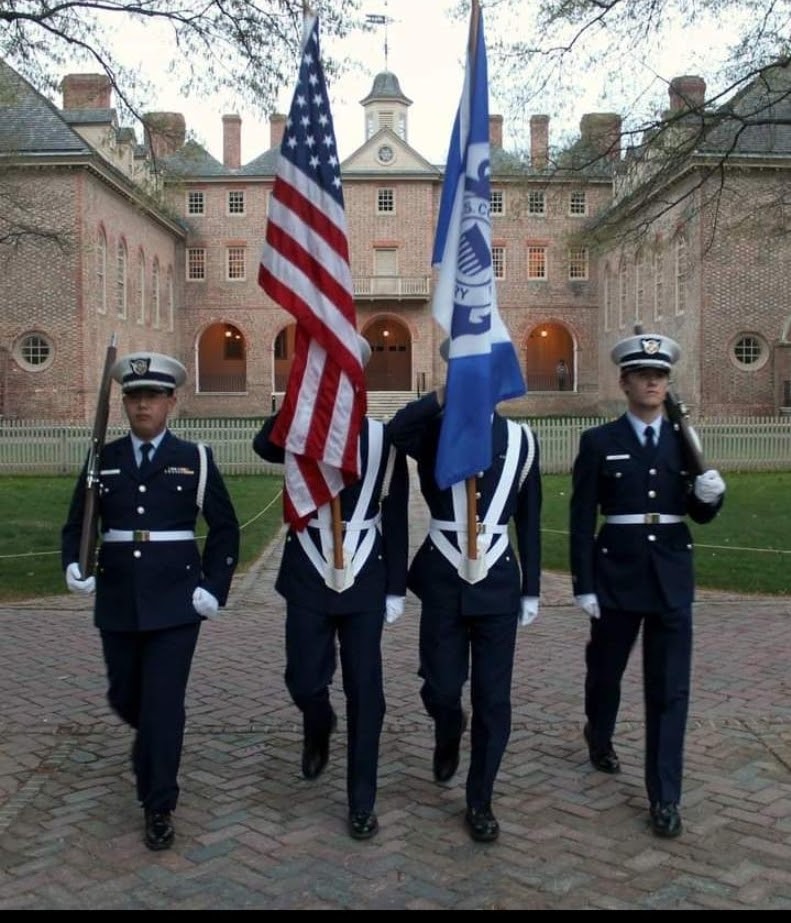
Not all organizations are authorized or structurally equipped to form color guards. Uniform appearance, affiliation, or tradition does not substitute for enlisted structure, command authority, and doctrinal grounding. When these elements are absent, the correct course of action is to refrain from forming a color guard and instead pursue appropriate ceremonial alternatives.
(Doctrinal Analysis and Policy Recommendation)
Purpose of This Article
This article explains why certain adult volunteer organizations — including the Coast Guard Auxiliary — should not form color guards, despite good intentions and public visibility. This position is not based on opinion, aesthetics, or personal preference. It is based on military doctrine, ceremonial authority, and the symbolic function of a color guard.
Color guards are not decorative elements. They are formal, symbolic extensions of military structure, hierarchy, and authority. When that structure is absent, the result is not harmless variation — it is doctrinal failure.
What a Color Guard Represents
A color guard is a ceremonial formation that exists to:
- Safeguard national and organizational colors
- Visually represent military discipline and hierarchy
- Demonstrate respect for national authority through precision and restraint
Across U.S. military services, color guards are governed by established drill and ceremonies doctrine (e.g., TC 3-21.5, MCO 5060.20, AFMAN/AFPM 34-1203). While details differ by service, the structural assumptions are consistent:
- Color guards are staffed by enlisted or NCO personnel
- Officers do not carry colors or serve as rifle guards
- Command authority is visually distinct from guard duty
- Equipment, spacing, and handling are doctrinally controlled
These principles are not optional traditions — they are foundational.
The Structural Problem with Adult Volunteer Organizations
Adult volunteer organizations such as the Coast Guard Auxiliary do not possess:
- Enlisted or NCO ranks
- Military command authority
- A unified, enforceable drill and ceremonies doctrine
- A standardized ceremonial training pipeline
Although Auxiliary members may wear uniforms and insignia resembling those of the active Coast Guard, these symbols do not confer military authority and were never intended to function within ceremonial drill environments.
This creates a structural contradiction:
The visual symbols suggest military authority, while the organizational reality does not support it.
That contradiction becomes most visible — and most problematic — in color guard formations.
The Rank and Insignia Conflict
In U.S. military tradition:
- Officers command; they do not guard the colors
- Enlisted personnel safeguard the colors
- Rank insignia communicates authority, not participation
When individuals who visually resemble commissioned officers perform enlisted ceremonial roles, the symbolism collapses. The audience sees authority performing a duty that doctrine explicitly assigns elsewhere.
This is not merely confusing — it is symbolically incorrect.
Why Errors Are Systemic, Not Isolated
Across numerous Auxiliary color guard appearances, the same errors appear repeatedly:
- Incorrect or mixed-service equipment
- Improper finials and flag combinations
- Incorrect flag heights and positioning
- Improper rifle handling
- Non-doctrinal spacing and cadence
- Inconsistent or incorrect facing movements
These errors persist not because members are careless, but because there is no authoritative doctrinal anchor guiding training, evaluation, or correction.
Without doctrine:
- Errors normalize
- Corrections become subjective
- Confidence replaces accountability
The Appropriate Alternative
This article does not argue against participation in patriotic ceremonies.
Instead, it recommends appropriate alignment between organizational structure and ceremonial role:
- Auxiliary members may serve as escorts, marshals, or organizational representatives
- Auxiliary units may coordinate with properly trained military, cadet, or youth color guards
- Auxiliary participation should emphasize support, not symbolic authority
This preserves dignity, accuracy, and respect — for the organization, the ceremony, and the national symbols involved.
Conclusion
Color guards are not simply about carrying flags. They are about who is authorized to carry them, why, and under what discipline.
When an organization lacks the structure required to support that responsibility, the correct decision is not to improvise — it is to refrain.
Choosing not to form a color guard is not a failure of patriotism.
It is an act of professionalism.
Examples

In the NOAA photo above: ❌Mirror Present is not authorized (and why do you have weapons?); ❌Wrong staffs; ❌Most likely wrong finials; ❌No colors harnesses for the bearers (the harness is part of the bearer uniform whether used or not); ❌Guard inboard hands are too high; 5. Colors not carried at the same height; 6. Fringe on the national; ❌Flag at far right is Rear Admiral Upper Half personal color (PC). A PC is NEVER carried in a color guard; ❌Middle flag is NOAA and flag next to national is Department of Commerce- Why are you carrying the DoC flag and NOAA? While NOAA is part of the DoC, the department’s flag is unnecessary.

In this CGA photo at right: ❌Wrong staffs; ❌Most likely wrong finials; ❌Left hands on sockets; ❌Sling mounted wrong; ❌Rifle held too high; ❌Right hand in wrong position on rifle; ❌Second chinstrap missing; ❌Second chinstraps not worn down; ❌National staff not vertical; ❌National carried lower than org; ❌Fringe on the national; ❌Both staffs not vertical.
The CGA “Flags and Ceremonies Guide” says it’s based on MCO 5060.20 but has images and standards from the Army Training Circular and uses ceremonial technique, which is not authorized. Many, many photos show wrong techniques and procedures. Just delete it, please, and rely on cadets.
NOAA, CGA, and PHS
These organizations are the main issue, especially CGA and PHS. CGA is apparently going to make color guard training official for its members. That might seem like a good thing, and I do appreciate the attempt, but you really should just not form a color guard at all. There’s no reason to. Do you want local public interaction? Form a gathering and walk while waving to the crowd in a parade. Have a requirement for colors at a ceremony? Post them in stands before the ceremony or have a cadet program present them.
Public Health
Please get rid of your drill and ceremonies manual. You state it’s based off of MCO 5060.20, Marine Corps Drill and Ceremonies, but when you begin reading it, you can see it was OBVIOUSLY created by those who saw ceremonial manual movements and positions and thought they would be cool to use. Some of the positions are even wrong.
Why do you have a sword manual, which shows the wrong positions, and your guards for a color guard using them? Guards for colors are only authorized swords in very specific instances for the military. PHS does not rate swords for colors, Public Health isn’t a military service, and doesn’t use weapons, or, like the Department of Education and its millions of rounds of ammunition purchased a few years ago, are you gearing up for something? If you absolutely must form an internal color guard (i.e., for a graduation ceremony), unarmed guards are appropriate. Your D&C guide should be minimal and have information for two color bearers and unarmed guards for internal ceremony colors requirements.
I’m softening a tiny bit on internal-only color guards. I do suggest that, if you have a formal colors presentation requirement, reach out to any of the armed services, local law enforcement, fire department, ROTC, JROTC, CAP, any other cadet or scouting program. You have the potential to work with some great people and open up communication to help out each other in the future.

In this Public Health photo at right: ❌The caption says, “Position of Attention”. No, it’s not! This is the position of Carry. ❌Team is shoulder-to-shoulder. ❌Wrong staffs. ❌Wrong finials. ❌Left hands on sockets or higher. ❌Guards are armed. ❌Swords not authorized for color guards (unless mounted or historic). ❌Heels and toes together. ❌National staff not vertical. ❌Right hands not high enough on staffs. ❌Fringe on the national. ❌National on shorter staff than org.
The photo is just one from the PHS “Drill and Ceremonies Manual” that is unnecessary. The rest of the photos in the manual, except for maybe six total, show wrong procedures and technique.
Angry?
You might be fuming with anger by now and it might just get worse as you read. Your anger and the nasty comments I’ve received from supposed adults speaks volumes. I’m pointing out standards and nothing more.
“Show me the federal law where it says…”
That’s a quote from someone who is angry with my stance. You don’t need federal law because federal law does not set the requirements for a color guard, you need the logic that I just laid out in this article. Getting upset with my logical, backed-up opinion shows you don’t have a leg to stand on. You don’t get to pick and choose your standards- but you have done so and no one seems to care that you’ve completely ignored established standards.
I seem to be the only one bringing up issues like this. It’s possible others have recognized it, maybe, but now that I am shining a light in this area, let’s do something about it.
You’re “Pedantic”
Thank you. I appreciate that. Webster’s Dictionary has this to say about the definition of that word.
“//a pedantic insistence that we follow the rules exactly”
M-W.com
So, we aren’t supposed to follow rules exactly? Please tell me how that works.
I didn’t write this article or make any posts to specifically anger people, although I know that happens quite frequently. I write to educate and do not control how others react, you control how you react and some of you really need to get a better hold of your temper.
Comments 4
CAP Here.
Pretty ironic that you got onto the organizations listed for cherry picking regulations, immediately afterward cherry picking the merriam-webster definition of “Pedantic”.
Author
That’s called accuracy. You may not like the truth, you obviously don’t by your comment, but this is the truth staring you in the face. Stop trying to be something you are not supposed to be.
DM
Whether the cherry picked excerpt is factual or not is a non-sequeter. What I’m pointing out is that It’s very “do as I say, not as I do”. To illustrate this, here’s another cherry picked excerpt from Merriam-Webster’s definition of “Pedantic”:
3
: UNIMAGINATIVE, DULL
Author
Way to stick to the subject.
You see, ladies and gentlemen, this is the argument. It NEVER stays on topic. NEVER. It ALWYS moves to the personal very quickly because those who cry and whine about what I’ve written always take it personally and can only react that way since the argument on the other side of the issue is completely empty. It’s always about them and how hurt they are.
Those who don’t whine and cry are able to understand what I’ve written, which is based on military standards, and eventually conform. It’s not about me or them, it’s about the standards for these people.
DM