
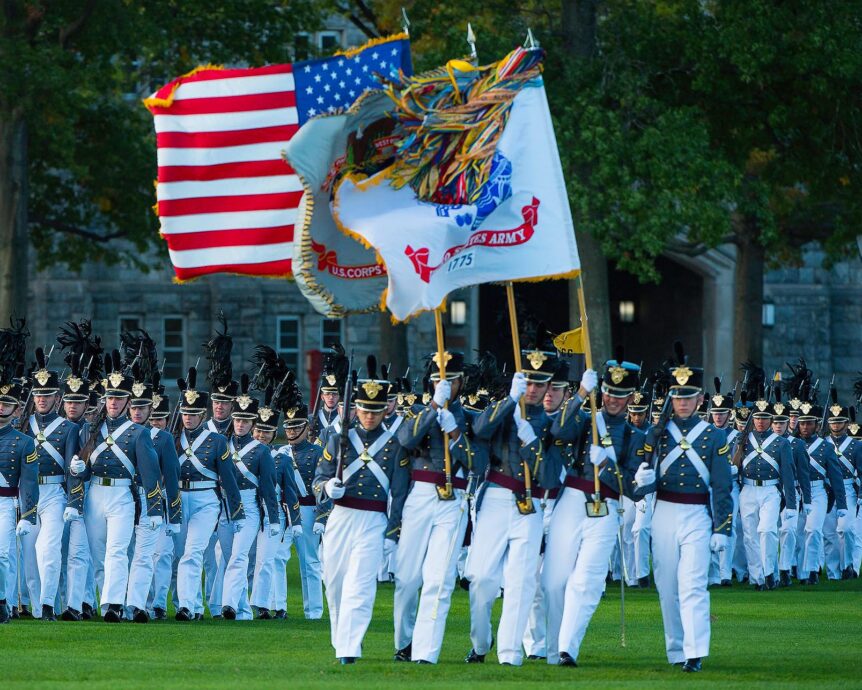
What Is Authorized — and What Is Not
This is a doctrinal bleed-over problem: honor guard practice migrating into regulation drill competition.
The two environments are not the same mission set.
Shoulder-to-Shoulder Is a Ceremonial Adaptation
In military ceremonial units:
- The Old Guard
- Army National Guard Honor Guards
- Marine Barracks Washington
- The Navy Ceremonial Guard
- The Air Force and Space Force Honor Guards
- Base Honor Guards
- The Coast Guard Ceremonial Honor Guard
— shoulder-to-shoulder marching for colors is routinely employed.
Why?
Because their mission demands:
- Maximum visual uniformity
- Increased lateral control of staff alignment (especially in high winds)
- Precision cadence synchronization
- Continuous forward visibility (critical when silk wraps during wind or indoor air displacement)
- Greater ceremonial gravitas in confined or high-profile environments
In that context, shoulder-to-shoulder spacing enhances:
- Staff control
- Step timing
- Visual compression
- Command response latency
- Environmental adaptability
Mechanically and visually, shoulder-to-shoulder is superior for ceremonial execution.
And for first responders performing ceremonial duty, it is often the better choice.
Regulation Drill Is Not Ceremonial Drill
Regulation drill competition is governed by service drill publications:
- TC 3-21.5
- MCO 5060.20
- DAFPAM 34-1203
These manuals describe color guard formations using Close Interval spacing. They do not authorize shoulder-to-shoulder as a baseline regulation configuration.
In regulation drill:
- Formation geometry is fixed.
- Interval is doctrinal.
- Deviation requires written authority.
Ceremonial units may modify based on mission authority. Regulation teams, those required to follow the service D&C manuals mentioned above, may not modify spacing.
The Core Error: Category Confusion
“If it works better for an honor guard, we should be able to do it.”
This is a mission conflation error.
Ceremonial drill is:
- Performance-optimized
- Mission-adaptive
- Often internally standardized beyond published manuals
Regulation drill is:
- Publication-bound
- Formation-restricted
- Evaluated against written standards
The honor guard’s authority comes from command directive.
A regulation or competition team’s authority comes from the manual.
Those are not interchangeable.
Mechanical Superiority Does Not Equal Authorization
You are correct:
Shoulder-to-shoulder improves:
- Lateral alignment
- Timing compression
- Peripheral coordination
- Forward visibility when silk obstructs bearers
But competition does not evaluate “mechanical superiority.”
It evaluates compliance with regulation.
The question is not: “Is it better?”
The question is: “Is it authorized?”
If the answer is no, then the performance is non-compliant.
Disqualification — A Precise Standard
Cadet drill competition standards state something to the effect:
- “All movements and formations must conform to service drill manual standards.”
Then color guard shoulder-to-shoulder spacing is:
- A formation violation
- A deviation from prescribed interval
- A structural alteration of the guard
In strict regulatory adjudication, that qualifies as a major formation error. Whether that rises to disqualification depends on the competition rulebook.
Why disqualification: All three service D&C manuals state specifically that color guards form and march at Close Interval. A deviation from that is purposeful or sheer ignorance and a clear message needs to be sent to the team.
But it is not a stylistic choice. It is a doctrinal violation.
What Should Be Taught
You are already teaching correctly:
- Ceremonial mission → Shoulder-to-shoulder
- Regulation drill competition → Close Interval only at all times
That distinction must be explicit.
Teams must understand:
Honor Guard standard ≠ Regulation Drill standard
The honor guard is authorized to adapt.
Competition teams are not.
Judge’s Note (For Regulation Competition)
If a team marches shoulder-to-shoulder in a regulation drill event:
- It constitutes a formation violation.
- It alters prescribed interval.
- It modifies pivot geometry for Wheel, Turn, and About movements.
- It changes the doctrinal structure of the guard.
This should be evaluated as a major structural deficiency. It is on purpose, meant to impress a judge who does not understand the application of Regulation Drill. Teams that do not march at Close Interval should be disqualified.
Judges must remain calm, clinical, and precise:
“The team altered prescribed interval spacing. Regulation drill requires Close Interval formation. This deviation materially changes guard geometry.”
No anger.
No belittling.
Just standards.
Final Position
Shoulder-to-shoulder is:
- Mechanically superior in ceremonial contexts.
- Often visually superior.
- Frequently safer in high winds.
But it is not authorized in regulation drill, including competitions. Better does not override doctrine.
In regulation drill, the manual governs — not preference, not aesthetics, not what the honor guard does.
And that is the line that must remain firm.