
Authority, Representation, and Why “We’re From Here” Is Not a Doctrine
This subject is one of the most common sources of confusion in Color Guard training, especially in scholastic and cadet programs. The root problem is that people treat flags as decoration, local pride, or a “nice touch,” when in reality every color carried in formation is a public statement of authority and representation.
If you want a Color Guard to be correct and defensible—particularly in public ceremonies and judged environments—there is one concept that must be understood first:
A Color Guard does not primarily represent where its members are from. A Color Guard represents who has authorized it to exist and act.
Once you digest that, many “traditions” collapse immediately, because they were never doctrine. They were assumptions.
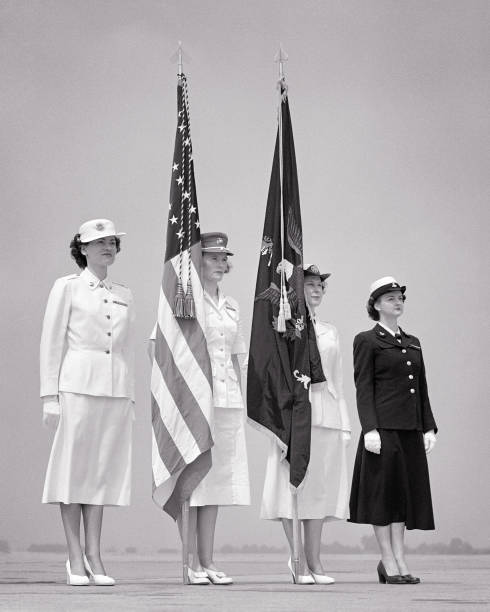
Note: All I know of the image at the top of the page is that it is from the 1950s. Right guard looks to be a Soldier, US color bearer is a Marine, organizational ( I don’t know the flag) is a Coast Guardsman, and left guard is a Sailor, probably a WAVE.
The Breakthrough: Representation Is Not Geography
A Color Guard can be physically located in Kentucky (for example), staffed entirely by Kentuckians, and still have no legitimate basis to carry the Kentucky state flag.
That statement is jarring to many people because they intuitively equate the state flag with “home.” But a flag in a Color Guard is not a sentimental label. It is a representational claim.
- Geography describes where you are.
- Identity describes who you are.
- Authority describes who you represent and under whose mandate you act.
Only authority belongs in the Color Guard.
A unit can be recognized as “Americans from Kentucky” without carrying a state color. That recognition is descriptive, not symbolic. The moment you place a state flag in the formation; you have moved beyond “from Kentucky” and into “representing Kentucky.”
Those are not the same thing.
A Real-World Example: The JROTC Color Guard Carrying a State Flag
Consider a competitive JROTC Color Guard carrying:
- The United States flag
- The Kentucky state flag
At first glance, many would call this harmless or even admirable. But once you apply the authority framework, the issue becomes obvious:
JROTC does not inherently represent the state government. JROTC represents its program and its parent service affiliation.
So what should that Color Guard have carried?
- The United States flag
- The AJROTC flag (or other program/service-identifying flag, as applicable)
That combination communicates:
- National allegiance (United States)
- Organizational authority (the program under which the unit exists)
If one wishes to acknowledge Kentucky, that is accomplished by the unit’s identity and location—not by conferring sovereign representation through a state color.
Why State Flags Are Different
A state flag is not merely “a flag from a place.” It is the symbol of a sovereign state government within the American federal system. When a Color Guard carries a state flag, it implies one of the following:
- The Color Guard is part of the state government, state military forces, or a state-controlled organization; or
- The Color Guard has been explicitly authorized by a competent state authority to represent the state in that manner.
Without one of those conditions, carrying the state flag becomes an overclaim—an implied authority the unit does not actually possess.
Even if everyone involved has good intentions, it is still a representational error.
The Commander Authorization Argument—and the Necessary Boundary
At this point, the most common rebuttal appears:
“A commander can authorize the carrying of state and other flags.”
That statement is directionally correct. U.S. military guidance (e.g., service-level publications governing flags and ceremonial use) recognizes that commanders can authorize the display and carrying of certain flags—state flags included—based on mission, ceremony type, and local requirements.
So, yes: within the Army, Air Force, and Space Force, you will see state flags carried when properly authorized.
But here is the part that people skip:
Commander authority is real—but it is not infinite. It is bounded by the authority that commander actually possesses and is delegated.
A commander can authorize flags within the scope of their command authority and chain of command. They cannot “authorize” representation they do not possess.
This boundary matters because it is where people try to bridge from the military to cadet programs too casually.
Active Units vs. Cadet Programs: Not the Same Type of Authority
Active-Duty / Guard / Reserve Units
Commanders in these formations operate within recognized governmental and military authority structures. They can be tasked to represent the service, the United States, and—when appropriate and authorized—state entities in formal contexts.
When such a Color Guard carries a state flag, it typically rests on:
- Established command authority
- Mission or ceremonial tasking
- Formal recognition of representational legitimacy
ROTC and JROTC Units
Cadet programs are different. Their authority is fundamentally program authority, not sovereign authority.
A senior instructor can absolutely establish standards, approve a unit’s ceremonial practices, and authorize what the unit does within the program. But a senior instructor is not automatically a “commander” in the governmental sense simply because they lead a unit.
This is the essential safeguard:
A cadet program may authorize what it represents as a cadet program.
It does not automatically gain authority to represent a state government simply because it exists in that state.
That means an instructor may authorize:
- The U.S. flag
- The program flag or service-affiliated flag
- Other flags that fall clearly within program authority and permitted practice
But the instructor does not, by default, have standing to elevate a state flag into the formation as if the unit is acting on behalf of the state.
To do that legitimately requires external authorization—typically from the state or a competent authority empowered to grant representational standing.
Why This Gets Worse in Competition
In competitive environments, symbolic errors become more damaging because:
- Judges and audiences interpret flags literally
- The presence of a flag implies legitimacy and endorsement
- The formation becomes a public claim of authority
So what looks like “Kentucky pride” becomes a doctrinal problem:
- The unit appears to be representing the state
- The unit likely lacks authorization to do so
- The presentation therefore overstates legitimacy
This is not nitpicking. It is a fundamental point of representational integrity.
The Doctrine You Can Teach
When training Color Guards—especially in first responder, cadet, and scholastic communities—teach this sequence in plain language:
- Determine authority first. Who does this Color Guard legitimately represent?
- Select flags that match that authority. U.S. first; then the program/service/organization flag that defines the unit.
- Treat geography as identity, not authority. “From Kentucky” is not the same as “representing Kentucky.”
- If a sovereign or governmental flag is desired, demand proof of authorization. Good intentions are not a substitute for legitimate standing.
This framework stops the endless improvisation that produces “buffet doctrine”—where people carry what feels right rather than what is correct.
Core Principle for First Responders
A color guard represents the authority of the organization currently acting in an official capacity.
It does not represent:
- Individual backgrounds (veteran status, prior service)
- Personal pride or heritage
- Multiple agencies at once
The formation speaks with one institutional voice.
Police Color Guards
Police color guards represent:
- The law enforcement agency
- The civil authority of the jurisdiction
They may properly carry:
- U.S. flag
- State flag
- Agency flag
They should not carry:
- Military service flags
- Other agencies’ flags
- “Joint” flags unless formally authorized
Fire Department Color Guards
Fire color guards represent:
- The fire department
- The municipal or district authority
Proper flags:
- U.S. flag
- State flag
- Department flag
Improper flags:
- Military service flags
- Police flags
- EMS flags unless the department is structurally combined
EMS/Medical Color Guards
EMS color guards represent:
- The medical response authority
- The operating agency or service
Proper flags:
- U.S. flag
- State flag
- Agency or service flag
They do not gain authority from:
- Veterans within the unit
- Fire or police affiliation unless formally combined
Joint First Responder Color Guards
A joint color guard is valid only when:
- Agencies are officially combined for the event
- Command authority is clearly defined
- Flags represent each participating authority equally, not casually
If no joint command exists, do not mix agencies.
The One-Sentence Rule
If the organization does not command it, it does not carry it.
Why This Matters for First Responders
Color guards:
- Signal legitimacy
- Establish public trust
- Communicate who is responsible
- Preserve inter-agency respect
Sloppy symbolism leads to confusion and loss of credibility, even when intentions are good.
Conclusion: Representational Accuracy Is Respect
The purpose of this discussion is not to strip away pride or to police people for minor details. It is to restore clarity.
A Color Guard is one of the most visible public statements an organization can make. When it carries a flag, it is speaking—formally and symbolically—about who it represents and under what authority it stands.
When we match flags to actual authority, we do more than “follow rules.” We protect the integrity of the symbols, the dignity of ceremonies, and the legitimacy of the unit itself.
And once you understand that representation is authority—not geography—you will never look at an incorrect Color Guard the same way again.