
A Doctrinal Review of a Recent State-Led Color Guard Formation
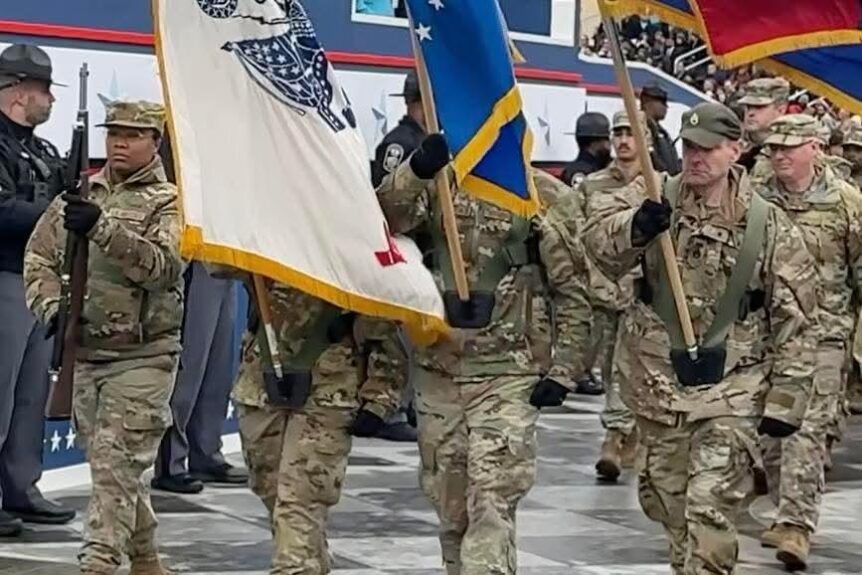
Recently, Virginia elected a new Governor. The image at the top of the page was shared on the VA State Defense Force Facebook page. Was this an SDF-led formation or was it National Guard, I’m not clear on that. However, there are many things wrong and here is what I noted on social media based on this image:
- The uniform is not a huge issue – utilities are the main uniform for everything they do.
- The next issue, in order of escalation, is marching at Present in a formation. The Army did away with Rifle Salutes decades ago opting for Present when walking on your own to/from a formation and needing to render a salute while walking.
- The colors harness worn by the Army color bearer is causing #HarnessSocketCrotchSyndrome – let’s look at this flag closely:
- The US Army flag represents the Department of the Army: the Regular Army and Army Reserve and conveys institutional authority of the United States Army. FYI, it does not represent the Army National Guard and:
- SDFs are NOT part of the US Army and are not authorized to carry the flag.
- By carrying the flag, it is an unauthorized claim of federal affiliation, a false signal of service status, and a breach of service heraldry and representation doctrine.
- No national colors. The US flag represents national sovereignty and ultimate authority. Organizational, state, or service flags derive their legitimacy only when subordinate to the National Colors. A formation that omits the US flag inverts the chain of symbolic authority – you are communicating that you are greater than the US.
With messages and comments received here is an updated critique based on the numbers above:
- The uniform is not an issue but is addressed in the article below.
- The right rifle guard here is Air National Guard. Present in a formation is still not authorized, her hands are positioned incorrectly, the rifle is too high, and the sling is through the Stacking Swivel.
- This is a National Guard Soldier. The harness sockets are everywhere and should be as close to the same level as possible.
- National Guard units do not normally carry U.S. Army service colors when operating under state authority; they carry National Guard or state-associated colors. U.S. Army service colors are carried only when the Guard is federally activated and representing the Army under federal command.
- The Army Flag is NEVER carried in the second or other rank of a Massed Color Guard.
- The team created a Massed Color Guard (two ranks, in this case). The “missing” US is not in frame; it’s in the first rank to the left of the photo. This means:
- The rifle guard is not authorized in (2) above is not authorized. Guards are only for the color guard proper, the first rank, only guard the national and service colors have guards.
- The only colors authorized here are detailed below in the article.
- There is much more below.
Note: Armed guards exist to symbolically protect the National Colors; their presence is triggered by the U.S. flag, not by additional flags or formations.
Purpose of This Article
This article is not a critique of individuals, effort, or intent. It is a doctrinal analysis of ceremonial authority. Color guards are not decorative; they are symbolic declarations of who is represented, who is in command, and what authority is present. When those elements are misaligned, the formation becomes institutionally incorrect—even if everyone involved is well intentioned.
We Lost the Ceremonial Knowledge Necessary Here
This situation is not primarily a failure of intent or professionalism. It is a loss of institutional ceremonial knowledge.
Over time, many organizations have:
- Reduced formal instruction in ceremony, heraldry, and authority
- Treated color guards as decorative or interchangeable (“people carrying flags”)
- Replaced doctrine with tradition, habit, or convenience
- Assumed symbolism is intuitive when it is not:
Ceremonial symbolism feels obvious, but it is a technical language that must be taught to be spoken correctly.
Many people assume that ceremonial symbolism “makes sense on its own” — that anyone can arrange flags, uniforms, or formations and the meaning will naturally be correct.
In reality, ceremonial symbolism is learned, not intuitive.
Each element communicates specific ideas about authority, hierarchy, and representation that are governed by doctrine, not instinct.
When symbolism is treated as intuitive:
- Flags are added for inclusion rather than authorization
- Personnel backgrounds are mistaken for institutional authority
- Rank and placement are seen as flexible instead of declarative
The result is symbolism that looks respectful but communicates something inaccurate.
As a result, formations are built around who is available, rather than what authority is being represented.
What Was Lost
Historically, ceremonial instruction taught:
- Who may represent whom
- Which flags belong together
- How rank and precedence communicate command
- Why mixing authorities creates false narratives
That knowledge was once explicit. Today, it is often assumed—or missing entirely.
The Consequence
When ceremonial knowledge erodes:
- Personnel are mixed instead of formations being authorized
- Flags are added to “include everyone”
- Rank structure becomes flexible when it is not
- Errors are repeated and normalized
The result is not disrespect—it is symbolic inaccuracy.
Communication — Why This Matters
Ceremony is a public language of authority. If we no longer understand the language, we speak it incorrectly. The public still reads the message—even if the presenters no longer know what they are saying.
This wasn’t malice or ego. It was lost doctrine.
Ego enters when one cannot separate a doctrinal explanation from personal feelings.
Rule 1: A Color Guard Speaks With One Institutional Voice
A color guard represents one presenting authority.
That authority determines:
- The formation
- The number of ranks
- The flags carried
- The order of precedence
Personnel composition does not create authority. Mixed uniforms do not create a joint formation. Individual service affiliation does not authorize flags.
If a formation has no single, clearly defined presenting authority, it is not doctrinally valid.
Rule 2: “Joint” Requires Formal Joint Authorization
A Joint Color Guard is not created by mixing personnel from:
- Army National Guard
- Air National Guard
- State Defense Force
A joint color guard requires:
- Formal designation as joint
- A clearly identified command authority
- An approved list of flags
- Proper placement by precedence
Absent this, the formation is mixed, not joint—and mixed formations are not authorized to display multiple institutional flags.
Rule 3: Flag Authority Belongs to the Formation, Not the Bearer
A recurring misconception is that a flag is authorized because the bearer “belongs” to that organization.
This is incorrect.
A flag represents:
- The institution, not the individual
- The department, not the uniform
A U.S. Army Soldier does not “own” the U.S. Army flag. Only the Department of the Army, acting through proper command authority, may authorize its display.
If the Army is not the presenting authority, the Army flag does not belong in the formation—regardless of who is carrying it.
Rule 4: Massed Color Guard Rank Structure Is Not Flexible
In a Massed Color Guard:
- First rank (color guard proper) represents primary authority
- Only the national and departmental/organizational colors are authorized here
- Foreign national, state, and territory colors are authorized in this rank only when appropriate and authorized for ceremonies – never for joint federal teams.
- The exception to the above rule is a joint National Guard team carrying the state/territory color.
- Subsequent ranks may carry only subordinate colors
- Only the subordinate colors of a regiment or higher are authorized in subsequent ranks. For the National Guard, that could be the state units.
- Service departmental colors, foreign national, state, territory, and random unit colors are never authorized.
Subordinate means:
- Same command lineage
- Same institutional family
- Same authorizing authority
Placing a federal service flag in a subordinate rank under state authority is a false command relationship.
If a second rank is not explicitly authorized:
- The rank itself is invalid
- Any flags carried in that rank are unauthorized
If the rank is wrong, everything in it is wrong.
This is a structural failure, not a stylistic one.
Rule 6: Tradition Does Not Create Authority
The statement “we always do it this way” has no doctrinal weight.
Ceremonial authority comes from:
- Law
- Command designation
- Institutional policy
Repetition of an error does not legitimize it, especially at high-visibility events such as gubernatorial inaugurations.
Rule 7: Uniform Policy Does Not Equal Flag Authority
Uniform guidance—such as headgear, name tapes, or other identifiers—has no bearing on flag authorization.
Uniform compliance ≠ ceremonial authority
Personnel identification ≠ institutional representation
Flags and uniforms are governed by different doctrines.
The Governor-Level Authority Standard
For inaugurations, funerals, and parades:
One event. One presenting authority. One approved set of flags.
If the authority cannot clearly answer:
- Who is being represented?
- Who authorized each flag?
- Why each flag belongs in that rank?
Then the formation is symbolically unauthorized.
If the National Guard Is the Presenting Authority
If the National Guard is officially in charge of the formation:
- The National Guard commander controls the formation
- The Guard controls which flags are authorized
- The Guard controls who may participate and how
In that case, participation ≠ representation.
When the SDF MAY Join the Formation
The State Defense Force may join only if:
- The formation is formally designated as a Joint Color Guard
- The chain of command is clearly defined
- The flag list is approved in advance
- Flag precedence and rank placement are correct
- The SDF’s role is explicitly subordinate or ceremonial, not representative of parallel authority
Even then:
- The SDF does not bring its own authority
- The SDF does not introduce additional flags unless approved
- The formation still speaks with one institutional voice
When the SDF Should NOT Join
The SDF should not be inside the Guard’s formation if:
- There is no formal joint designation
- The SDF is expected to represent itself
- Additional flags are added to “include everyone”
- Multiple chains of command are visible
In those cases, inclusion creates symbolic confusion.
The Correct Alternative: Separate Color Guards
If both organizations are to be honored:
- National Guard Color Guard (Guard authority)
- State Defense Force Color Guard (State authority)
Each formation:
- Represents its own command
- Carries only its authorized flags
- Preserves clarity and legitimacy
This is the cleanest and safest doctrinal solution.
Closing Thought
Color guards do not merely honor events—they visibly declare command relationships. When those declarations are wrong, the formation unintentionally misrepresents authority, hierarchy, and legitimacy.
Precision in ceremony is not pedantry.
It is professionalism.
Governor-Level Ceremonial Authority Rule
When a color guard is presented for a gubernatorial event, the Governor’s designated authority determines the formation, flags, and structure. The color guard must represent one clear chain of command and may display only those flags the presenting authority is empowered to authorize.
Personnel from multiple organizations may participate only if the formation is formally designated as a Joint Color Guard, with approved flags placed by precedence. Absent formal joint designation, flags may not be mixed across federal, state, or organizational authorities, regardless of individual service affiliation.
Tradition, past practice, or individual credentials do not confer ceremonial authority.
Plain-Language Version (Same Rule)
One event. One authority. One approved set of flags- carried, all can be displayed.
If the authority is unclear, the (carried) flags are not authorized.