“A soldier will fight long and hard for a bit of colored ribbon.”Napoleon Bonapart Napoleon’s observation remains relevant because it identifies a fundamental truth of military culture: recognition matters. Ribbons, medals, badges, cords, and other uniform distinctions are not superficial. They are visible acknowledgments of effort, competence, and commitment. They communicate, without explanation, that an individual or group has earned …

4 of 4 The Unyielding Precedent: Guardianship, Standards, and the Timeless War Against Stupidity
The first three installments established the analytical imperative (Cipolla), the ethical guardrails (Scripture/Stoicism), and the strategic mandate (Negentropy). This final article completes the foundation, demonstrating that the need to guard standards and warn against irrationality is not new—it is a central, continuous theme across military, philosophical, and wisdom traditions spanning millennia.
3 of 4: The Second Law of Thermodynamics, Stupid People, and The DrillMaster
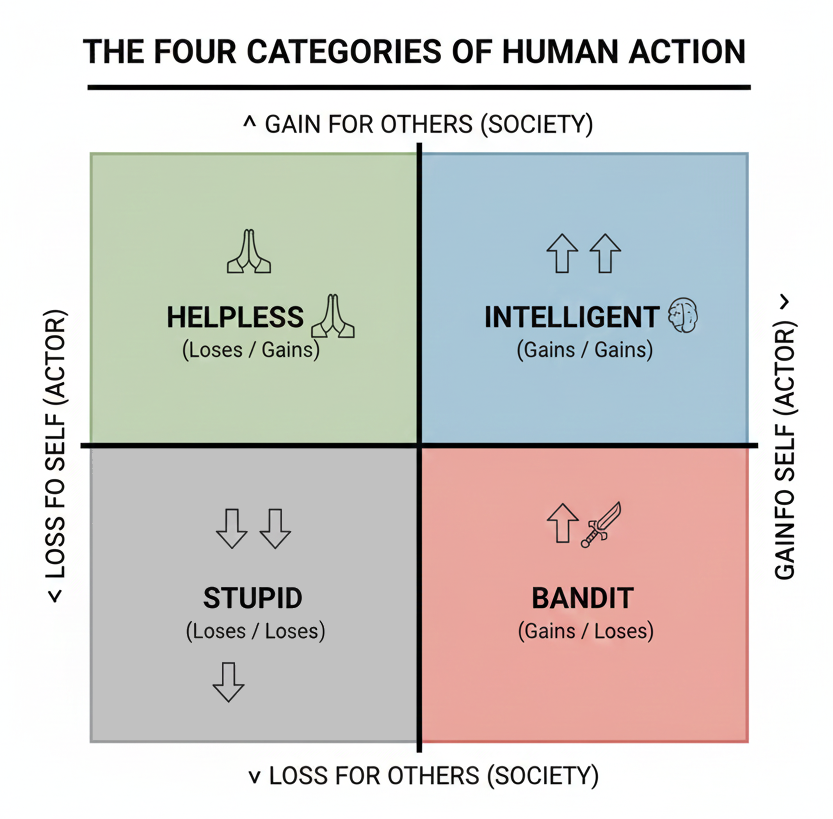
I asked AI and we created a further explanation in this series. I posited the question, “Does entropy have a role in Cipolla’s model?” The answer was: While there is no recognized physical or statistical quantity called “social entropy,” the concept of entropy provides a near-perfect metaphor for the destructive, corrosive force that Carlo M. Cipolla assigned to “stupid people.” …
2 of 4: Mastering the Madness: An Ethical and Intellectual Strategy Dealing with Stupid People
The first installment established that the greatest threat to success is the stupid action—behavior that causes pure, uncompensated net loss to a system. It also laid the analytical groundwork (Cipolla’s Laws) and the ethical foundation (Scripture’s warning against contempt). This second installment is the call to action. We now translate theory into practice, detailing how to deploy a unified, three-part …
1 of 4: The Five Laws of Human Stupidity and Scripture
Every functioning system—from a military unit to a multinational corporation—is ultimately challenged by actions that defy logic: actions taken by stupid people causing loss with no rational benefit to anyone. This article lays the groundwork for understanding this challenge by synthesizing two powerful pieces of information. First, we look at economic historian Carlo M. Cipolla’s explanation of his five laws …
Standards vs. Excuses: My Role and Your Responsibility
This article is not just directed toward JROTC instructors alone, but also adults over all other cadet programs. The text of a recent critique for the above photo (with additions here): Colors, you have X the wrong staffs (AFI 90-1201 tells us what to use, the light ash wood guidon staff), X wrong finials (same AFI for the flat, silver …
AFMAO – Zero Margin for Error
This investigation is grounded in a review of five critical articles from prominent news sources—including Stars and Stripes, NBC News, Washington Post, the American Legion, and NPR—which collectively detail a pattern of failures that constitute a betrayal of trust by Air Force Mortuary Affairs Operations (AFMAO). This historical record highlights instances of mishandled veteran human remains and failed accountability, unequivocally …
Mission Overreach and Organizational Erosion: A Call to Re-Establish Ceremonial Standards Under The Air Force Honor Guard
Finished 24 October 2025. I’ve spent years detailing the operational conflicts that are actively undermining the Base Honor Guard program online through my website and social media. This is more than just a turf war; it’s about the legal requirement to preserve a congressional mandate. To download this position paper in PDF, click here. Download the sample suggested DAFI rewrite …
“Marching Doesn’t Win Wars”
The value of marching isn’t about the act itself, but about the discipline, skills, and teamwork it instills that can be applied to many different areas of life.
Why We Perform Ceremonies
Why do all of this ceremonial “stuff”? Some believe (wrongly) that all this is just a, waste of time, effort, money, etc. Gone are the days of the Army never entering Rome, which was seen as an act of aggression and possible overthrow of the government, which, in that day, it was. Read about crossing the Rubicon and the phrase “The die is cast”, alea iacta est.