

A Doctrinal Explanation Derived from TC 3-21.5
Army JROTC follows the TC to the letter. Marine Corps, Navy, and Coast Guard JROTC follow the same guidance with MCO 5060.20 guidon techniques. Air and Space Forces JROTC follow the same guidance with AFPAM 34-1203 guidon techniques.
The major difference here is the technique that must be adapted from the MCO. All service JROTCs are forced to use the Army standard for casing and uncasing sequences in color guard competition. My suggestion is to adapt going from Carry (easily done for the AF/SF) to Present Guidon. Do this by using the USAF Raised Guidon technique as the first position from Carry and then lower the staff while rotating it to bring the spade edge-forward.
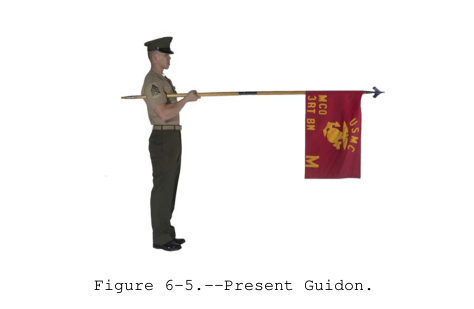
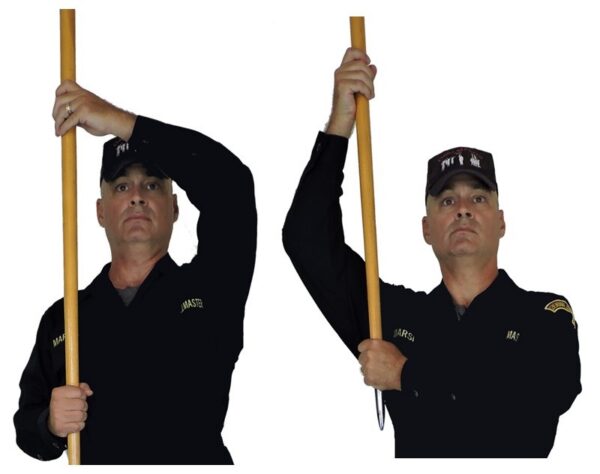
The difference here must be that you hold the staff with both hands to enable staff rotation to furl and unfurl the color.
The Issue
Army Training Circular (TC) 3-21.5 prescribes that, during the uncasing and casing of the colors, the color bearer executes the sequence using the positions of Present Guidon. The manual does not explicitly state the orientation of the spade finial during this process.

This omission has led some readers to assume that finial orientation is discretionary. It is not.
The correct orientation of the finial is implied by the positions required and by the mechanical necessity of the uncasing process itself.
Paragraph 15-20: “The Color bearers lower the Colors (same as Present Guidon). The two guards move forward and untie and uncase the Colors. The Color bearers unfurl and immediately return the Colors to the Carry (Order) Position. While the Colors are being unfurled, the guards fold the cases and secure them in their left hand.”
Note: Coming from Order or Carry, the logical conclusion is that the color bearers go to Raised Guidon to facilitate the position or Present Guidon for furling and unfurling the colors. This is how we know that the guidon staff and flagstaff manuals are the same, just with different ending positions in certain cases depending on the flag that is attached to the staff.
Doctrinal Foundation: Positions Govern Orientation
TC 3-21.5 clearly establishes the following:
- The color bearer executes uncasing and casing through Raised Guidon and Present Guidon.
- These positions are not symbolic—they are defined, repeatable staff positions with known staff and finial orientation.
- The color begins and ends the sequence at Order/Carry, passing through Raised and Present, and then reversing back through those same positions.
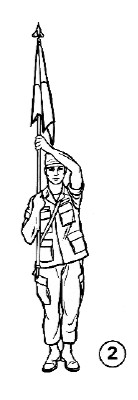
The key doctrinal fact is this:
At Order/Carry, Raised Guidon, and Present Guidon, the spade finial is flat to the front—not edge-on.
This is not optional. It is a structural requirement of the position.
Mechanical Reality: Cloth Cannot Rotate Independently
As the color is unfurled or furled around the staff:
- The fabric rotates around the axis of the staff
- The finial does not rotate independently of the staff
Because the staff remains aligned in doctrinal positions throughout the sequence, the finial must:
- Begin flat (at Order/Carry)
- Remain flat as the staff is raised and presented
- End flat after staff rotation and return through Present and Raised back to Order/Carry
If the finial were to end edge-on or any other position, that would indicate a deviation from the defined positions of Raised or Present Guidon. Either condition constitutes a doctrinal violation.
Why This Is Not “Assumed Technique”
This interpretation is not conjecture, tradition, or personal preference. It is an example of doctrinal inference, which is standard practice when:
- A manual prescribes positions but does not restate every physical attribute already defined elsewhere
- The movement is described as passing through established positions
- The equipment involved has fixed mechanical properties
Doctrine routinely relies on readers understanding that:
- If Position A requires Condition X
- And the movement passes through Position A
- Then Condition X must be present during that movement
The finial’s flat orientation is one of those conditions.
Teaching Point for Instructors and Evaluators
A useful way to explain this to others is with a single diagnostic question:
“If the color bearer is at Present Guidon, what orientation must the spade be in?”
If the answer is flat, then the conclusion follows automatically:
The finial cannot change orientation during uncasing or casing, because the staff never leaves those prescribed positions.
This reframes the discussion from “where does it say that?” to
“what does the position require?”—which is how doctrine is meant to function.
Understanding Implied Requirements in Army Manuals
Army doctrinal publications do not restate every physical or mechanical requirement for each movement. Instead, they rely on defined positions, prescribed sequences, and standardized equipment characteristics to convey requirements implicitly.
When a manual directs a Soldier to move through or execute an established position, all conditions of that position apply, whether or not each condition is restated in the specific paragraph.
This doctrinal approach serves three purposes:
- Prevents Redundancy
Repeating every requirement of a position each time it appears would make manuals unnecessarily long and internally repetitive. - Maintains Standardization
Positions such as Order, Carry, Raised Guidon, and Present Guidon are defined once and reused consistently. Their requirements do not change unless the manual explicitly authorizes a deviation. - Ensures Mechanical Consistency
Army drill movements are designed around fixed equipment and human biomechanics. Equipment cannot be selectively reoriented without violating the position itself.
How Implied Requirements Function
Implied requirements arise when three conditions exist:
- A position is defined elsewhere in the manual
- A movement or sequence passes through that position
- The equipment involved has fixed physical characteristics
In such cases, the Soldier is required to meet all conditions of the position while executing the movement—even if those conditions are not repeated verbatim.
This principle applies broadly across drill and ceremonies, not only to color guard procedures.
Application to Color Guard Procedures
During casing and uncasing of the colors, the color bearer is directed to use the positions of Raised Guidon and Present Guidon. These positions already define staff alignment and finial orientation.
Because the staff must assume those positions precisely:
- The finial begins in the required orientation
- The finial remains in that orientation throughout the movement
- The finial returns in the same orientation when reversing the sequence
Any alteration of finial orientation would require an unauthorized rotation of the staff, which is not prescribed.
Instructional and Evaluation Standard
When evaluating or instructing drill movements governed by implied requirements, the correct question is not:
“Where does the manual say I can’t?”
But rather:
“What does the position require?”
If a condition is inherent to a prescribed position, it is doctrinally required unless the manual explicitly states otherwise.
Key Doctrinal Principle
Army doctrine specifies results through positions, not by listing every mechanical detail.
Implied requirements are not assumptions—they are the logical and enforceable outcome of executing prescribed positions correctly.
Judge’s Note – Evaluating Implied Requirements in Drill & Ceremonies
When Army doctrine prescribes a movement or sequence that passes through an established position, all requirements of that position apply for evaluation purposes—even if those requirements are not restated in the specific paragraph.
Judges must evaluate what the position requires, not whether a detail was explicitly repeated in the movement description.
Application to Color Guard Uncasing and Casing
During uncasing and casing of the colors, the color bearer is directed to execute the sequence using the positions of Raised Guidon and Present Guidon.
For judging purposes, this establishes the following standards:
- The staff must meet all positional requirements of Raised and Present Guidon
- Finial orientation is governed by the position, not by individual interpretation
- The finial begins flat, remains flat throughout the sequence, and ends flat as the staff reverses through the same positions
Any visible change in finial orientation indicates:
- Unauthorized staff rotation, or
- Failure to achieve a prescribed position
Either constitutes a technical deficiency, not a stylistic choice.
Scoring Guidance
Judges should assess finial orientation under Execution / Technique, not General Effect or Interpretation.
Use the following scale as guidance:
- No Error
Finial remains flat and consistent through all prescribed positions. - Minor Error
Momentary misalignment corrected without disrupting the sequence. - Major Error
Sustained edge-on finial, visible staff rotation, or forced manipulation to “fix” orientation.
Judge’s Diagnostic Question
When uncertainty arises, judges should ask:
“Is the performer achieving the required position as defined in doctrine?”
If the answer is no, the error is objective and scoreable.
Adjudication Principle
Judges do not enforce tradition or preference.
They enforce doctrinal outcomes produced by correct positions.
Implied requirements are valid evaluation criteria when they are the unavoidable result of executing a prescribed position correctly.
Conclusion
Although TC 3-21.5 does not explicitly state “the spade remains flat during uncasing and casing,” it does not need to.
By requiring the color bearer to execute the process through Raised Guidon and Present Guidon, the manual already dictates finial orientation. The finial begins flat, remains flat, and ends flat because the staff remains in doctrinally defined positions throughout the sequence.
This is not an added rule.
It is the unavoidable result of following the manual correctly.