
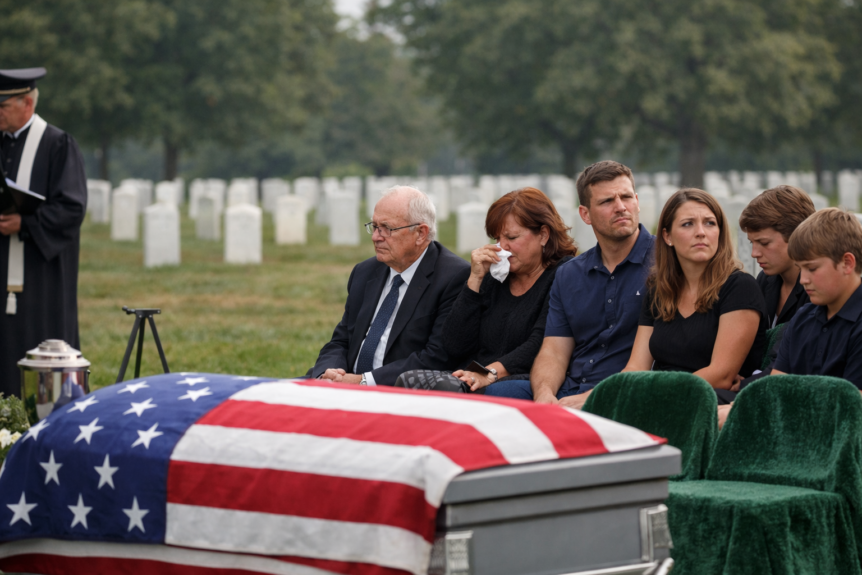
The Consequences of AFMAO’s Unauthorized Control of the Base Honor Guard Mission
Military funeral honors are among the most sacred obligations entrusted to the Department of the Air Force.
When an Airman or Guardian dies, the nation makes a visible promise: no one will be forgotten, and every honor will be rendered with precision, dignity, and certainty.
That promise is not symbolic. It is operational. And today this duty is in danger of not being met.
Funerals and other ceremonies are being mishandled because the Air Force Honor Guard is losing control of the Base Honor Guard (BHG) program mission. Consequently, BHGs are struggling to execute the very mission they exist to perform.
These failures are not random, and they are not merely local leadership issues. They coincide directly with a documented, underhanded transfer of ceremonial authority to an organization never designed, trained, or historically responsible for executing honor guard operations: the Air Force Mortuary Affairs Operations (AFMAO).
Across successive revisions of Air Force Mission Directive 16, AFMAO’s (“afmayo”) role expanded from pure mortuary affairs in 2015, to functional manager of funeral honors and installation honor guards in 2019, and ultimately to full procedural, enterprise, and inter-service control by 2023.
As this authority expanded, ceremonial performance has degraded—the clearest possible indicator of mission-authority misalignment.
This article examines that progression in plain doctrinal text and addresses the unavoidable institutional question that follows:
How did a mortuary affairs organization assume control of Air and Space Force funeral honors, a purely ceremonial mission—and why is the mission now failing as a result?
This article is the third in a series. How many articles does it take? As many as necessary. Please read the first two, Mission Overreach and Organizational Erosion: A Call to Re-Establish Ceremonial Standards Under The Air Force Honor Guard, and AFMAO – Zero Margin for Error.
Note: the image at the top of the page was created with AI at my request. It’s title is “Where Are They?”
Phase I — 2015: Clear Mission Boundaries For AFMAO
The 2015 directive confines AFMAO strictly to mortuary affairs operations:
- Recovery
- Identification
- Preparation
- Dignified transfer
No ceremonial governance.
No Base Honor Guard oversight.
No Military Funeral Honors management.
Doctrinally, this reflects a clean institutional division:
Mortuary Affairs prepares the fallen.
Honor Guards render the honors.
Phase II — 2019: Functional Management Introduced
The stealing of the BHG program from the Air Force Honor Guard begins.
The 2019 revision introduces a pivotal new role:
Serve as the Military Funeral Honors and Installation Honor Guard Program functional manager for the Air Force.
This single sentence represents a transfer of functional authority historically exercised by the United States Air Force Honor Guard (USAFHG) since the mid-1990s.
However, the 2019 change still leaves ambiguity:
- No procedural ownership
- No doctrinal development authority
- No enterprise-level coordination language
In effect, AFMAO is named manager, but not yet architect.
Phase III — 2023: Authority Consolidated and Expanded
The grab for ceremonial influence increased. The “Mayo” is rancid.
The 2023 edition removes that ambiguity entirely.
AFMAO is now directed to:
3.9. Serve as functional manager for the Air Force and Space Force
3.9.1. Develop Base Honor Guard procedures, techniques, and processes
3.9.2. Act as the primary Department of the Air Force point of contact
3.9.3. Coordinate Military Funeral Honors support from Veteran Service Organizations
This is no longer symbolic authority.
It is full-spectrum program control:
- Doctrine development
- Enterprise coordination
- External ceremonial integration
- Service-level expansion to the Space Force
What began in 2019 as a single managerial sentence has become, by 2023, a comprehensive reassignment of ceremonial governance.
The Doctrinal Problem
This progression raises a fundamental institutional question:
How did a mortuary affairs organization become the doctrinal authority for Air and Space Force ceremonial programs?
Because historically:
- USAF Honor Guard standardized ceremonial execution
- Ceremonial doctrine flowed from honor guard lineage and training
- Mortuary affairs remained operationally distinct
The 2015 → 2023 trajectory does not show collaboration.
It shows absorption.
And notably absent across all revisions is:
- A rescission of USAFHG authority
- A higher-order doctrinal directive explaining the transfer
- Institutional justification grounded in ceremonial expertise
Without those elements, the change appears not as deliberate doctrinal evolution, but as incremental mission creep formalized over time.
Why Progressive Expansion Matters More Than a Single Change
A one-time doctrinal anomaly can be dismissed.
A three-edition expansion cannot.
The pattern is sequential:
- 2015 — No authority
- 2019 — Managerial authority introduced
- 2023 — Full doctrinal and enterprise control established
This is the classic structure of bureaucratic jurisdictional growth:
Name the role → normalize the role → expand the role.
By the time the expansion is visible,
it already appears institutionally permanent.
Institutional Risk to Ceremonial Integrity
When ceremonial governance shifts away from the organization historically designed to execute it, predictable consequences follow:
- Fragmentation of standards across installations
- Training divergence from honor guard doctrine
- Erosion of ceremonial lineage and expertise
- Confusion of authority at the graveside
These are not administrative inconveniences.
They are visible failures of dignity in the Air and Space Forces’ most sacred public duty.
The Question Leadership Must Now Answer
Because the 2023 language goes beyond implication and establishes complete functional ownership, the central question is no longer narrow:
Was this transfer of ceremonial authority ever doctrinally justified?
If justification exists, it must be:
- Traceable
- Published
- Hierarchically authorized
- Historically coherent
If it does not, then the Air and Space Forces face a different conclusion:
Ceremonial governance has shifted without doctrinal legitimacy.
Conclusion: From Text Change to Mission Transfer
The progression of AFMD 16 from 2015 to 2023 is no longer a matter of interpretation.
It documents, in plain language, the transfer of Air and Space Force funeral-honors authority from the organization historically created to execute ceremonial duty to one created to perform mortuary operations.
That transfer did not occur in theory.
It occurred in practice.
And the results are now visible where failure is least acceptable—
at the graveside.
When funerals and ceremonies are mishandled (missed funerals is the next thing to happen), the issue cannot be dismissed as administrative friction or local error. Such outcomes signal a deeper problem: mission authority has separated from mission competence.
In military structure, that separation is unsustainable.
Sacred duties demand alignment between doctrine, ownership, training, and execution.
Anything less produces exactly what is now being witnessed across portions of the Base Honor Guard enterprise—
degradation of the nation’s final tribute to its fallen.
This reality leaves the Department of the Air Force with a responsibility that cannot be deferred.
Leadership must determine, openly and doctrinally:
- Whether AFMAO’s assumption of ceremonial authority was ever properly justified
- Whether current mission failures are the direct consequence of that transfer
- And whether funeral-honors governance must be restored to the honor-guard lineage designed to sustain it
These are not ceremonial preferences.
They are matters of institutional integrity, public trust, and moral obligation.
Every military funeral communicates a single message from the nation to the family:
Your service mattered.
Your sacrifice is honored.
You are not forgotten.
When the system responsible for delivering that message falters,
correction is not optional.
It is a duty.
The doctrinal record is now clear.
The operational consequences are becoming clear.
What remains is the decision only senior leadership can make:
Restore alignment between authority and sacred mission—
or accept continued failure in the most visible promise the Air and Space Forces make to their fallen.
Comments 2
DM,
Thank you for addressing this. As Commander of American Legion Leighr A. Wright Post 53, and Deputy Commander of Civil Air Patrol Composite Squadron GLR-MI-395 – both of Hillsdale, MI, I’ve committed and had to stand by while egregious aberrations of good order and discipline play out in full public view. The alternative being disrupting solemn rituals for spot correction. As Legion Honor Guard, we do fairly well with just a bit of chalk-talk before a program to ensure everyone knows where and what we’re doing, and we’re all old vets so we get things done fairly well. What we are doing is preparatory drilling – developing muscle memory in doing it right before we’re on the spot with an audience.
What is missing specifically for CAP are clear consistent standards of conduct, especially as regards our amazing cadets’ activities. As the auxiliary of the USAF, we don’t do funerals per-se, but do we render honors and provide Honor Guard for parades and Memorial Ceremonies, and participate in an annual Flag Appreciation and Retirement Ceremony with our Legion, our local Elks Club, and Scouts of America troop. Those Scouts being much younger than our cadets as a rule, take a lot of notes, and we/I want very much to ensure we’re setting a high and enviable standard of bearing and protocol. New this summer, we’re welcoming Michigan Boy’s State to Hillsdale as they are moving here from Grand Valley, specifically by CAP cadets demonstrating on Sunday a 13-step flag folding ceremony the Boy’s State delegates will repeat in teams of four that Friday complete with a poem each team will compose in cadence with the folds. If you’d care to make a trip to Hillsdale Friday, June 25th, we’d be honored to have you sit in a judge’s seat!
Again, we want to ensure our actions are to the letter. Unfortunately, we don’t have clear step-by-steps, but loose acknowledgement of USAF customs as devolved from US Army Instruction. CAP leadership have shut me down when I objected to their directing cadets to make a two-step motion from Present Arms to Order, without a Port or Carry in between. They have their hand-written local guidance and that make-it-up-as-you-go mindset is what gets used for Cadet Competitions and promulgated to hundreds of dedicated and bright next-gen airmen and guardians.
Might we take advantage of there being novices in charge? I’m a ground-up change agent in professional engineering, project management, and logistic circles, so wonder if, as in this case of CAP’s being almost literally out on its own limb, and an AFMAO organization without the historical comprehension that it ought to promulgate and enforce standards, a bit of SOP jiu-jitsu may be in order?
At the risk of being a well-intentioned tail trying to wag a dog, is there boilerplate Drill and Ceremonies language one could push from the flight line through our Group and Wing toward, Regional, and National C2, specifying a regimented USAF, Academy, ROTC, and CAP protocol to replace (and drive a silver stake through the unholy heart of) the historic fuzzy mis-interpolation of dated USAF and Army regs?
For the USA,
David Hambleton, USN – Ret.
Commander, American Legion Leighr A. Wright Post 53 Hillsdale, MI
Deputy Commander, Civil Air Patrol Hillsdale Composite Squadron GLR-MI-395
Author
Commander Hambleton,
Thank you for your thoughtful and principled comment—and more importantly, for the work you continue to do in service to veterans, cadets, and your community.
I have been trying to wag the dog for many, many years. I have provided clear guidance to CAP HQ members and am trying to raise the alarm regarding AFMAO.
You have articulated the central tension with precision: the need to preserve the dignity of solemn ceremony while operating inside organizations that lack clear, enforceable, step-by-step standards. Your description of preparatory drilling, chalk-talk coordination, and intentional modeling for younger participants reflects exactly the kind of quiet professionalism that sustains ceremonial excellence across generations.
You are also correct in identifying the structural gap within Civil Air Patrol. While CAP properly looks to U.S. Air Force customs and courtesies, the absence of consistently promulgated procedural detail allows local interpretation to drift into locally invented practice—particularly in cadet competition environments. This is not a failure of intent, but of doctrinal clarity and institutional transmission.
The solution is not confrontation during ceremony, as you wisely note, but disciplined doctrinal reconstruction:
clear language, correct sequence mechanics, and standardized instructional references that can move deliberately from squadron level through Group, Wing, Region, and ultimately National channels.
Yes—there *is* boilerplate language that can be built from established Air Force, service academy, and joint ceremonial doctrine. More importantly, that language can be framed not as criticism, but as **support for CAP’s stated identity as the Air Force Auxiliary**—restoring alignment rather than forcing change.
Your instinct toward what you called “SOP jiu-jitsu” is well placed.
Institutional correction in ceremonial culture succeeds best when it proceeds through:
• Documentation, not debate
• Alignment, not accusation
• Instruction, not interruption
I would be honored to continue this conversation and assist in developing clear, usable doctrinal language that units like yours can employ confidently—and that higher headquarters can adopt without friction.
And thank you as well for the invitation to Hillsdale. The work you are doing with cadets, veterans, and community partners represents exactly the living continuity that military ceremony is meant to protect.
With respect and appreciation,
DrillMaster