
Introduction
In two previous articles (available here and here), I examined instances in which U.S. Air Force–affiliated cadet programs appeared to depart from published Department of the Air Force drill and ceremonies doctrine. Those discussions raised important questions about authority, interpretation, and the proper limits of cadet instructional publications.
This article explains those issues in clear, specific terms. Rather than offering general criticism, it analyzes:
- the exact wording used in cadet drill publications,
- the corresponding language in parent-service manuals, and
- the doctrinal implications when the two do not align.
The purpose is not to question the value of cadet programs or the dedication of their instructors/adults in the programs. It is to ensure that cadet drill instruction remains accurate, transferable to military service, and fully consistent with lawful Air Force doctrine.
What follows is a precise explanation of the Civil Air Patrol and AFJROTC issues most frequently raised by instructors, judges, and cadets—and what the governing publications actually require.
I received an excellent comment on the first article with two questions. This article answers those questions as completely as possible. The discussion begins with a closely examined training construct introduced in Civil Air Patrol guidance—“In Cadence.” This example illustrates how a method drawn from another service can appear consistent with military practice while still requiring precise attribution and doctrinal clarity.
From there, the analysis proceeds to guard positioning, equipment terminology, and the broader question of interoperability between Air Force, Army, and Marine Corps drill authorities. Each section addresses the same central concern: whether cadet publications are faithfully transmitting parent-service doctrine or unintentionally altering it.
1 https://thedrillmaster.org/2026/02/04/can-a-cadet-program-change-drill-and-ceremonies-doctrine/
Issue 1, Use of “In Cadence”
“CAP’s CAPP 60-33 adds the command in cadence (page12) from the army TC, a command not available in the AFPAM. I have personally been led to believe that TIs in Air Force initial entry training, are presently incorrectly training recruits at basic performance what in cadence describes while they give the command by the numbers. What are your thoughts of borrowing a command that otherwise does not exist from parent service. CAP Does authorize using army doctrine when the Air Force otherwise does not have instructions, so I wonder if this is acceptable.”
CAP wording
CAPP 60-33 states: “In Cadence is the method to enable Airmen to learn or maintain cadence and develop rhythm…”
The description mirrors Army TC 3-21.5, where In Cadence is an established drill-training method.
This is a doctrinal conflict. AFPAM 34-1203 does not include “In Cadence” as an Air Force drill training construct.Therefore, CAP’s presentation creates a false doctrinal implication:
- The method appears to be Air Force-authorized,
- when it is in fact Army-derived and unacknowledged.
Correct doctrinal handling
If CAP elects to use an Army training method, I fully support that, but doctrinal clarity requires:
- Explicit attribution to Army TC 3-21.5, and
- A clear statement that the method is supplemental, not Air Force doctrine.
There really isn’t an issue with adopting this method for teaching, it’s a very good method. The issue is with how CAP implemented it. Because this attribution is absent, the wording functions as an unauthorized doctrinal expansion, not a neutral training aid.
Terminology Drift and the Loss of Doctrinal Meaning
CAPP 60-33 states that In Cadence enables Airmen to learn.
This produces two doctrinal inaccuracies:
- If you mean that Airmen in the Regular Air Force, Air National Guard, or the Air Force Reserve use this then, no, “In Cadence” is not listed in the AFPAM as an authorized training methodology. Airmen do not use it. If Training Instructors are using it in Basic Military Training (BMT), I’m all for methods that will increase the effectiveness of training, but the USAF needs to codify it in AFAPM 34-1203 and not have “Well, we use it in Basic”.
- If you are inferring that members of CAP are Airmen, they are not (unless currently active, a retiree, or veteran of the USAF). In order for a civilian to become an Airman, one must enlist and graduate BMT or go through an officer accession route through college ROTC or the USAF Academy.
Beyond simple ambiguity, careless use of the term Airman/Airmen introduces a deeper structural risk: terminology drift.
In Department of the Air Force doctrine, the word Airman is not informal or symbolic. It denotes a specific military status attained through lawful accession into service and accompanied by defined authority, responsibility, and regulatory obligation.
When a civilian auxiliary publication applies the same term without precision:
- the distinction between military personnel and civilian members becomes unclear, and
- the doctrinal scope of instructions becomes uncertain.
Over time, repeated imprecise usage produces a more serious effect:
A status-defining term gradually loses its institutional meaning and becomes merely descriptive or aspirational.
No status:
AJROTC cadets are not Soldiers. MCJROTC, Marine Cadets of Iowa, and Young Marines are not Marines. NJROTC, Sea Cadets, and Sea Scouts are not Sailors. AFJROTC and CAP cadets are not Airmen. SFJROTC and Space Force Cadet Corps are not Guardians. CGJROTC cadets are not Coasties.
Pending Status:
Even cadets in AROTC, NROTC, AFROTC, and CGROTC, and the service academies are not Soldiers, Marines, Sailors, Airmen, Guardians, or Coast Guardsmen – yet.
Doctrine cannot function under such ambiguous conditions. Military instruction depends on stable terminology tied to lawful authority.
Allowing protected status language to drift from its defined meaning does not merely create confusion—it erodes the clarity upon which doctrinal enforcement depends.
For cadet publications tasked with transmitting Air Force standards, preserving terminological precision is therefore not stylistic preference, but doctrinal necessity.
Issue 2, Left/Right Shoulder
This also applies to Air Force JROTC along with CAP.
“Colors instruction in cap 60-33 matches army instructions for carry. For some reason the AFPAM, and the AFMANs before it each have the Air Force color guards with left hand carry. As I have met with Air Force color guards, leaders, and honor guards, they all indicate they right hand carry vs left, and many are surprised when I show them the AFPAM indicating left hand carry. They usually tell me the AFPAM is wrong, and they don’t do it that way. I usually only hit this point with them if they are serving as judges at our event and want to make sure they don’t dock our cadets who would be following our published instructions.”
CAP wording
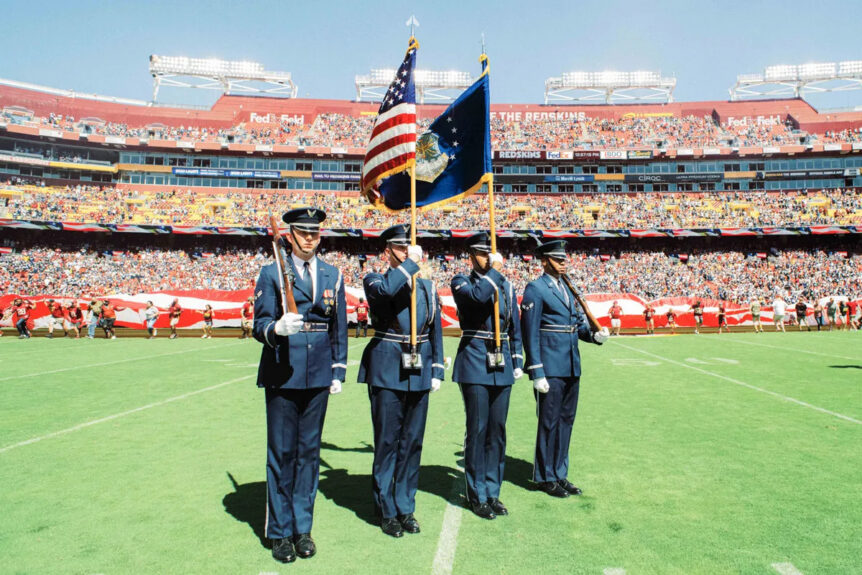
The CAP pamphlet’s description of the position of Carry for the color guard doesn’t necessarily follow the Army standard. What you are referring to is the left rifle guard being at Right Shoulder, a position only the Army follows.
CAPP 60-33 states: “When flags are at the carry, guards carry rifles at right shoulder arms. Alternately, the left guard may carry the rifle at left shoulder arms.”
The critical term is “alternately.”
Doctrinal conflict
Air Force color-guard depictions and descriptions consistently include:
- color-bearer harness slings as standard equipment.
No Air Force ceremonial procedure defines a normal carry without slings.
Therefore the CAP phrase introduces either:
- a non-standard condition, or
- imprecise terminology unsupported by Air Force doctrine.
In either case, the wording lacks doctrinal grounding.
Air Force color-guard structure establishes:
- Guards on the outside shoulder only.
- Left guard → left shoulder.
- Right guard → right shoulder.
No Air Force publication authorizes an optional reversal of the left guard’s shoulder.
Introducing optionality where doctrine is singular creates:
- competing standards
- inconsistent training and adjudication
- incorrect ceremonial transfer to Air Force service
Thus the CAP wording constitutes a doctrinal modification, not interpretation.
The Lack of Knowledge
“As I have met with Air Force color guards, leaders, and honor guards, they all indicate they right hand carry vs left, and many are surprised when I show them the AFPAM indicating left hand carry. They usually tell me the AFPAM is wrong, and they don’t do it that way.”
There is a big problem that the US military has. In the 1990s, and probably before, the military started paying less attention to D&C and that crept out into the public, in general. The Army removed Active Duty instructors from military schools, all of the services replaced more and more marching time with other “necessary” training—except for the Marine Corps, thankfully.
This pushing out D&C from initial training gave the impression to those going through training that D&C was no longer relevant. Consequently, our current members of the military think that there is little to no importance to D&C and that a colors presentation is merely a nice affectation; a colorful moving display that harkens to a bygone time and now we are much more advanced.
When the USAF was created, it took a few years, but we created the first D&C manual in 1956. Guards for a color guard were armed with sidearms because in that era, all the way up to 2007. Very early in the service’s history, the Air Police/Law Enforcement Airmen did the colors ceremonies because that what the Army did. The USAF changed the photos in 2013, adding the rifle for the guards, creating a much greater presence.
As the D&C manuals progressed, we can see work to create an Air Force standard built from some Army techniques (the armed flight/element uses the TC) and some Marine Corps techniques. One of those techniques from the Marine Corps that we took on was the guards of a color guard at the outside (what the sea services call the “outboard”) shoulder. That creates the necessity for the guards to follow the MCO.
While we are at it
Let’s bring up “7.2.5. Position of Flags at the Carry without Slings.” There is no such thing. “Slings” are the color bearer’s harnesses, and colors harnesses are part of the uniform/equipment of a color bearer—always. How do we know this? The AFPAM shows the colors bearers always wearing them and paragraph 7.33.2. mentions the “sling”.
The root doctrinal problem revealed by the wording
Across all three examples, the same structural error appears:
CAP language presents external methods, optional standards, or undefined conditions
as though they possess Air Force doctrinal authority.
This exceeds the permitted role of cadet publications, which is limited to:
- transmitting doctrine
- clarifying doctrine
- instructing doctrine
—but never expanding or redefining it.
Final Doctrinal Conclusion
The issues examined in this analysis—unattributed adoption of external training methods, creation of optional standards where doctrine is singular, misunderstanding of interoperability requirements, and erosion of status-defining terminology—are not isolated editorial oversights.
They are expressions of a single underlying problem:
The gradual movement of cadet publications from transmitting doctrine toward informally reshaping it.
This shift often occurs with positive intent—seeking clarity, efficiency, or improved training outcomes.
Intent, however, does not confer authority.
In military systems, authority flows only from lawful doctrine and formal publication.
When subordinate materials:
- present Army procedures as implicit Air Force practice,
- introduce alternatives where parent-service standards are fixed,
- misapply interoperability as permission to modify rather than faithfully apply, or
- blur the protected meaning of terms such as Airman,
the result is not clarification.
It is doctrinal drift.
Doctrinal drift carries consequences beyond wording:
- cadets learn procedures that may not transfer to military service,
- judges confront conflicting standards with no lawful resolution,
- instructors rely on tradition rather than publication, and
- institutional credibility weakens through inconsistency.
None of these outcomes serve the purpose of cadet drill instruction, which exists to transmit Department of the Air Force standards accurately, faithfully, and without alteration.
The corrective path is neither complex nor adversarial.
It requires only a disciplined return to first principles:
- State external doctrine explicitly when used.
- Preserve singular standards where parent doctrine is singular.
- Apply interoperability functionally—never editorially.
- Protect status-defining terminology with absolute precision.
Adhering to these principles does more than resolve individual discrepancies.
It restores the essential boundary between:
instruction that serves doctrine
and
instruction that substitutes for it.
Cadet programs perform their highest service not by improving doctrine,
but by preserving it intact for the next generation.
Anything less, however well intentioned,
replaces lawful authority with local preference—
and in military doctrine, that substitution cannot be allowed to stand.