

The USAF drill and ceremonies manual recognizes this configuration as an acceptable color guard formation. Its inclusion establishes that the formation is doctrinally valid. The other services do use this team set up, but it is relegated to formal visits on the international stage.
7.32.1.3. When only the US flag is carried, the color guard is composed of one flagbearer and two guards. AFPAM 34-1203 (13 Sept 2022)
However, doctrinal validity is not the same as universal authorization.
A Functional Taxonomy
Composition of the Color Guard (Taxonomy Framework)
Service drill and ceremonies manuals do not establish a formal, named taxonomy of color guard formations beyond descriptive statements. When read collectively, however, they support a set of functional categories that can be used for instruction, evaluation, and policy guidance, so I created one.
This taxonomy classifies how formations are employed, not how they are named in doctrine.
The Standard Color Guard
The Marine Corps provides the clearest foundational description (I very much appreciate this):
“The standard Marine Corps color guard consists of four individuals of approximately equal height.”
(MCO 5060.20)
For purposes of instruction and standardization, the Standard Color Guard is defined as:
- Two Color Bearers
- U.S. National Color
- Organizational, service, or state color (as authorized)
- Two Armed Guards
This four-person formation represents the default ceremonial configuration when more than one color is authorized and presented. It is the baseline against which other formations are compared.
The Three-Man Color Guard
(National Color Only Formation)
The Three-Man Color Guard consists of:
- One U.S. National Color Bearer
- Two Armed Guards
All service drill and ceremonies manuals recognize this formation as doctrinally acceptable when the U.S. National Color alone is presented.
Within this taxonomy, the Three-Man Color Guard is classified as a conditional formation, not a standard one.
It is appropriately employed when:
- Protocol or host-nation requirements limit presentation to the National Color
- Foreign national or diplomatic ceremonies preclude additional colors
- Higher authority directs “National Color only”
The Three-Man Color Guard is not a reduced version of the Standard Color Guard, nor is it intended for routine substitution.
The Massed Color Guard
The Massed Color Guard is a scaled formation created through additive expansion, not substitution.
Characteristics include:
- A Standard Color Guard in the front rank
- Additional ranks carrying subordinate unit colors
- Guard assignments as required by ceremony scale
The Massed Color Guard preserves the authority model of the Standard Color Guard while accommodating large ceremonial requirements.
Foreign National Color Integration Models
Doctrine establishes different integration models for foreign national colors, resulting in a clear service-based distinction.
Sea Services
(Department of the Navy and Coast Guard)
Sea service doctrine authorizes two methods:
- Separate Three-Man Team
- A distinct three-person formation carries the foreign national color
- The Standard Color Guard remains intact as the color guard proper
- No state or territory colors are included
- Integrated Formation (Permitted, Less Common)
- The foreign national color is added to the color guard proper
- Positioned to the left of the U.S. National Color
- State or territory colors are not included
The separate-team method is doctrinally preferred.
Land Services
(Army and Department of the Air Force)
Land service doctrine requires integration:
- Foreign national, state, or territory colors are added directly to the color guard proper
- Additional colors are positioned to the left of the U.S. National Color
- No separate color guard team is formed
This reflects a single-formation authority model.
Taxonomy Summary (Instructor and Evaluator Reference)
For instructional clarity, the following functional categories are recognized:
- Standard Color Guard
Default four-person formation when multiple colors are authorized. - Three-Man Color Guard
Conditional formation used when only the National Color is presented. - Massed Color Guard
Scaled formation created by adding subordinate colors to subsequent ranks. - Foreign National Color Integration Models
- Sea Services: Separate team preferred; integration permitted
- Land Services: Integration required
Instructional Note
The Three-Man Color Guard exists to meet specific ceremonial constraints, not to replace the Standard Color Guard.
Classifying it as a conditional formation preserves doctrinal intent and prevents normalization through convenience.
Doctrinal Silence Does Not Create Unlimited Authority
The manuals’ treatment of the three-man color guard follows a consistent pattern:
- The formation is listed as acceptable
- No exhaustive list of restrictions or use cases is provided
- No language designates it as the default or preferred formation
This is a deliberate characteristic of military doctrine. Manuals establish what may exist, not when it must be used.
Absence of restriction language does not mean:
- The formation is interchangeable with the four-man color guard in all contexts
- Units may arbitrarily reduce formation size for convenience
- Command presence and representational balance are irrelevant
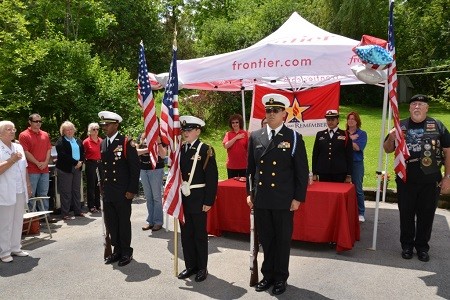
Intended and Appropriate Use
The three-man color guard is most appropriately employed when external constraints exist, not personal preference.
Common legitimate use cases include:
- Foreign national or diplomatic ceremonies
- Where only the US National Color is presented by a three-man team and another three-man team carries the visiting dignitary’s national color.
- See: https://thedrillmaster.org/2022/07/29/joint-service-separated/
- Multinational events
- Usually overseas, representatives from each nation carry their national flag.
In these cases, the three-man formation preserves:
- National dignity
- Visual balance
- Guarded authority of the National Color(s)
What the Formation Is Not Intended For
The three-man color guard should not be treated as:
- A convenience alternative to the four-man color guard
- A solution for insufficient manpower
- A stylistic variation for competitions or parades
- A substitute when organizational, state, or service colors are authorized and available
Routine ceremonial environments—parades, colors presentations, reviews, funerals, and competitions—normally support and expect the standard four-man formation when additional colors are authorized.
Note: I do understand that things happen; a team member cannot make the parade due to illness, etc. This means you need to develop contingencies for such a situation.
Instructor and Commander Guidance
When evaluating or authorizing a three-man color guard, the controlling question should be:
What protocol requirement or external constraint justifies limiting the presentation to the National Color alone?
If no such justification exists, the formation should be reconsidered.
Doctrinal Principle
The inclusion of a formation in drill and ceremonies doctrine establishes acceptability, not universality.
The three-man color guard exists to meet specific ceremonial and protocol requirements and should be employed intentionally, not by default.
Below is a manual-ready, doctrine-neutral policy insert written to drop directly into Color Guard, Volume I.
Tone, structure, and language mirror formal guidance issued by a standards body. No editorial framing, no advocacy.
Authorization and Employment of the Three-Man Color Guard
Purpose
This policy provides guidance on the authorization, justification, and appropriate employment of the three-man color guard consisting of one U.S. Color Bearer and two Guards.
It clarifies the distinction between doctrinal acceptability and routine authorization to ensure consistent ceremonial standards across commands, services, and instructional environments.
Scope
This guidance applies to:
- Military color guards (all services)
- Cadet and auxiliary color guards operating under military doctrine
- Ceremonial commanders, instructors, and evaluators
- Training, public ceremonies, official functions, and reviews
This policy does not supersede service regulations or command authority.
Foundational Principle
The inclusion of a formation in drill and ceremonies doctrine establishes acceptability, not universality.
Authorization to employ a specific formation must be based on ceremonial context and protocol requirements, not convenience, manpower limitations, or stylistic preference.
Authorized Formation
The three-man color guard is an authorized formation consisting of:
- One U.S. National Color Bearer
- Two Guards (armed or unarmed as directed)
This formation is doctrinally valid and may be employed when conditions require presentation of the National Color alone.
Conditions for Appropriate Employment
Authorization of a three-man color guard is appropriate when external protocol constraints or ceremonial requirements limit the presentation to the National Color only.
Acceptable justifications include, but are not limited to:
- Foreign national or diplomatic ceremonies
- Joint or multinational events where additional colors would conflict with host-nation protocol
- Ceremonies directed by higher authority specifying National Color only
- Events requiring strict minimization of national or organizational symbolism
In such cases, the three-man formation preserves national dignity, visual balance, and guarded authority of the U.S. Color.
Conditions Requiring Additional Scrutiny
Use of a three-man color guard should be carefully reviewed when:
- Organizational, state, or service colors are authorized and available
- The event is a routine domestic ceremony (parade, review, funeral, presentation of colors)
- The formation is proposed due to manpower shortages
- The formation is selected for convenience, uniformity, or stylistic preference
Absent a protocol-based justification, commanders and instructors should consider the standard four-man color guard.
Prohibited Rationales
The following are not valid reasons for authorizing a three-man color guard:
- Insufficient personnel
- Simplification of training
- Visual preference or competition strategy
- Substitution for a properly authorized four-man color guard
- Assumption that doctrinal silence implies unrestricted use
Instructor and Commander Responsibility
Commanders and instructors authorizing a three-man color guard should be prepared to identify the specific ceremonial or protocol requirement necessitating its use.
The guiding question shall be:
What external constraint requires limiting the presentation to the National Color alone?
If no such constraint exists, authorization should be reconsidered.
Instructional Note
This policy is intended to prevent erosion of ceremonial standards through gradual normalization of reduced formations.
Intentional, justified use reinforces legitimacy; default use undermines doctrinal clarity.