
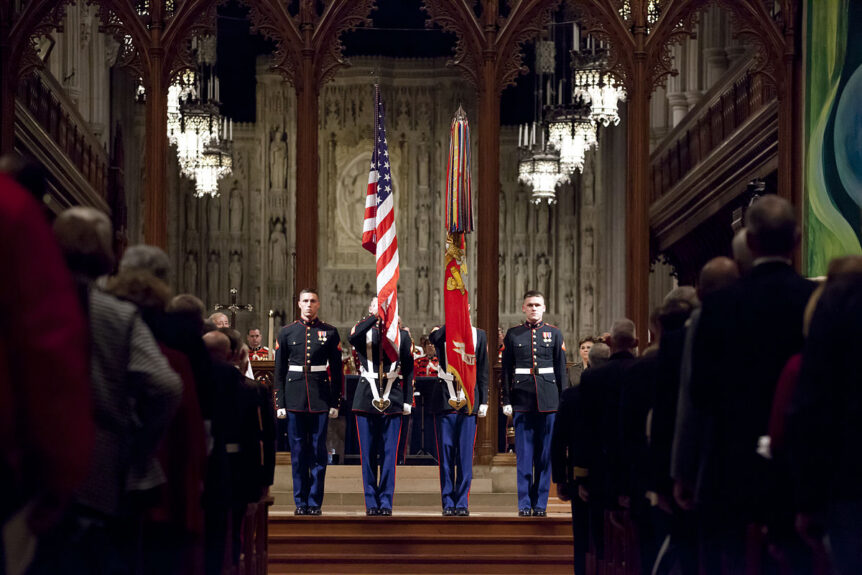
Over the years, I’ve had the same conversation with cadets again and again. It usually starts with a simple question:
“Where does it say we can’t do that?”
And just as often, the answer is silence—or worse:
“That’s just how we’ve always done it.”
Recently, a senior ROTC cadet reached out with a familiar situation. He was told that facing movements cannot be executed in a color guard. When he asked for the source, no one could provide one. At the same time, different leaders were giving different instructions, all delivered with complete confidence. When he raised concerns, he was told:
“It doesn’t matter. Stop worrying about it.”
That statement is the problem.
Everyone Knows—But No One Agrees
In many ROTC programs, there is no shortage of instruction. Cadets are taught constantly. Commands are given. Corrections are made. Standards are enforced—at least on the surface.
But underneath, there is often a breakdown:
- Multiple leaders teaching different methods
- Conflicting explanations for the same movement
- Inability to cite governing doctrine
- Dismissal of legitimate, standards-based questions
The result is a training environment where everyone sounds confident, but no one is aligned.
The Real Issue Isn’t Knowledge—It’s Classification
The problem is not that ROTC lacks standards. The problem is that many programs fail to distinguish between three very different things:
- What is written
- What is adapted
- What is simply assumed
Authoritative guidance exists. Publications like Army Training Circular 3-21.5 clearly define movements, positions, and procedures. That is doctrine.
At the same time, adaptations exist. Units may modify execution slightly for flow, space, or context. That can be acceptable—if it is identified as an adaptation.
What is not acceptable is when assumption or habit is presented as fact.
When those three categories are treated as equal, standards collapse.
“It Doesn’t Matter” Is Not Leadership
When a cadet asks a standards-based question and is told “it doesn’t matter,” several things happen immediately:
- Precision is dismissed
- Learning is shut down
- Authority is weakened
Drill and ceremonies are not about arbitrary perfection. They are a controlled environment designed to develop:
- Attention to detail
- Consistency under direction
- Respect for established standards
- Accountability in execution
If standards do not matter here, where everything is controlled, they will not matter when conditions are not.
Saying “it doesn’t matter” is not saving time. It is abandoning the purpose of the training.
That’s a strong addition—it reinforces why this matters beyond drill itself. Here’s a section that fits your tone and integrates cleanly into the article (place it just before the closing, after the cadet guidance section):
Drill and Ceremonies Is Foundational Training—Not Optional
There is a persistent misconception that drill and ceremonies are peripheral—that they are separate from “real” military training.
They are not.
Drill and ceremonies form the baseline training environment where fundamental military attributes are developed and evaluated:
- The ability to follow and give precise instructions
- The discipline to execute without deviation
- The habit of attention to detail
- The expectation of consistency across a unit
These are not drill-specific skills. They are universal.
Whether an officer leads a platoon, manages logistics, operates in a staff environment, or commands at higher levels, the underlying requirements remain the same: clarity, consistency, and adherence to standards.
Drill is where those expectations are introduced in their simplest and most controlled form.
If standards are treated as optional in this environment, that mindset carries forward.
If ambiguity is accepted here, it will be accepted later.
If “it doesn’t matter” becomes the response in training, it will become the response in execution.
Drill and ceremonies are not about marching.
They are about establishing the expectation that standards exist, are knowable, and will be followed.
Remove that expectation, and the foundation is compromised.
As a college ROTC cadet, you will spend time marching in formations, and some of you will volunteer for drill team or color guard. For most cadets—and depending on your service—this will be the last time you spend any meaningful time on the parade deck. Likewise, you will likely not serve on a color guard again; commissioned officers do not man color guards. That reality often leads to the assumption that these duties are temporary and therefore insignificant. That assumption is incorrect.
The value of this training is not in how long you perform it, but in what it develops: precision, discipline, and adherence to standards. This is especially true for the color guard. When you carry the Colors, you are entrusted with representing our national symbol, and that responsibility demands the highest level of respect, care, and correctness in execution. Just because you may not perform these roles again does not mean they “don’t matter.” In fact, it is exactly because this is your primary exposure to this level of controlled, standards-based training—and, for some, the solemn responsibility of carrying the Colors—that it matters as much as it does.
A Simple Test for Any Instruction
Before accepting any guidance, ask three questions:
- Where is it written?
- Is this an adaptation?
- Or is this just how we’ve been doing it?
If those questions cannot be answered clearly, the instruction is not authoritative.
A Quick Example: Color Guard Execution
Consider a common point of confusion: movement in a color guard.
- “Left Wheel,” “Left Turn,” and “About” are marching facing movements
- Assumption: Because we face from Order Arms with a rifle, facing from any other position must be prohibited
This assumption fails because it does not consider the context of the color guard.
Color guard movement is not a direct translation of individual rifle manual at Order Arms. It operates within a different framework—one that emphasizes formation integrity, continuous movement, and coordinated directional changes while carrying the Colors.
Leaders must distinguish between facing movements executed from a halt and directional changes executed while marching in formation. They are not the same category of movement, even though they share similar terminology.
When that distinction is not made, cadets are left to guess which interpretation is correct.
That is not a performance issue.
That is a leadership issue.
What Good Leadership Looks Like
Effective leaders in drill and ceremonial training do four things consistently:
- They require source-based instruction
- They identify adaptations clearly
- They correct unsupported statements immediately
- They never dismiss a standards-based question
This does not slow training down. It makes training meaningful.
For the Cadet Who Notices the Problem
If you are the one asking questions while others dismiss them, understand this:
You are not the problem.
You are doing exactly what this training environment is supposed to produce—someone who:
- Recognizes inconsistency
- Seeks verification
- Cares about doing things correctly
At the same time, professionalism matters. Learn the standards. Ask your questions. Execute what your program requires. Build credibility through consistency.
That balance—not just being right—is what sets you apart.
Closing
Standards do not fail on their own.
They are either:
- Enforced
- Adapted with intent
- Or ignored
When “it doesn’t matter” becomes the standard, the outcome is predictable.
The question every ROTC program must answer is simple:
Which of those are you teaching?
Downloads
Download these ICS Document Clarification Statements: