

I have posted about this situation at Texas A&M and have even received the response, “But it’s not a salute.”
On the surface, that sounds reasonable. If the rule is about saluting, then removing the salute should remove the restriction—right? No. That’s not how the standard works.
In the image at the top of the page, the Corps Color Guard of Texas A&M University prepares to march through a low archway on campus. Going through the arch at Carry is not possible, so their solution is to dip all of the staffs, march through, and raise the staffs.
That’s not appropriate, here’s why.
What the Standard Actually Says
Across services, the guidance is consistent.
- Army Training Circular 3-21.5 states that the national color renders no salute (is not dipped).
- Marine Corps Order 5060.20 states the national colors render no salute, with only very limited exception.
- Air Force Pamphlet 34-1203 does not restate the prohibition directly, but it does specify that all other colors are dipped at appropriate times—clearly excluding the national color.
Taken together, the intent is clear: The national color is not dipped.
Where the Misunderstanding Happens
The mistake is treating dipping the staff, angling it forward, as a situational rule—something that only applies during a salute.
It is not. This is a positional standard.
That means the rule is based on how the national color is carried and displayed at all times—not just during specific commands or ceremonial moments.
The Key Distinction
This is the line that resolves the issue:
The question is not whether it is a salute.
The question is whether the national color was dipped.
If the staff moves forward from vertical, even briefly, the condition exists.
Intent does not change that.
“We Needed Clearance”
Another common justification is environmental:
- Passing under an arch
- Entering a building
- Moving through a height-restricted space
In these situations, the solution is not to lower the national color.
The solution is to adjust:
- The route
- The formation
- The grip on the staff
The standard is not modified to fit the environment.
How to Make the Transition
Moving through a low clearance area is taken care of by bringing the staff to what MCO 5060 calls Trail and what we in the ceremonial drill world call Port.
The command and movement sequence for this is straight forward.
Since the team marches shoulder-to-shoulder ( you really should be at Close Interval), the commander must call the subdued command “Split It”. It is just for the color guard to hear. On that command, the team moves to Close Interval to facilitate the next sequence.
The command will be, “Port, COLORS!” It’s “Colors” and not “Arms” because the guards will remain at Shoulder for the duration since there is no need for them to transition to Port and back.
On two consecutive right (left) heel strikes you could call, “Port, COLORS!” On the following left heel strike move to Count 1 (shown below). On the next heel strike move to Count 2.
You can make this whole sequence happen very quickly:
Call “Port, COLORS!” On a left and right heel strike and execute Counts 1 and 2 on the next left and right heel strikes.
The technique:
- All color bearers must execute this movements simultaneously.
- Count 1: The right elbow, forearm, and staff are directly in front of your right shoulder.
- Count 2: Thrust the staff straight down with the right hand by letting go of the staff with the left and regrasping it when the right arm is fully extended. Keep the left forearm horizontal.
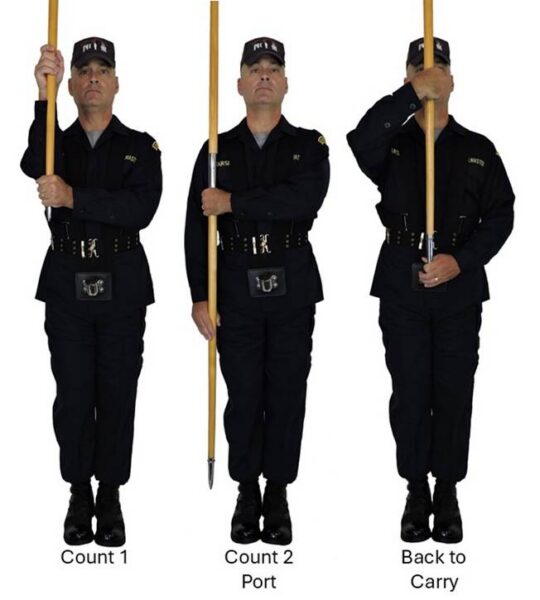
When through the arch and down the steps, “Carry, COLORS!” and “Ready, CUT!” brings the staffs back. After that, the team can then either remain at Close Interval or move back to shoulder-to-shoulder.
Why This Matters
This is not about nitpicking. The position of the national color represents respect for the nation, adherence to established standards, and the credibility of the unit executing the ceremony. When the standard is ignored—even unintentionally—it does two things:
- It normalizes incorrect execution
- It teaches others the wrong information
That is how standards drift.
The Bigger Issue
The “it’s not a salute” argument is part of a larger pattern:
- Redefining rules to fit the situation
- Substituting intent for correctness
- Treating assumption as authority
That pattern leads directly to inconsistent training and loss of credibility.
Bottom Line
The standard is not:
“Do not dip the national color during a salute.”
The standard is:
The national color is not dipped.
Download the Full Standard
For a complete breakdown of the doctrine, including Army, Marine Corps, and Air Force references, along with application guidance for formations and environmental constraints: