

For many people involved in military drill, ceremonial color guards, marching band, or drum corps, one question keeps resurfacing:
How did we all start in the same place—and end up speaking completely different languages about flags, rifles, and sabers?
The answer is not stylistic. It is structural.
It is a story about authority—where it came from, where it went, and why confusion persists today.
The Military Origin: Color Guard as Authority, Not Decoration
The color guard did not originate as an artistic element. It originated as a custodial function.
In military formations, the colors:
- Represent the nation, service, or unit
- Are entrusted, not owned
- Confer legitimacy on the formation they accompany
The bearer’s role was not expressive. It was representational.
Bearing the colors meant:
- Subordinating the individual to the symbol
- Maintaining control, dignity, and restraint
- Executing movements prescribed by doctrine, not preference
This was authority made visible.
Civilian Adoption: Borrowed Legitimacy
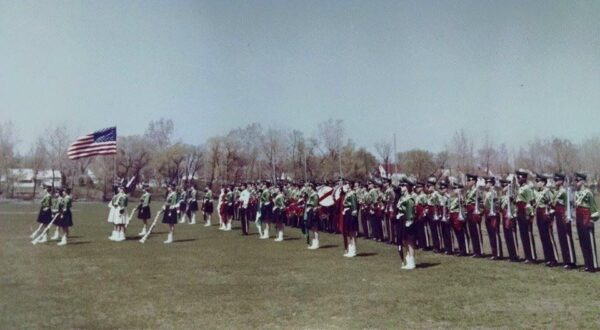
When civilian marching bands and early drum corps emerged—particularly from the 1940s through the 1970s—they borrowed heavily from military structure.
At that time:
- Bands and corps were often required to present the colors
- Color guards were not optional visual enhancements
- The presence of the flag validated the performance space
The color guard did not exist to interpret music. It existed to authorize the ensemble.
Even as movement vocabulary expanded, the underlying posture remained formal:
- Vertical and horizontal flag work
- Controlled tosses
- Martial rifle handling
- Restrained emotion
The guard framed the ensemble with order, discipline, and credibility.
The Turning Point: When the Requirement Ended
The critical shift occurred when colors presentations was no longer required in competition.
Once the colors were no longer mandatory:
- Their authority ceased to be structural
- The guard became optional
- Optional elements must justify themselves differently
This is the moment when authority vacated the space.
When authority no longer mandates presence, appeal must replace it.
That replacement came quickly—and logically.
Dance as a Replacement Authority
Dance did not “take over” color guard by accident.
It entered because something had to replace the governing framework that military doctrine once supplied.
Dance provided:
- A coherent movement language
- A training pipeline
- An evaluative structure
- A new source of legitimacy
Under this framework:
- The performer became the subject
- The body became primary
- Equipment became expressive tools rather than custodial objects
- Emotion moved from implied to performed
Flags wrapped the body. Rifles lightened and flexed. Sabers became stylized rather than martial.
Authority did not disappear—it migrated.
Two Lineages from One Root
From the same military origin, two legitimate—but incompatible—lineages emerged.
Military / Ceremonial Color Guard
Governed by:
- Doctrine
- Representation
- Custodial responsibility
Key traits:
- The flag is the subject
- Stillness has meaning
- Precision is ethical, not aesthetic
- The bearer serves the symbol
Authority here is external.
Pageantry/Dance-Based Color Guard
Governed by:
- Choreographic intent
- Musical interpretation
- Visual effect
Key traits:
- The performer is the subject
- Continuous motion is expected
- Precision supports clarity
- Equipment supports expression
Authority here is internal to the art form.
Where Conflict Comes From
Problems arise when:
- These lineages are treated as interchangeable
- One borrows selectively from the other
- Performances are evaluated using the wrong authority framework
This leads to familiar tensions:
- Ceremonial guards pressured to “add expression”
- Pageantry guards invoking military roots without military constraints
- Judges conflating execution excellence with doctrinal correctness
These are not disagreements about quality. They are authority mismatches.