
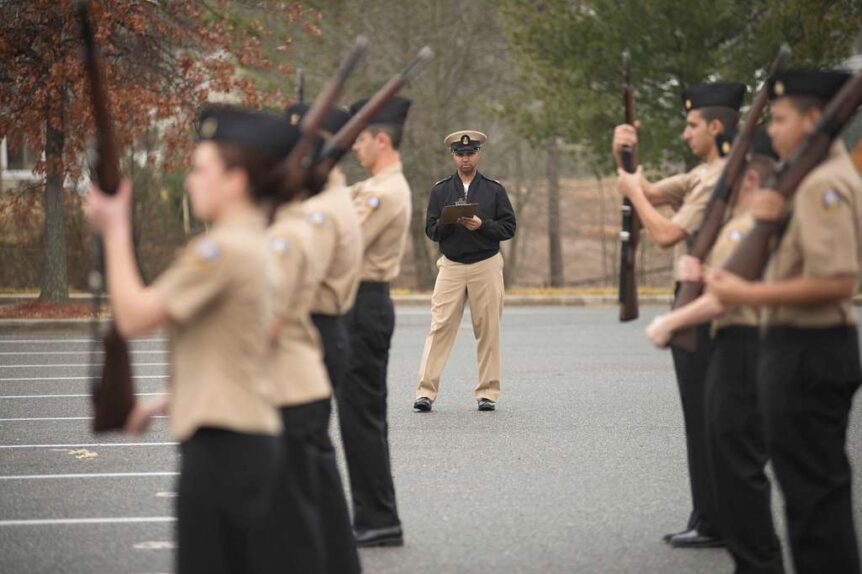
Although exhibition drill may borrow tools from pageantry arts, the two are not the same discipline. They differ fundamentally in purpose, authority, design intent, and evaluation philosophy.
1. Authority and Purpose
Exhibition Drill (Military Discipline)
- Rooted in military authority, hierarchy, and discipline (what we commonly call “Military Flavor“)
- Exists to demonstrate control, order, responsibility, and recoverability
- Even in an exhibition setting, performers act as representatives of an institution, not as individual artists
- Audience engagement is important, but never at the expense of authority or control
Pageantry Arts
- Rooted in artistic expression and performance convention
- Exists to communicate emotion, narrative, and visual impact
- Performers are interpreters of a show concept, not institutional representatives
- Audience engagement and emotional response are primary objectives
2. Movement Vocabulary and Design Intent
- Movement expands from a fixed military center
- Vocabulary must remain:
- Controlled
- Recoverable
- Clearly subordinated to formation, spacing, and hierarchy
- Borrowed movement (from step, dance, or guard) must serve military clarity, not compete with it
- Stillness, precision, and restraint are design tools—not gaps
Pageantry
- Movement expands outward for visual effect
- Asymmetry, exaggeration, and stylistic contrast are encouraged
- Stillness is often transitional, not authoritative
- Movement exists to enhance expression, not enforce structure
3. Equipment Philosophy
- Equipment (rifle, saber, flag) is treated as:
- A symbol of responsibility
- An extension of discipline and control
- Risk is acceptable only when fully owned and recoverable
- Loss of control has institutional meaning, not just technical consequence
Pageantry
- Equipment and props exist primarily for visual interest
- Risk is often rewarded for innovation and effect
- Equipment is expressive, not symbolic of authority
4. Evaluation and Judging Philosophy
Exhibition Drill Evaluation
Judges ask:
- Is military authority preserved at all times?
- Does the design maintain hierarchy, responsibility, and clarity?
- Are borrowed influences subordinate to discipline?
- Does the performance remain recoverable under pressure?
Judging language emphasizes:
- Authority
- Integration
- Structural responsibility
- Ensemble control
Pageantry Evaluation
Judges ask:
- Is the concept engaging and expressive?
- Is innovation effective?
- Does the performance emotionally connect with the audience?
Judging language emphasizes:
- Impression
- Innovation
- Risk
- Effect
5. The Key To Remember
Exhibition drill may use pageantry tools, but it may never adopt pageantry priorities.
The moment effect overrides authority, the performance stops being military drill—regardless of uniforms or rifles.