
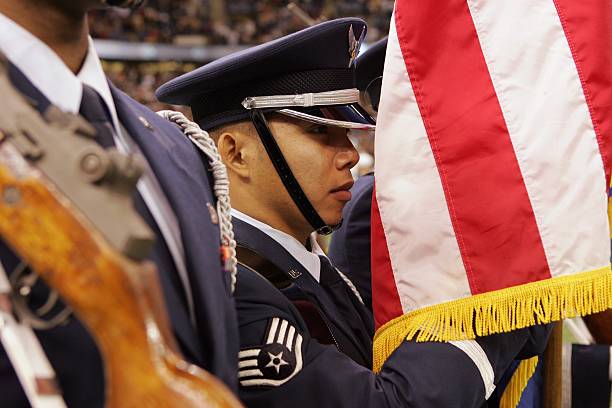
This question arises frequently at ceremonies, particularly when a chaplain invites those present to bow their heads. The answer depends on a critical distinction: who is acting as an individual—and who is acting as a representative.
When prayer is offered, individual members of a formation may bow their heads if they choose. That action is a matter of personal faith and conscience.
A color guard, however, is not acting as a collection of individuals at that moment.
Once the Colors Are Picked Up
Once the colors are carried or posted, the team functions as a symbolic extension of the institutions represented—the United States and the unit or organization. Those institutions are non-sectarian. They do not engage in religious expression.
Because of that role, any visible gesture made by a color guard member—especially a religious one—appears as an institutional act, not a private one. Bowing the head while holding the colors creates the appearance that the flag itself is participating in prayer.
That is improper.
Accordingly, the correct and respectful posture for a color guard during prayer is simple:
- The colors remain vertical and motionless
- Guard members remain at attention
- No head movement or change in bearing occurs
This stillness is not a lack of respect. It is the highest form of ceremonial respect—maintaining institutional neutrality while allowing others the freedom to observe their faith.
A useful way to remember it is this:
Individuals may bow their heads in prayer. The colors do not.
“There’s Nothing Wrong With Showing Emotion”
This statement is often offered in good faith, especially during funerals or other emotionally charged ceremonies. It is also incorrect when applied to honor guards and color guards while performing ceremonial duties.
There is nothing wrong with feeling emotion.
There is something wrong with displaying it while acting in a representational role.
During funerals and memorial services, the family is not looking to the honor guard for shared grief. They are looking for stability.
The role of the honor guard—including the color guard—is not emotional expression. It is containment. The guard provides a fixed point of dignity, control, and reliability at a moment when everything else is unstable.
Visible emotion—bowed heads, tears, altered posture, or loss of bearing—shifts attention away from the ceremony and toward the performers. That undermines the comfort and reassurance the detail is meant to provide.
Families need the honor guard to be the solid rock:
- Unmoving
- Unemotional in appearance
- Consistent from start to finish
This does not diminish compassion. It protects it.
Emotion is honored through precision, discipline, and restraint, not through visible reaction. The discipline required to remain composed in the presence of grief is itself a profound form of respect.
The correct standard is therefore clear:
- Emotion is human and expected
- Expression is deferred until the duty is complete
Stillness, control, and bearing are not cold.
They are reassuring.
The Importance of Choosing—and Keeping—One Standard
This issue extends beyond prayer posture and applies broadly to how first responder honor guards operate.
Every honor guard must choose a standard and commit to it. That standard may be a military reference such as TC 3-21.5 or MCO 5060.20, or a civilian reference such as The Honor Guard Manual. The specific choice matters less than the discipline to apply it consistently.
What causes problems is treating doctrine like a buffet.
Too often, honor guards adopt parts of multiple manuals—keeping what feels familiar, rejecting what feels inconvenient, and modifying the rest based on personal preference or prior experience. Rank, seniority, or past military service then becomes an informal substitute for authority.
That approach produces inconsistency, confusion, and visible breakdowns—especially in funerals, where families notice far more than teams realize.
Doctrine is not modular. A standard is not something to be sampled, blended, or customized on the fly. It is a complete system. Once adopted, it removes ego from execution and replaces opinion with clarity.
Professional honor guards do not ask, “What do we like?”
They ask, “What standard are we executing?”
Consistency is not rigidity.
It is respect.
“Where Is This Written?”
No U.S. military manual explicitly instructs a color guard to bow—or not bow—during prayer.
However, doctrinal guidance governing the custody, posture, and symbolic role of the colors makes the answer clear.
While individuals in attendance may bow their heads as an act of personal faith, a posted color guard does not. The guard is not acting as individuals but as representatives of institutions that remain non-sectarian. Any expressive gesture performed while holding the colors becomes institutional in appearance, not personal in nature.
Therefore, the correct and defensible posture during prayer is immobility:
colors vertical, guards at attention, bearing unchanged.
Has the Government or Military Addressed This?
Indirectly, yes. Explicitly, no.
U.S. military doctrine routinely addresses:
- The role and authority of the colors
- Required posture and immobility of a posted color guard
- Religious accommodation for individuals
- Institutional neutrality of the state
What doctrine does not do is enumerate every possible ceremonial scenario and prescribe a response for each one. Prayer posture is one of those gaps.
That silence is not accidental. It is structural.
Why This Is Not Written Anywhere—and Why That Matters
Military drill and ceremonial doctrine exists to govern:
- Form
- Authority
- Movement
- Symbolic responsibility
It deliberately avoids regulating:
- Individual belief
- Personal conscience
- Acts occurring outside ceremonial function
Once a service member, cadet, or ceremonial guard assumes responsibility for the colors, they are no longer acting as an individual. They are executing symbol custody.
Doctrine assumes—without restating—that:
- A posted color guard remains motionless
- A posted color guard does not emote
- A posted color guard does not participate expressively
Prayer is expressive participation, not drill execution.
That is why explicit guidance is absent—it is already implied by posture and bearing requirements.
The Doctrinal Logic
You do not need a sentence that says, “do not bow your head.”
Doctrine consistently establishes that:
- Colors represent institutions, not people
- Posted colors remain vertical and unmoving
- Guards remain at attention unless directed otherwise
- Religious observance is an individual accommodation, not an institutional act
From these premises, the conclusion is unavoidable.
This is the same way doctrine treats:
- Talking while posted
- Shifting weight
- Acknowledging applause
- Reacting emotionally to music
- Saluting at unauthorized times
None of these are individually prohibited in narrative form—yet all are universally understood to be improper.
Why This Position Is Doctrinally Strong
This position rests on three defensible foundations:
- Institutional Representation
- The colors embody the state or organization.
- The state does not bow its head.
- Symbol Custody
- A color bearer is not “present” in a personal sense.
- They hold authority in trust.
- Neutrality Through Stillness
- Stillness is not disrespect.
- It is the highest form of ceremonial respect.
This logic aligns fully with:
- Constitutional neutrality
- Military ceremonial tradition
- Existing posture and movement requirements