

This article examines a recent colors presentation conducted by the California Military Institute in support of the California State Guard. As always, the intent here is not criticism for its own sake, but education. By unpacking both strengths and deficiencies, we can clarify standards, improve training outcomes, and reinforce the non-negotiable principles that govern military color guard operations.
See the presentation here:
1. Headgear Indoors — A Common but Serious Error
Issue:
- The color guard performed uncovered indoors, matching other uniformed personnel.
Standard:
- Even when the event is indoors and everyone in uniform is uncovered, the color guard wears their headgear as shown in the colors section of all three drill and ceremonies manuals. This is a long-standing military custom and is reinforced across services.
- The only widely recognized exception appears in MCO 5060.20, which allows removal of headgear inside a chapel.
Teaching Point:
- Indoors does not equal uncovered for a color guard. The colors themselves dictate bearing and appearance. This error is widespread, but it is still incorrect and easily correctable through instruction.
2. Entrance Formation — Strong Execution, Missed Opportunity
What Went Right:
- The column formation entrance was well executed and visually clean.
What Should Have Happened:
- By moving into column formation, that forced the trail guard to turn excessively to the right an approximate 70 degrees.
- That column entrance should have converted to line formation prior to the halt. The entrance strongly resembled a classic “Every Left On” from stage right — in this case, indirectly from stage right — which naturally lends itself to a column to line conversion.
- Moving from column formation to column formation just prolonged the entrance.
Teaching Point:
- Good movement does not automatically equal doctrinally complete movement. Clean execution must still resolve into correct and logical formations.
3. Marching Tempo and Execution — A Training Issue, Not a Style Choice
a. Issue: Tempo
- There was a noticeable increase in marching tempo during movement.
Standard Guidance:
- 120 steps per minute is traditional but often too fast for the ceremonial nature of colors presentations.
- Excessive speed can create audience confusion and disrupts ceremony gravity.
- Excessive slowness drags and weakens impact.
Recommended Tempos for Colors:
- 90–100 steps per minute for indoor or ceremonial environments.
- Consistency matters more than the exact number.
- Use a metronome app on your phone to practice consistent tempo.
Teaching Point:
- Tempo drift is human — but untrained tempo drift is avoidable. All marching must remain consistent from first step to final halt.
- By increasing the speed, the lead guard and commander then forced everyone to begin marching faster as they moved into place, causing visual confusion in the feet.
b. Issue: Marching Pivots
- Color guards do not execute flanking or column movements.
Teaching Point:
- The movements described for the color guard are clear and do not include pivoted movements except for the Colors Reverse/Countermarch.
- Color guards round their corners when traveling in column formation.
c. Issue: Stationary Pivots
- Facing Movements while at Carry.
Teaching Point:
- While the rest of the military executes facing movements at Order, color guards do face at Carry. It’s the most expedient position rather than going to Order, facing, and then going back to Carry.
4. Flag Selection and Posting — Correct Minimalism
What Was Done Correctly:
- Posting only the US flag and the California state flag at the front corners was an excellent choice.
Why This Matters:
- Minimal can be the best choice. When in doubt, US and host/state flag only is almost always appropriate.
5. Direction of Drape — An Often-Missed International Standard
The General Rule:
- The direction a flag or color drapes is tied to how the culture reads written language.
- Left-to-right reading cultures (e.g., United States, Asia, and most of Europe):
- Colors drape to the right
- Right-to-left reading cultures (e.g., Arabic and Hebrew-reading nations):
- Colors drape to the left
- Saudi Arabia is the hard exception to this general drape rule.
Why This Matters:
- Reversing the drape disrupts visual logic and, in international or joint settings, signals a lack of cultural and ceremonial awareness.
Teaching Point:
- All colors in the US military have fringe attached, except for the national in the Marine Corps. When you post colors “fringe to the right” is your guidance. This means that the top edge of the color drapes to your right enabling any writing on the flag to be readable by the audience.
- This is a general international rule, not a country-specific quirk. While national regulations may codify it differently, the underlying principle remains consistent across ceremonial traditions.
6. Advanced Issue 1: Preposted Colors
This portion moves into advanced ceremonial doctrine, so it’s presented here as informational rather than corrective. This is an advanced ceremonial concept that requires formal study. It involves higher-level color guard doctrine that is often overlooked in routine training. While not visually obvious, it is governed by established standards and becomes especially relevant in formal, joint, or high-visibility ceremonies.
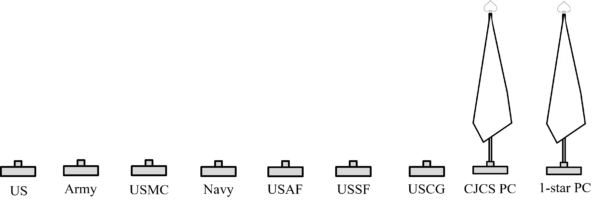
a. Issue: Colors Already Posted
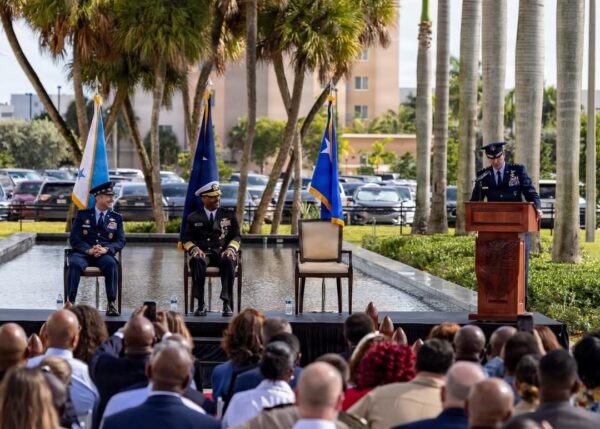
- Personal (e.g., General Officer (GO)) and/or positional colors (e.g., CNO).
- Known as a “PC”.
- Also identified inconsistently as a “Personal/Individual Flag” in the Army.
- Are not carried in a color guard and are also not carried separately to be posted.
- Are carried in formal occasions where the PC bearer follows the GO during a ceremony.
- Are carried at the funeral of the GO.
- Expected to be preposted.
- Carried at outdoor ceremonies with bearers standing near the official.
- Can be preposted directly behind the official’s seat (on stage, at a change of command).

- POW/MIA
- Never carried, must be preposted.
- Only carried as a PC at the funeral of a former POW.
- Expected to be preposted.
- Usually not posted in line with other colors, most often off on its own.
- Never carried, must be preposted.
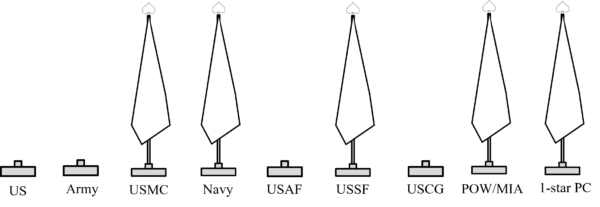
- The presence of select preposted service or organizational colors creates a decision point:
- Either carry all appropriate colors or none.
- Carry only the minimum required (US and State).
- Mixing carried and preposted colors.
- Only posting some colors because of whatever reason (not enough personnel, is the most common).
b. Issue: A More Serious Concern: Posting Without the US Flag Present
- At least one preposted color was present without the US flag already raised or posted.
- 4 U.S. Code § 7 – Position and manner of display:“(f) When flags of States, cities, or localities, or pennants of societies are flown on the same halyard with the flag of the United States, the latter should always be at the peak. When the flags are flown from adjacent staffs, the flag of the United States should be hoisted first and lowered last.”
- Why military manuals do not typically address the above information in the Flag Code: The majority of military installations only have one main flagpole/mast near the headquarters building.
This violates a fundamental standard:
- No flag or color is raised or posted before the US flag.
- This rule applies regardless of whether the colors are service, organizational, or positional.
Teaching Point:
- This issue is often overlooked because it isn’t visually obvious — but it is doctrinally critical.
7. Advanced Issue 2: Posting From Behind the Colors
Posting the colors from the front of the colors, with your back to the audience, is going to be the usual technique. Every so often, you will be requested to post in stands that are at the edge of the stage (for instance) and the only approach you have is from behind, facing the audience.
Teaching Point:
- Ensure your finial is flat to the audience.
- Fringe to the left: Ensure the top of the color drapes to your left (audience right).
8. Advanced Issue 3: The Show-and-Go Color Presentation Model
In many ceremonies, a set of colors is already preposted on the stage or at the venue. In these cases, the most effective and doctrinally sound solution is the Show-and-Go model.
Description:
- A color guard formally presents a second set of colors.
- The colors are rendered honors, presented, and then retired.
- The preposted colors remain in place throughout the ceremony.
Key Advantages:
- Preserves ceremonial dignity.
- Avoids unnecessary movement or congestion.
- Eliminates the need to carry colors already properly displayed.
- Maintains U.S. flag primacy and order of precedence.
Clarification: Multiple U.S. Flags at a Ceremony
Doctrine:
- There is no restriction on the number of United States flags displayed at a ceremony, provided all are displayed with proper dignity and precedence.
Historical Note (Not Doctrine):
- General Douglas MacArthur preferred that only one US flag be present at ceremonies in which he participated. This was a personal preference, not a regulation, directive, or standard.
Teaching Point:
- Personal preference — even from senior leaders — does not establish ceremonial doctrine.
Critical Clarification:
- The color guard does not need to carry all colors that are already posted in stands. The ceremonial act is the presentation, not duplication.
The Standard:
- Only government and military colors are authorized to be carried by a military color guard.
- Display is different. Preposted colors that are not authorized to be carried can be preposted in stands if necessary (which leads to a Show-n-Go).
Authoritative References:
- DoDI 5410.19, Vol 4 — Community Outreach Activities: Ceremonial, Musical, and Aerial Event Support
- 5.1. b. (2) In all other public programs or ceremonies, Service members in uniform and in an official capacity must not carry flags of foreign nations, veterans’ groups, or other non-military organizations.
- AR 840-10 — Flags, Guidons, Streamers, Tabards, and Automobile and Aircraft Plates
- 1-8 (4) f. Carrying of nonmilitary organizational flags. U.S. military personnel in uniform or in civilian clothing acting in an official capacity will not carry flags of veterans’ groups or other nonmilitary organizations; however, commanders may authorize military personnel to carry State and territorial or national flags during military ceremonies.
- MCO 5060.20 — Marine Corps Drill and Ceremonies Manual
- Chap. 7, 5. f. The flags or banners of non-U.S. military organizations (e.g., Boy Scouts, Kawanas [sic] Club, etc.) are not carried in the color guard.
- AFI 90-1201 — Protocol
- 2.6.4. The POW/MIA flag is not carried or displayed in parades or reviews but may be carried at official military funerals.
- 2.12.3. Carrying of non-military organizational flags. U.S. military personnel in uniform or in civilian clothing, acting in an official capacity, will not carry flags of veterans’ groups or other non-military organizations. (T-0) The U.S. flag should never be carried flat or horizontally, but always aloft and free. Commanders may authorize military personnel to carry state, territorial, or national flags during military ceremonies. (T-3) U.S. military personnel in uniform are authorized to carry all Department of Defense (DoD) recognized flags.
These authorities collectively establish which colors may be recognized, carried, and accorded honors in military and ceremonial contexts.
What Is Not Authorized
The following are not authorized for carry by a military or military-style color guard:
- Private organization colors (POW/MIA, veteran associations, nonprofits)
- Unit logos presented as “colors”
- Sponsor or donor flags
- Event or commemorative flags
- Corporate or civilian agency branding
Key Point:
- The term “color” has a specific legal and ceremonial meaning. Not every flag qualifies as a color.
What Is Authorized for the Army and Air and Space Forces
Authorized colors generally include:
- The United States Color
- Foreign national color
- Government colors: State, territory, county, city
- Military Service colors
- Authorized unit colors (traditionally for Infantry) or standards (traditionally for Cavalry)
What Is Authorized for the Marine Corps, Navy, and Coast Guard
Authorized colors generally include:
- The United States color
- Tribal Nation color
- Foreign national color
- Government colors: Territory (considered a sovereign nation by the UN)
- Military Service colors
- Authorized unit colors (traditionally for Infantry) or standards (traditionally for Cavalry)
Why This Is an Advanced Issue
This violation often occurs because:
- Organizations equate importance with authorization
- Civilian practices bleed into military-style ceremonies
- Good intentions override regulatory knowledge
Teaching Clarification
This restriction applies specifically to:
- Military color guards
- Military cadet programs
- Any unit claiming military-based ceremonial standards
It does not prohibit:
- Civilian organizations displaying their own flags
- Non-military ceremonies designed entirely around civilian customs
Doctrine Summary
Military color guards are authorized to carry only government and military colors as defined by regulation. Organizational flags, regardless of intent or significance, do not meet that standard.
10. Advanced Issue 4: Audience Facing
Standard:
- The audience is not required—and generally not expected—to turn and face the colors as they enter, move through the venue, or reposition within the room.
What the Audience Is Expected to Do
Audience members are expected to:
- Rise when the colors are presented (when directed)
- Face forward toward the focal point of the ceremony
- Render honors at prescribed moments (e.g., National Anthem, Pledge, posting)
The audience should not be required to track the colors’ movement through the space.
Why This Standard Exists
- Ceremonial Focus
The focal point of a ceremony is the posting location, not the path of travel. - Practicality and Safety
Turning, twisting, or rotating crowds—especially in confined or formal seating—creates confusion and distraction. - Preservation of Dignity
Excessive audience movement detracts from the solemnity of the ceremony. - Command Authority
The color guard commander, not the audience, controls the movement and presentation of the colors.
Common Error
Instructing the audience to:
- Turn and follow the colors
- Face rearward or sideways during movement
- Remain standing and facing the colors throughout the march
This turns a formal presentation into a spectator exercise rather than a ceremonial act.
What Does Require Audience Facing
The audience should face the colors only when:
- The colors are posted
- The National Anthem is played
- The Pledge of Allegiance is recited
- Honors are explicitly rendered by command or announcement
Outside these moments, facing is neither required nor expected.
Teaching Statement
“The audience faces the ceremony, not the hallway. Honors are rendered at the posting — not during the march.”
Doctrine Summary
Audience orientation supports ceremonial focus.
- The audience does not track the colors’ movement; they respond at prescribed ceremonial moments.
Show-and-Go Color Presentation Chart
The DrillMaster Colors Decision Criteria
For your use, the Show-and-Go (present the colors only) model.
1. Are colors already preposted at the venue?
| Condition | Guidance |
| No preposted colors | Do not use Show-and-Go |
| U.S. flag and/or other colors already in stands | Proceed to next question |
Explanation:
Show-and-Go only exists because colors are already properly displayed.
2. Are the preposted colors correctly arranged and in precedence order?
| Condition | Guidance |
| Incorrect order / missing flag | Correct the display first |
| Correct order, US flag present | Proceed |
Doctrine Note:
Show-and-Go does not excuse incorrect displays.
3. Is the ceremony formal or ceremonial in nature?
| Ceremony Type | Guidance |
| Casual, informal, civic-only | Optional, commander’s discretion |
| Military, paramilitary, honor, memorial, official | Strong candidate |
4. Would carrying all posted colors cause congestion or redundancy?
| Condition | Guidance |
| Space allows full movement cleanly | Either model acceptable |
| Stage is crowded / limited access / narrow aisles | Show-and-Go preferred |
Teaching Point:
Efficiency is not laziness when it preserves dignity.
5. Is manpower limited?
| Condition | Guidance |
| Sufficient personnel for full set | Either model |
| Insufficient personnel | Show-and-Go or reduce to minimum |
Critical Reminder:
Personnel limits affect execution, not precedence.
6. Is the audience already visually anchored on the posted colors?
| Condition | Guidance |
| No (audience attention begins with entry) | Consider full carry |
| Yes (stage-focused ceremony) | Show-and-Go ideal |
7. Does the ceremony require symbolic presentation rather than physical posting?
| Requirement | Guidance |
| Physical posting required (e.g., new display) | Full carry-and-post |
| Symbolic honors, national anthem, pledge | Show-and-Go |
Doctrine Summary
Show-and-Go is a ceremonial presentation model, not a shortcut.
It preserves dignity, precedence, and clarity by presenting a second set of colors without duplicating what is already properly displayed.
Closing Clarification
These last two points are advanced concepts and are not easily recognized without formal instruction. This is provided here as educational information, not condemnation.