
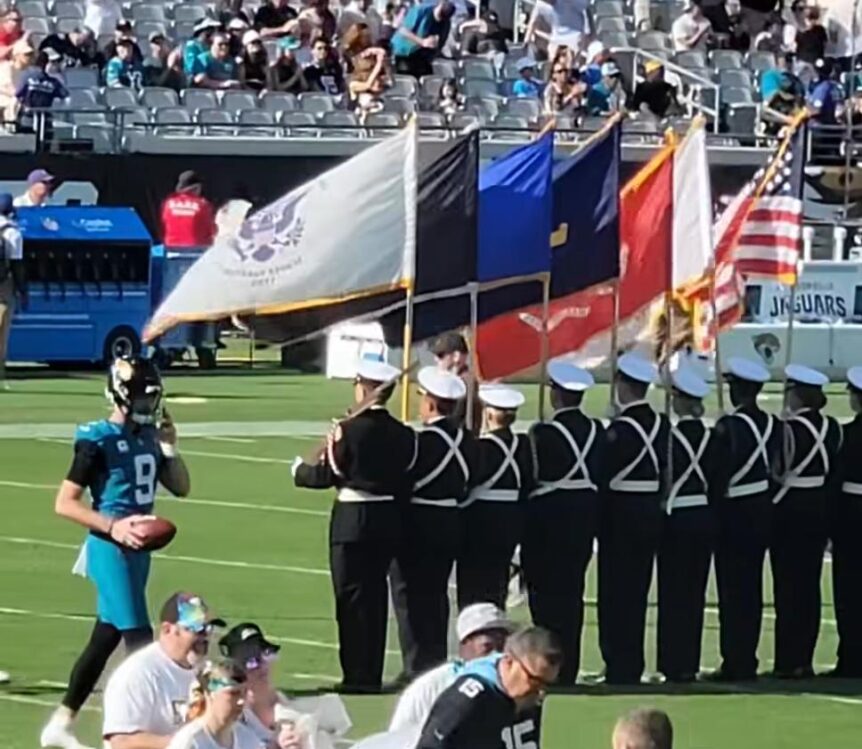
Over the past year (2025), I have shared several photos of JROTC units presenting all of the service colors at patriotic events and then wrote my thinking of the situation: “is this authorized?” and I went on to invite my readers to comment.
I need to be clear:
- Anyone other than a member of the military, Active Duty, National Guard, or Reserve, is not authorized to carry a service departmental colors.
- This means that the Bishop Kenny (FL) NJROTC pictured at the top of the page is breaking the rules.
- Army Regulation 840-10 restricts AJROTC units from owning, displaying, or carrying the Army Ceremonial and Organizational Colors (the 4’4”x5’6” and 3’x4’ colors, respectively).
- I want JROTC and other cadets programs to have special permission to do so.
This creates a “why” behind the rules that backs up both positions: 1) it’s not authorized, and 2) it needs to be authorized.
The Conflict: When a cadet unit carries the flags of all six U.S. Services, they are not acting disrespectfully or attempting to claim CBU status. They are performing an instinctive, visible act of patriotism and showing collective respect for the totality of the Armed Forces who secure the freedoms they study.
Denying this ability forces these citizenship programs to choose between adhering to a technical rule (CBU status) and fulfilling their civic mission (inspiring public patriotism). This directive resolves that conflict by granting the necessary formal authority to channel this patriotic impulse correctly.
Below, I offer my work to create Special Authorization for Multi-Service Patriotic Color Guards.
Joint Service Cadet Program Directive (JSCPD)
I. Purpose and Scope
This Directive establishes the formal, written authorization and protocol for authorized youth and auxiliary programs to execute a multi-service patriotic color guard during specified national holidays and specific events. This team is purely ceremonial and does not alter the unit’s legal status, nor does it bestow Color-Bearing Unit (CBU) status upon the organization.
II. Authorized Programs & Events
- Programs Specifically Not Covered in this Directive: The following programs are cadets and midshipmen working under contract to be commissioned in the US military. They are already authorized to carry their service colors.
- Cadet and Midshipmen of the service academies (US Military Academy, US Naval Academy, US Air Force Academy, US Merchant Marine Academy.
- Senior ROTC units at colleges and universities.
- Authorized Programs: This Directive applies to units certified under:
- Junior Reserve Officer Training Corps (JROTC) – Army, Marine Corps, Navy, Air Force, Space Force, and Coast Guard.
- Civil Air Patrol (CAP).
- Naval Sea Cadet Corps (USNSCC).
- Marine Cadets of IOWA.
- California Cadet Corps.
- Young Marines (YM) Units.
- Authorized Events: The Joint-Service Patriotic Color Guard is authorized only during the following designated national holidays or ceremonies: Memorial Day, Independence Day (4th of July), Veterans Day, Armed Forces Day, and official, service-sanctioned events such as a change of command, retirement, or memorial ceremony.
III. The Team and Composition
The is a special Patriotic Color Guard (PCG), not the unit’s standard color guard.
- PCG Composition: A minimum of one Detail Leader and nine members (Cadets) is required to carry the standard full complement of six service colors and the national color with two rifle guards. DoDI 5410.9 Vol 4 explains that a single service can carry all other service colors and that a mix of members of each service can serve as the commander and guards. See https://thedrillmaster.org/2021/12/14/the-why-of-color-guard-precedence-and-command/
- Standard Colors to be Carried (MANDATORY): The PCG shall carry the full complement of six service departmental colors alongside the national color in the established DoD order of precedence found in DoDI 5410.19 Vol 4, DoDD 1005.8, TC 3-21.5, MCO 5060.20, and AFI 90-1201. See https://thedrillmaster.org/2021/12/14/the-why-of-color-guard-precedence-and-command/
- The National Color (US Flag).
- The U.S. Army Flag.
- The U.S. Marine Corps Flag.
- The U.S. Navy Flag.
- The U.S. Air Force Flag.
- The U.S. Space Force Flag.
- The U.S. Coast Guard Flag.
- Restricted Colors. In joint formations, certain colors are not authorized.
- Active Duty (all cadet programs follow this category: All services. Foreign national, state, territory, and unit colors are not authorized in a partial or full joint colors formation.
- National Guard: Army and Air Force. Foreign national and unit colors are not authorized in the joint colors formation.
- The National Guard’s state or territory colors are authorized.
- Reserve: All services. They act IAW Active Duty.
A. Single-Service Execution (DoDI 5410.19-V4 Precedent)
In the event a Multi-Service PCG cannot be formed, the single authorized program may carry the full complement of all six service departmental colors. This authorization is granted under the principle of DoD ceremonial accommodation, mirroring the flexibility granted to military commands per the DoDI.
Meaning: An AFJROTC or combination of different service JROTC cadets can carry all service colors; they do not have to only carry their service’s color.
B. Joint Cadet Color Guard Options
When two or more authorized cadet programs form a joint color guard, they must choose one of the following two focuses:
- Organizational Focus: Carry the National Color and the Organizational/Institutional Color of each participating program.
- Service Focus (Special Authorization): Carry the national color and the full complement of all six service departmental colors (the PCG).
- Requirements:
- A joint cadet color guard is prohibited from carrying both its organizational colors and the service colors simultaneously.
- All colors must have gold fringe; the Space Force color has silver fringe. Fringe is mandatory.
- All staffs must be the light ash wood guidon staffs. Length of staff discussed below:
- All service colors must be the same size.
- The USMC, USN, and USCG colors only comes in 4’4”x5’6” and are only mounted on a 9’6” staff.
- Only the Army, Air Force, and Space Force are authorized 3’x4’ colors on 8’ staffs. The sea services do not carry or display this size.
- There are unauthorized 3’x5’ colors for each service. They fit best on 8’ staffs. It is understandable that cadets might be better off carrying this size color and staff, even though it’s not authorized in the service, cadets do need this option.
IV. Educational Requirements
To ensure the authorization is respected and understood, mandatory educational and practical certification standards are required.
- A. Mandatory Education: All participants must complete a training module covering:
- The difference between allegiance (National Color) and Command Status (Service Colors).
- The technical rule: Why the service color is reserved for Active Duty/National Guard/Reserve Color-Bearing Units (CBUs).
- The PCG’s role as a ceremonial team, not a standard unit color guard.
- B. Practical Certification: Cadets must demonstrate and articulate:
- The correct order of precedence for all seven flags.
- The rule that service colors do not dip on command.
V. Procurement and Security
The handling of the official Service Flags requires the highest level of respect and accountability.
- Procurement: Official service departmental colors must be procured through authorized military sources (e.g., GSA) to ensure they meet official specifications. Unofficial replicas are prohibited (except where noted above).
- Accountability: Each unit should maintain an inventory log detailing the acquisition source, condition, and disposition of each of the six service colors.
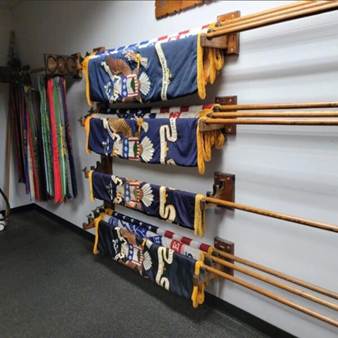
- Storage: Service Flags shall be stored in a cabinet designated exclusively for the colors or on a wall-mounted rack.
- Handling: The must be handled by certified PCG cadets and are never to be used for general drill practice. When PCG cadets train and practice, color will be cased until a time is deemed appropriate to practice with the colors uncased (occasionally) for realism.
- Repair and Disposal: Worn, torn, or frayed colors that can be repaired must be at the unit’s earliest convenience. Colors that are unrepairable must be retired via the formal military method of flag retirement (e.g., respectful burning ceremony). All services follow the guidance of AR 840-10, paragraph 10-3. Care of flags, d. See also https://thedrillmaster.org/2024/06/18/the-disposition-of-american-flags/
VI. Program Differences and Precedence
In a joint formation, all youth and auxiliary programs listed in the directive are considered peers in their mission of citizenship and service, but they differ significantly in their funding source, official status, and chain of authority.
- Junior Reserve Officer Training Corps (JROTC)
- Structure: A federally funded high school curriculum (10 U.S.C. § 2031).
- Affiliation: Directly supervised by the relevant Service’s Cadet Command (e.g., US Army Cadet Command, HQ AF JROTC) and falls under the Department of Defense (DoD).
- Primary Mission: “To Motivate Young People to be Better Citizens.” It is purely educational and has no operational or service-related mission.
- Precedence Basis: Its placement (e.g., AJROTC first) is derived solely from the founding date of its sponsoring service (Army, Marine Corps, Navy, Air Force, Space Force, Coast Guard).
- Civil Air Patrol (CAP) Cadet Program
- Structure: The cadet component of the Civil Air Patrol, which is the official civilian auxiliary of the US Air Force and now US Space Force (36 U.S.C. § 40301).
- Affiliation: Falls under the Department of the Air Force but is staffed by civilian volunteers. CAP maintains a separate charter from the DoD.
- Primary Mission: Providing operational emergency services (e.g., search and rescue), aerospace education, and the cadet program. It has an official, non-combatant operational role.
- Precedence Basis: CAP’s placement follows its parent service, the Air Force.
- Naval Sea Cadet Corps (USNSCC)
- Structure: A national youth organization supported by the Department of the Navy (DoN) but operated as a separate non-profit corporation.
- Affiliation: Authorized by Congress (36 U.S.C. § 135) and sponsored by the Navy and Coast Guard but operates independently of Navy/Coast Guard training command structures.
- Primary Mission: Instilling sea-going skills, discipline, and maritime knowledge. While often associated with Navy JROTC, it is a separate, independent, civilian-run youth program.
- Precedence Basis: Follows the founding dates of the U.S. Navy and U.S. CoastGuard, standing in the position of its oldest parent service (Navy).
- Sea Scouts, BSA
- The Sea Scouts program is included for contextual clarity in joint patriotic events but operates under a distinctly different legal structure than the other organizations.
- Structure: A specialized, high-adventure maritime explorer program of the Boy Scouts of America (BSA). While they do not have the same official, direct military affiliation as the USNSCC or JROTC, their relationship with the Coast Guard Auxiliary is significant for a comprehensive review of maritime youth organizations.
- Affiliation: A private, non-profit youth organization. It is officially supported by the U.S. Coast Guard Auxiliary (CGAUX), a civilian volunteer organization under the Department of Homeland Security, not the active duty Coast Guard military service itself.
- Primary Mission: Promoting character development, citizenship, and personal fitness through sailing, seamanship, and maritime activities. It is entirely civilian-run.
- Precedence Basis in a JCG: Because Sea Scouts lacks a formal, direct legal or command link to the services, it is not included in the established military order of precedence for the JCG.
- Placement: If Sea Scouts participate alongside the JCPF, they are traditionally positioned behind all other cadet program teams, reflecting their status as a civilian non-profit auxiliary program.
- Color Protocol: Sea Scouts carry the National Color and their Ship/Unit Color (often a blue field with the Sea Scout emblem). They are not authorized to carry any service departmental colors, nor is this directive intended to grant them that authorization, due to their independent civilian status.
- Exclusion: This section ensures that while the Sea Scouts are a major maritime youth organization, their purely civilian nature is explicitly highlighted, justifying their exclusion from the PCG authorization.
Cadet Precedence in Joint Color Guard
The key principle is that when these programs form a joint formation, the differing legal and funding structures are irrelevant to the ceremonial structure. The only rule that maintains military dignity and honors the entire chain of command is the founding date of the Service being represented. This an important detail to capture, especially for an organization as new as the Space Force.
| Program Type / Unit | Parent Service | Service Founding Date | Precedence Rule | |
| Army JROTC, CA Cadet Corps | US Army | June 14, 1775 | Army Founding Date | |
| Marine Corps JROTC, Marine Cadets of Iowa, Young Marines | US Marine Corps | November 10, 1775 | USMC Founding Date | |
| USNSCC, Navy JROTC | US Navy | October 13, 1775 | Navy Founding Date | |
| AFJROTC, CAP | US Air Force | September 18, 1947 | Air Force Founding Date | |
| Space Force Cadet Corps, SFJROTC | US Space Force | December 20, 2019 | Space Force Founding Date | |
| Coast Guard JROTC | US Coast Guard | January 28, 1915* | Coast Guard Founding Date |
*Note on Coast Guard Precedence: While the original service was founded in 1790 (Revenue Cutter Service), the Coast Guard is placed last in official military precedence when all six services are represented (personnel/colors) because it is under the Department of Homeland Security, not he Department of War, following the DoD’s operational guidelines. When Congress officially declares war, the USCG moves under the DoN and the USCG color changes places to move ahead of the AF/SF.
Appendix A: Senior ROTC Guidance on Joint Formations
This appendix provides essential guidance for Senior ROTC (College/University) units (Cadets and Midshipmen) who are already authorized to carry their service colors but often lack knowledge of standardized joint ceremonial protocol.
I. Color Uniformity Requirements
When SROTC units form a joint color guard, uniformity of size and presentation is mandatory, overriding single-service preferences.
- Color Dimensions:
- All service departmental colors must be the same size. Units should endeavor to use the 4’4″x5’6″ ceremonial size, which is mandatory for the Army, Marine Corps, Navy, and Coast Guard.
- Using the smaller 3’x4′ size is not permissible even if only the Army, Air Force, and/or Space Force are in the formation and no other service.
- Fringe: All colors must have gold fringe, with the exception of the Space Force color, which must have silver fringe.
- Staff Length: All colors must be mounted on 9’6″ staffs, which is mandatory for the Marine Corps, Navy, and Coast Guard.
II. Army ROTC Specific Guidance
Army ROTC units face a unique challenge regarding their colors. See AR 840-10.
- The Standard: The Army Field Flag and AROTC Institutional Color (3’x4′ on an 8′ staff) is the authorized substitute for the Ceremonial Flag, as per Army policy, for AROTC units.
- Restrictions:
- Display of or carrying the Army Ceremonial Color requires the attachment of battle streamers which can be prohibitively expensive for ROTC units.
- The Field Flag and AROTC Institutional Color is not authorized for joint colors formations. Army and joint service guidance states that only the service colors are carried.
- For joint formations: The larger, Ceremonial Color is required.