

Marine Corps ceremonial doctrine establishes a clear restriction for Joint Color Guards (JCGs):
Joint Color Guards use only two basic turning movements to change the direction of march by 90 or 180 degrees: “Right (Left) Wheel, MARCH” and “Left About, MARCH.”
Doctrinal Limitation on Joint Color Guard Movements
This language is not descriptive—it is prescriptive.
Therefore, any maneuver not listed is doctrinally excluded for a Joint Color Guard unless higher authority provides written authorization.
Implication for the Five-Member Countermarch
Because:
- The five-member color guard described in MCO 5060.20 is explicitly tied to joint service composition, and
- Joint Color Guards are restricted to Wheel and Left About as their only turning maneuvers,
the following doctrinal conclusion is unavoidable:
A five-member Joint Color Guard is not authorized to execute Countermarch.
This is not a matter of interpretation or preference.
It is a matter of movement authorization within Marine Corps ceremonial doctrine.
Countermarch or Marine Corps Wheel?
A recurring question arises:
Can a five-member color guard execute Countermarch?
Yes.
However, the reasoning must be grounded in doctrine rather than assumption.
What MCO 5060.20 actually provides
- The only explicitly described five-member movement is the Wheel with rotation about the center.
- This wheel is written in the context of a joint service color team.
- The Marine Corps document does not explicitly restrict the movement to joint teams, nor does it provide an alternative maneuver for non-joint five-member formations.
This silence has produced unnecessary uncertainty.
Interpreting the Wheel Correctly
The Marine Corps Wheel differs fundamentally from the Army wheel (which the MCO terms a Turn):
- Army Wheel/Marine Corps Turn Guard-pivot wheel:
- Rotation on the guard.
- Approximately 8 steps for visual control and cadence integrity.
- Adding a fifth marcher increases the step requirement and degrades timing.
- Marine Corps center-pivot Wheel:
- Rotation about the center of the formation.
- Completed in approximately 6 steps.
- Designed specifically to preserve time, cadence, and ceremonial appearance in larger color teams.
Therefore, the Marine Corps Wheel is not stylistic preference—it is a time-and-geometry solution to formation expansion.
Resolving the Competition Conflict
When a competition or local directive requires:
- Five members, and
- Execution of Countermarch,
the requirement creates a doctrinal contradiction:
- Countermarch is not authorized for Joint Color Guards.
- The only approved 180-degree directional change for a JCG is Left About, MARCH.
- The only approved 90-degree change is the Wheel.
Therefore, competitors face three possible realities:
- The event is non-doctrinal by design
→ Countermarch becomes a competition movement, not a ceremonial one. - The team is not functioning as a Joint Color Guard
→ Different doctrinal authorities could theoretically apply. - The event guidance is incomplete or incorrect
→ The proper corrective action is clarification from event leadership.
From a strictly Marine Corps ceremonial standpoint, only one statement is fully supportable:
If the formation is a Joint Color Guard, Countermarch is not authorized—regardless of team size.
Professional Guidance
For college and cadet teams preparing for competition:
- Follow written event rules to remain competitive.
- Understand when those rules depart from doctrine.
- Never present non-doctrinal movements as Marine Corps ceremonial procedure.
Doctrine governs ceremony.
Competition governs scoring.
The two are not always the same—and professionals must know the difference.
If You Are Forced Into a 5-Man Countermarch
Recent competition guidance—most notably the Tulane NROTC Mardi Gras Drill Meet—replaced the Wheel with Countermarch while simultaneously requiring five-member color guards.
Because MCO 5060.20 contains no five-member countermarch procedure, teams were left without doctrinal direction and forced into improvised solutions.
This situation demands a doctrinally defensible answer.
Doctrinal Resolution: Applying Army Counter Column Principles
When Marine Corps ceremonial doctrine is silent on a movement geometry, the correct professional response is:
Maintain Marine Corps standards of bearing, cadence, and alignment
while borrowing maneuver geometry from established U.S. Army drill doctrine.
TC 3-21.5 provides the necessary structure through Colors Reverse for the 5-man Team.
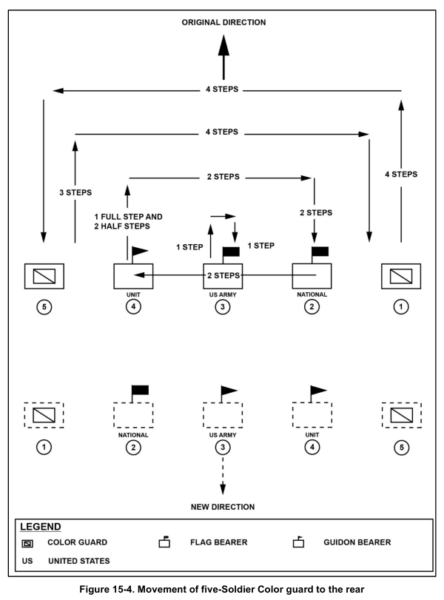
To face a five-Soldier Color guard to the rear, the command is Colors Reverse, MARCH. At the command MARCH, each Soldier simultaneously executes the following movements:
- Right Rifle Guard takes four steps forward, faces to the left in marching, takes four full steps forward, faces to the left in marching, takes four full steps in the new direction, and marks time.
- National Bearer faces left while marking time, takes two steps forward, and faces to the left while marking time.
- Organizational Bearer 1 takes one full step forward, executes about face while marking time, takes one full step in the new direction, and marks time.
- Organizational Bearer 2 takes one full step and two half steps, faces to the right while marching, takes two full steps, faces to the right in marching, takes two full steps, and marks time.
- Left Rifle Guard takes three full steps forward, faces to the right in marching, takes four full steps forward, faces to the right in marching, takes three full steps forward, and marks time.
Judge’s Note on the Five-Man Countermarch in Tulane-Style Competition
Purpose.
This note provides adjudication guidance when a competition directive requires a five-man color guard to execute Countermarch, despite Marine Corps ceremonial doctrine limiting Joint Color Guard (JCG) turning movements to:
- Right (Left) Wheel, MARCH — 90-degree change of direction
- Left About, MARCH — 180-degree change of direction
Countermarch is not listed among authorized JCG movements and is therefore non-doctrinal in a ceremonial context.
Adjudication Principle
When an event explicitly mandates a movement that differs from published service doctrine:
Event requirements govern execution.
Doctrine governs evaluation of quality.
Judges must therefore separate:
- Authorization (set by the competition)
from - Execution quality (set by professional drill standards)
Scoring Guidance
1. Do not penalize for performing Countermarch
If the written competition standard requires Countermarch:
- Teams shall not receive doctrinal penalties for executing it.
- The movement is treated as a competition maneuver, not a ceremonial violation.
2. Evaluate only execution fundamentals
Judging must focus on elements that remain doctrinally universal across all services:
- Cadence consistency
- Interval and alignment maintenance
- Proper staff control and verticality
- Preservation of national color dominance
- Command voice, timing, and unity of action
- Collision-free maneuver geometry
- Overall military bearing and ceremonial dignity
Errors in these areas are scorable, regardless of movement type.
3. Distinguish ceremonial correctness from competitive compliance
Judges should recognize three separate conditions:
| Condition | Judge Treatment |
| Doctrinal ceremony | Apply full Marine Corps / service standards |
| Competition-required non-doctrinal movement | Score execution only |
| Unrequired, invented movement | May be penalized for lack of standardization |
The Tulane-style five-man countermarch falls into the second category.
Recommended Judge Comment Language
To preserve clarity and professionalism, judges may use standardized remarks such as:
- “Countermarch executed per event requirement; evaluated on alignment, cadence, and control rather than doctrinal authorization.”
- “Movement geometry acceptable; interval and national color precedence require refinement.”
- “Competitive compliance achieved while maintaining strong ceremonial bearing.”
This language:
- Protects teams from unfair doctrinal penalties
- Maintains professional judging credibility
- Clearly documents the doctrine vs. competition distinction
Final Adjudication Position
For Tulane-style competition:
The five-man countermarch is treated as a required competitive maneuver,
not a Marine Corps ceremonial movement.
Accordingly:
- Teams are judged on execution quality only.
- No doctrinal deduction is applied solely for performing Countermarch.
- Ceremonial fundamentals remain fully enforceable.
This approach ensures:
- Fairness to competitors
- Fidelity to military doctrine
- Integrity of the judging profession