
Authorization, Representation, and the Limits of Civilian Ceremonial Honors
I received a message a short time ago regarding cadets taking part in the funeral of a civilian adult who was a member of Civil Air Patrol. This applies not only to CAP but also NSCC, and CGA (CGA has some interaction with the Sea Scout program).
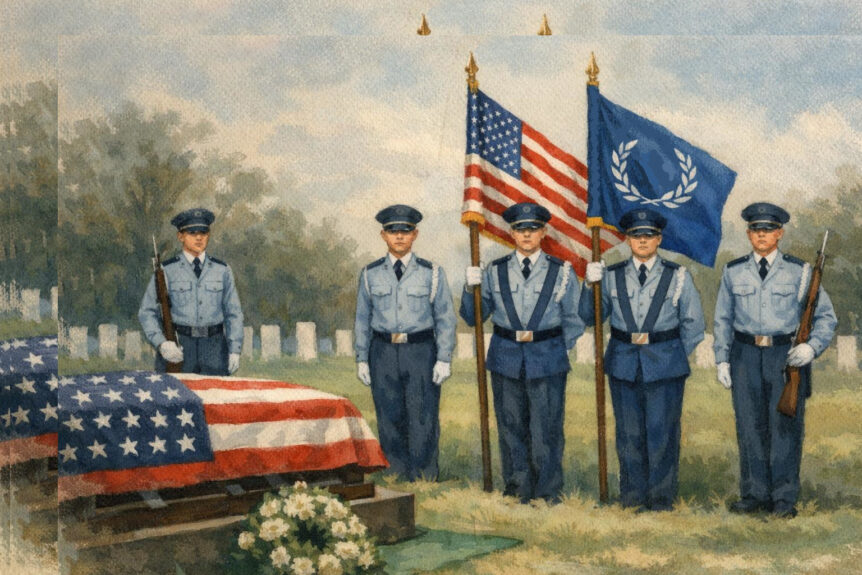
Note: I had an AI generate a generic image for this article to give a better feel for what is in store. Thank you to all for the feedback, I appreciate it.
Purpose of This Article
This article exists to clarify what Civil Air Patrol (CAP), Naval Sea Cadet Corps (NSCC), and Coast Guard Auxiliary (CGA) members may and may not do when honoring one of their own at a funeral service.
Confusion most often arises not from intent, but from uniform appearance and ceremonial similarity to military practices. This article draws clear, enforceable distinctions between:
- Military Funeral Honors (MFH) — federally authorized and restricted
- Civilian ceremonial funeral honors — lawful, appropriate, and limited
Understanding the difference protects families, funeral directors, and uniformed participants from unintentional misrepresentation.
Military Funeral Honors
Public Law 106-65 amended Title 10 U.S. Code § 1491 – Funeral honors functions at funerals for veterans.
Military Funeral Honors (MFH) consists of two or more Active Duty, Reserve, and/or National Guard members of the US military (Army, Marine Corps, Navy, Air Force, Space Force, and/or Coast Guard) performing any or all of the following ceremonial elements at a memorial or funeral for a veteran of the US military: pallbearers; flag fold and presentation; colors guard; firing party volleys; and sounding Taps.
The only time the Military can participate formally in a civilian funeral service, is if the decedent was an elected official. There is some ambiguity as to whether local government leaders such as Mayors, City or County/Parish Councilmembers, or County Commissioners should be included, but Governors, members of the State Legislature, State Supreme Court members, members of US House and Senate, Supreme Court Justices, and current and former Presidents and Vice Presidents are authorized MFH. Also included in this list is Ambassadors, and the Secretary of State. But it is unclear as to whether other members of the Cabinet are entitled to this honor. It is assumed that the secretary of Defense, Secretary of the Army, Navy and Air Force are authorized if death occurs in office, but again there is no clear direction.
Military Funeral Honors vs. Civilian Funeral Honors
Military Funeral Honors (MFH)
Military Funeral Honors are governed by Title 10, United States Code, §1491 and are:
- Federally authorized
- Performed by uniformed members of the U.S. Armed Forces
- Coordinated through official military channels
- Provided only to individuals who meet statutory eligibility requirements
MFH cannot be replicated, substituted, or approximated by civilian organizations, regardless of uniform appearance or ceremonial precision.
Members of CAP, NSCC, and CGA are civilians, not members of the U.S. Armed Forces, and therefore are not eligible to receive or perform Military Funeral Honors under federal law.
This is where some don’t understand the separation: members of the military cannot be part of any kind of honors for a civilian. Where a first responder is a military veteran or retiree and there will be a joint funeral, see this article.
Civilian Funeral Honors
This is the same as MFH, right? No. The same ceremonial elements might be presented, but no one from the military is involved. this means pallbearers; flag fold and presentation; Color guard; firing party volleys; and the sounding Taps is not forbidden; they are performed by first responders or others.
The Casket and the Flag
Every American is authorized to have a flag drape their casket. Who carries the casket and who folds the flag are the questions that need answers. Here are the answers:
- Members of the US military can informally carry the casket of any American.
- An example of this would be a Soldier who wears his uniform in honor of and carries the casket for a family member who was a veteran or not a veteran.
- Members of the US military cannot formally carry the casket of any American civilian. This is tantamount to MFH.
- An example of this would be an American who never served- a civilian.
- Another example is an American who never served in the US military but volunteered with the Coast Guard Auxiliary, Civil Air Patrol, or Naval Sea Cadet Corps- still a civilian.
- Members of the US military only fold the American flag and only for veterans.
- ROTC cadets and midshipmen, once under contract, are authorized MFH.
- US Military, US Naval, and US Air Force Academy cadets and midshipmen are authorized MFH.
- JROTC, Sea Cadets, CAP cadets
Avoidance of US government endorsement is the guiding principle.
What is Authorized?
Colors
Cadets of each organization can form a color guard for the deceased. CAP, NSCC, and CGA cadets can form color guards for any occasion. Adults in these programs should not, although CAP authorizes an adult member to step in as a last result.
The color guard can present (and post) the colors for a memorial inside a chapel. The team can then retrieve the colors and stand at graveside for that ceremony. If the flag will be presented to the family inside the chapel, don’t retire the colors as that is a final act, the flag presentation needs to be highlighted and last.
Casket Carry
There is no problem with cadets carrying a casket and folding the American flag.
Every American can have a small-star interment flag drape their casket.
Cremated remains? That means you pre-fold the flag and carry it and the urn (to the left of or behind the flag) to the graveside. You don’t have to unfold and refold the flag to present it, but you can. The flag must be folded before the service. The option is unfolding and refolding.
Firing Party
The first part of honors.
Most likely the cadets could borrow rifles for firing the three volleys from a veteran’s group.
Sounding Taps
The second part of honors.
When Taps is sounded, everyone stands at Attention. It is never sounded with anything else going on, everything stops. A cadet can use an electronic bugle or play his/her own horn.
Flag Fold and Presentation
This is the final part of honors.
There is nothing wrong with cadets folding the flag. It might be best to have a senior member present it to the family. It’s up to you. The presentation could be too much for the cadets to handle.
Uniform Wear: Legal Status and Representation
Are These Federally Styled Uniforms?
Yes. Members of CAP, NSCC, and CGA wear federally authorized civilian uniforms, some of which are intentionally similar in appearance to military uniforms.
However, similarity does not equal status.
- These uniforms are authorized by civilian statute, charter, or regulation.
- They are not U.S. military uniforms.
- Their wear does not confer military authority, rank, or obligation.
Uniform wear alone does not create a legal obstacle at a funeral.
What the Law Actually Prohibits
U.S. law does not prohibit civilians from wearing authorized uniforms or participating in ceremonies. What it prohibits is:
- Impersonation of a member of the U.S. Armed Forces
- False representation of military authority or entitlement
- Mischaracterization of a ceremony as federally authorized when it is not
In other words, the issue is representation, not appearance.
As long as:
- Members are clearly identified as CAP, NSCC, or CGA
- Uniforms are worn in accordance with organizational regulations
- The ceremony is accurately described as civilian and ceremonial
There is no legal conflict.
Where Problems Occur
Issues arise when:
- Funeral services are advertised as “military honors”
- Uniformed civilians are allowed to be mistaken for active-duty personnel
- Language such as “military-style honors” is used
- Families are not briefed on the nature of the ceremony
These are avoidable errors rooted in poor explanation, not improper intent.
What Is Not Authorized
The following are not permitted without formal Military Funeral Honors authorization:
- Describing any portion of the ceremony as “Military Funeral Honors”
- Assigning military titles, authority, or status to civilian participants
- Wearing unauthorized military insignia or decorations
- Allowing funeral materials to imply federal military endorsement
Intent does not override doctrine.
Key Doctrinal Principle
Uniforms convey identity, not authority.
Honor is demonstrated through correctness, not imitation.
Civilian uniformed organizations honor their members best by operating within their own lawful authority.
Guidance for Families, Instructors, and Funeral Directors
- Be explicit about what the ceremony is and is not
- Coordinate early to prevent advertising or language errors
- Ensure participants understand the boundaries of their role
- Never allow ceremony to drift into misrepresentation
Doing something “almost military” is not respect—it is confusion.
Final Takeaway
Civil Air Patrol, Naval Sea Cadet Corps, and Coast Guard Auxiliary members deserve dignified, professional funerals.
They do not require Military Funeral Honors to be honored properly.
Correct ceremony, properly described, is always sufficient.
Originally written in 2023 at the request of a CAP unit. Clarified writing for a USNSCC cadet funeral in January 2026.