
Each year, across the United States, rifle volleys echo on Memorial Day, presidential birthdays, and civic remembrance ceremonies. The sound is familiar. It is also, in most cases, not doctrinally authorized.
This is not a matter of opinion. It is a matter of reading the manuals we claim to follow.

Editor’s Note on the Opening Image
The image at right depicts a U.S. Military Academy firing party at the tomb of President Franklin D. Roosevelt during a ceremony marking his birthday. This event is only one of many recurring ceremonies in which rifle volleys are employed outside the context of military funeral honors. This is abuse of honors.
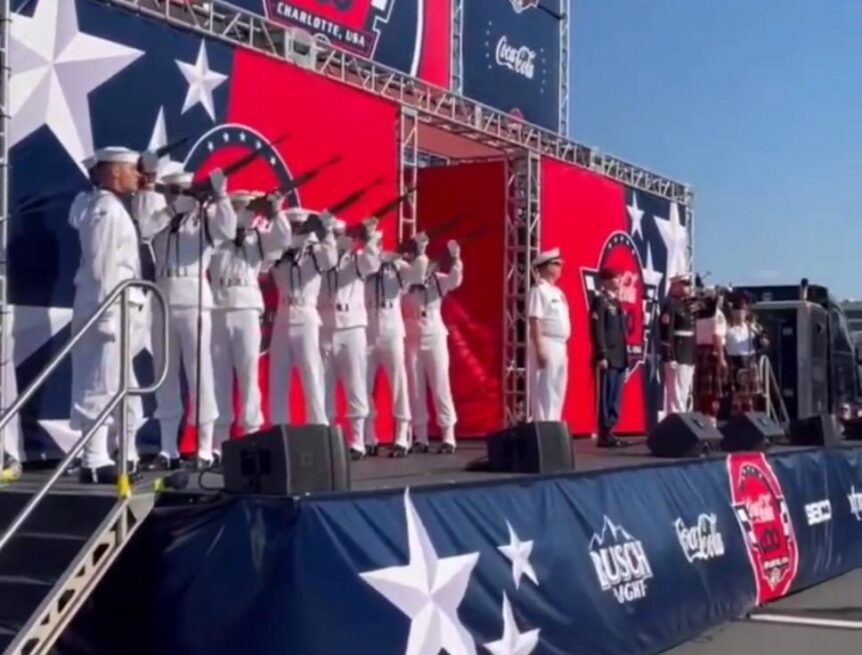
At the top of the page is the US Navy Ceremonial Guard Firing Party at a NASCAR event.
Download the brief White Paper here.
Such usage reflects a growing ceremonial drift:
what doctrine reserves exclusively for the final tribute to an eligible deceased service member or veteran is increasingly repeated at commemorations, holidays, and memorial observances.
Army TC 3-21.5 and Marine Corps MCO 5060.20 confine the firing party’s role to the execution of three volleys as part of funeral honors. They do not establish rifle volleys as a general ceremonial effect, patriotic symbol, or commemorative tradition.
When volleys are used repeatedly for annual observances—Memorial Day, presidential birthdays, and similar ceremonies—the act shifts from singular national farewell → routine ceremonial display.
This transformation is not doctrinal. It is cultural. the Department of Defense is allowing this for public relations, just like the flag being held flat.
And culture, when separated from doctrine, can unintentionally diminish the very honor it intends to express.
The responsibility of the military firing party is therefore precise and limited:
to render three volleys once, as part of the nation’s final military honors for the deceased.
Preserving that limitation preserves the meaning of the honor itself.
What the Army and Marine Corps Actually Say
In Army TC 3-21.5, the firing party appears only in the military funeral honors chapter.
Not in holiday ceremonies.
Not in patriotic observances.
Only funerals.
The Marine Corps says the same thing in MCO 5060.20. Rifle volleys are embedded in the sequence of final honors to the deceased, not general ceremony.
When doctrine places a procedure in one context only, that placement is intentional. Military publications authorize by inclusion, not by silence.
Funeral Honors Are Not a Sound Effect
The Department of Defense treats three elements as the nation’s final tribute:
- the folded flag
- Taps
- the three rifle volleys
These are rendered once to an eligible veteran or service member.
Not annually.
Not symbolically.
Not repeatedly.
When volleys are fired at routine ceremonies, the meaning shifts from final honor to background tradition.
Something sacred becomes something familiar.
And familiarity erodes significance.
Why This Keeps Happening
Three reasons appear again and again:
- People confuse memorial with funeral honors.
- Civilian veteran customs are mistaken for military doctrine.
- Silence in the manual is treated as permission.
But doctrine does not work that way.
If it isn’t authorized, it isn’t doctrinal.
The One Legitimate Exception
There is a narrow case where volleys belong outside a graveside:
If a memorial service replaces the funeral for an eligible deceased individual,
that memorial may include the full honors sequence.
That is substitution.
Not repetition.
Why This Matters
This is bigger than procedure.
Every unnecessary volley risks turning the nation’s final farewell into routine ceremony.
Honor is not preserved by repetition.
It is preserved by restraint.
Doctrine is not restrictive for its own sake.
It protects meaning.
A Simple Standard
If no eligible deceased service member or veteran is being honored
with their one rendering of military funeral honors,
then rifle volleys do not belong.
That standard is clear.
And clarity is the beginning of professionalism.
Command Guidance: When Rifle Volleys Are Authorized — and When They Are Not
1. Purpose
This guidance clarifies the doctrinal authorization for the ceremonial firing party and the three-volley salute as prescribed in:
- Army Training Circular 3-21.5, Drill and Ceremonies
- Marine Corps Order 5060.20, Drill and Ceremonies
It is intended for honor guard commanders, NCOICs, and ceremonial planners to ensure doctrinal compliance and preservation of ceremonial meaning.
2. Governing Principle
The firing party and three rifle volleys are elements of military funeral honors rendered:
- to an eligible deceased service member or veteran
- as part of the prescribed final honors sequence
- once, as the nation’s concluding military tribute
Authorization is therefore individual, singular, and funeral-bound.
3. Authorized Use of Rifle Volleys
Rifle volleys are doctrinally authorized only under the following conditions:
A. Military Funeral Honors at a Graveside or Committal Service
When conducted in accordance with TC 3-21.5 or MCO 5060.20 for an eligible deceased individual, including:
- presence of remains or interment ceremony
- integration with Taps and flag presentation
- execution by an assigned firing party
B. Memorial Service Substituting for a Funeral
When:
- the deceased is eligible for military funeral honors, and
- no graveside service will occur, making the memorial the sole honors event
This constitutes substitution, not repetition.
4. Non-Authorized Use of Rifle Volleys
Rifle volleys are not doctrinally authorized for:
- Memorial Day ceremonies honoring the fallen collectively
- Presidential birthday commemorations
- Unit remembrance events or anniversaries
- Civic or patriotic observances
- Dedications, unveilings, or public memorial programs
- Any ceremony not rendering funeral honors to a specific eligible deceased individual
Such use represents customary or symbolic practice, not prescribed military ceremony.
5. Rationale for Limitation
A. Preservation of Meaning
Doctrine reserves rifle volleys for the nation’s final salute.
Repetition converts final honor into routine display.
B. Doctrinal Integrity
Military ceremonies derive authority from explicit authorization, not tradition or familiarity.
C. Professional Responsibility
Honor guards act on behalf of the United States, not local custom.
Doctrinal fidelity is therefore an ethical obligation, not merely procedural compliance.
6. Commander’s Decision Standard
If the ceremony is not the single rendering of military funeral honors
for an eligible deceased individual, rifle volleys will not be used.
This standard provides:
- doctrinal clarity
- ceremonial consistency
- protection of the dignity of final honors
7. Implementation
Honor guard leaders should:
- review upcoming ceremonies for doctrinal compliance
- educate supported agencies and civic partners
- recommend alternative honors when volleys are not authorized
(e.g., moment of silence, bell toll, wreath laying, Taps alone when appropriate)
Conclusion
Army TC 3-21.5 and Marine Corps MCO 5060.20 confine the firing party and three-volley salute to military funeral honors rendered once to an eligible deceased individual.
Routine ceremonial firing outside this context is extra-doctrinal and should be discontinued to preserve the solemn meaning of the nation’s final tribute.