
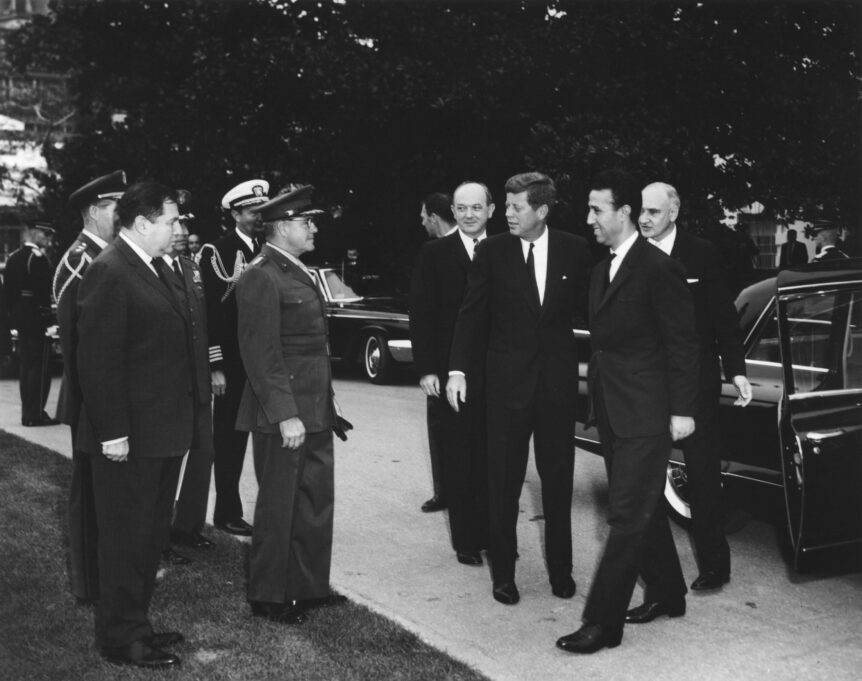
The formal White House State Arrival Ceremony—the structured, visually striking event held on the South Lawn featuring joint armed-forces platoons, a multi-service color guard, the U.S. Army Band, and the Old Guard Fife & Drum Corps—is a relatively recent development in American ceremonial tradition. Although military honors for foreign dignitaries have existed since the early years of the republic, the arrival ceremony as we recognize it today took shape during the administration of President John F. Kennedy.
This article outlines the ceremony’s historical development and the origins of the specific ceremonial units that participate. It is written for instructors, historians, ceremonial planners, and drill and ceremonies professionals.
Early Military Honors Prior to the 1960s
For more than a century, visiting foreign leaders received some form of military recognition—gun salutes, small guard detachments, or musical honors—often staged at train stations, ports, or later, airports. These honors were important, but they lacked a consistent, codified format. The White House grounds were not yet the centerpiece for arrival pageantry, and ceremonies varied significantly between administrations.
By the mid‑20th century, “arrival ceremonies” were a recognized component of state visits, but remained flexible, sometimes occurring at airports or other venues rather than the White House itself.
Kennedy’s Vision for a Modern Arrival Ceremony (1961–1962)
President John F. Kennedy reshaped the nature of diplomatic welcomes. Beginning in 1961, Kennedy and his staff envisioned a formalized ceremonial program on the South Lawn, one that showcased American military tradition, national identity, and historical continuity. His goal was to elevate the dignity and symbolism of American hospitality toward foreign heads of state.
This initiative culminated in the ceremony that is widely regarded as the first modern State Arrival Ceremony.
October 15, 1962: The First Modern South Lawn Ceremony
On this date, President Kennedy welcomed Ahmed Ben Bella of Algeria. Contemporary White House records and Kennedy Library materials identify this event as the first official welcome ceremony held on the South Lawn in the structured format that would become standard.
Kennedy’s remarks even noted the uniqueness of the moment, acknowledging that Ben Bella was the first foreign leader to be welcomed in this manner.
From this point forward, the South Lawn became the default venue for major diplomatic welcomes when weather and scheduling allowed.
Evolution of the Units Involved
The modern ceremony includes several key military components, each with its own history. Kennedy’s redesign coincided with the availability of these units, enabling a visually powerful presentation.
Joint Armed Forces Platoons and Color Guard
The joint ceremonial platoons are drawn from:
- The 3rd U.S. Infantry Regiment (The Old Guard)
- Marine Barracks Washington
- The Navy Ceremonial Guard
- The Air Force Honor Guard
- The Space Force Honor Guard
- Coast Guard Ceremonial Honor Guard
A joint-service color guard accompanies these formations. While each service had ceremonial units long before 1960, the joint presentation—standing as a unified American military element—became a consistent part of the South Lawn ceremony starting in the Kennedy years.
U.S. Army Old Guard Fife & Drum Corps (Established 1960)
Formed on February 23, 1960, the Old Guard Fife & Drum Corps brought 18th‑century military musical heritage into modern ceremonial practice. The Corps’ period uniforms and instrumentation provide a powerful historical accent and became a hallmark of the Kennedy-era arrival ceremonies.
Their presence reflects Kennedy’s desire to highlight America’s colonial and Revolutionary War traditions.
The U.S. Army Band (Pershing’s Own)
Founded in 1922, Pershing’s Own has long served as the primary musical support for high‑level ceremonies in Washington. For arrival ceremonies, elements of the band—often the Ceremonial Band—perform national anthems, ruffles and flourishes, and other required musical honors.
The combination of Pershing’s Own with the Old Guard Fife & Drum Corps was deliberate: one represented America’s modern professional Army, the other its historical roots.
Why 1962 Matters
Although earlier administrations hosted dignitaries with varying degrees of pomp, Kennedy’s 1962 ceremony introduced the structured, jointly manned, historically conscious format that is still in place today. Key components of the modern ceremony either originated shortly before this time (such as the Fife & Drum Corps) or were reorganized to reflect national unity and military professionalism.
From 1962 onward, the State Arrival Ceremony evolved into:
- A joint-service formation
- A consistent ceremonial program
- A fusion of modern and colonial-era musical support
- A public, symbolic display of American diplomatic respect
This blueprint has remained largely unchanged for more than six decades.
Why This History Matters Today
Understanding the origins of the modern State Arrival Ceremony reinforces why military drill and ceremonies remain vital in the 21st century. These traditions are not relics—they are deliberate, carefully crafted expressions of American national identity. Every formation, facing movement, musical cue, and joint-service element communicates unity, professionalism, and respect on behalf of the nation. By learning where these standards come from and why they exist, today’s cadets, honor guards, and ceremonial units carry forward a responsibility that is both historic and active: to represent the United States with precision and dignity whenever they stand in uniform.
Conclusion
The modern White House State Arrival Ceremony is a product of intentional design, national identity, and military tradition. While rooted in older practices, it was President Kennedy’s administration that formalized the ceremony into the visually recognizable and symbolically powerful event that takes place on the South Lawn today.
Understanding its origins not only clarifies the role of each ceremonial unit but also underscores how military pageantry communicates honor, respect, and statecraft.