

Understanding Guidon Port, Flagstaff Port, and Angle Port in Military Ceremony
Across the United States, military and cadet units routinely conduct physical training runs with a unit guidon.
This practice is normal, historically grounded, and fully supported by service drill doctrine.
In recent years, however, a different and more problematic pattern has appeared:
the national and organizational colors being carried in ways derived from guidon handling, including port-style carries associated with running or rapid movement.
At first glance, this may seem insignificant.
Guidon staffs and color staffs look similar, and many movements in their manuals appear nearly identical.
But drill and ceremonies is governed by a deeper rule:
The flag determines everything that happens with the staff.
When that rule is forgotten, doctrine blurs, symbolism weakens, and ceremony loses meaning.
The Guidon Was Designed to Move
Army, Marine Corps, and Air Force drill publications explicitly depict the guidon bearer at Double Time with the staff stabilized across the body in a port-style carry.
This is not artistic illustration—it is doctrinal authorization.
Historically, the guidon descends from battlefield maneuver standards that identified units in motion.
They marched with the unit.
They maneuvered with the unit.
They ran with the unit.
Modern doctrine preserves that functional heritage.
The guidon therefore represents:
- Unit identity in motion
- Mobility and maneuver
- Practical stabilization during rapid movement
Running with the guidon is not merely permitted. It is historically and doctrinally appropriate.
The Colors Were Designed to Represent the Nation
The national and organizational colors come from a different lineage entirely.
As warfare evolved and nation-states matured, flags ceased to function as maneuver markers and instead became embodiments of sovereignty, sacrifice, and citizenship.
Because of this transformation, colors were no longer treated as equipment in motion but as emblems carried in dignity.
Modern drill doctrine reflects that shift:
- Movement is measured and ceremonial
- Cadence is controlled
- Handling preserves visual reverence
Across service manuals, one fact is consistent:
No running carry position exists for the colors.
This silence is meaningful.
In ceremonial doctrine, absence of authorization—especially involving the national flag—signals intentional exclusion, not oversight.
Regulation Drill and Ceremonial Drill Serve Different Purposes
Understanding confusion between guidons and colors requires recognizing a rarely stated doctrinal truth:
Regulation Drill standardizes movement.
Ceremonial Drill preserves dignity in real-world conditions.
Service drill manuals assume:
- Open marching space
- Standard formations
- Predictable ceremonial geometry
They are not written to solve every situational constraint faced by color guards in:
- Buildings
- Narrow passageways
- Low ceilings
- Staging areas
- Prolonged standing environments
Ceremonial practice therefore extends beyond Regulation Drill—not by abandoning doctrine, but by protecting symbolic dignity when space prevents textbook execution.
Three Distinct Flagstaff Positions
Clarifying modern confusion requires separating three mechanically different—and symbolically unrelated—positions.
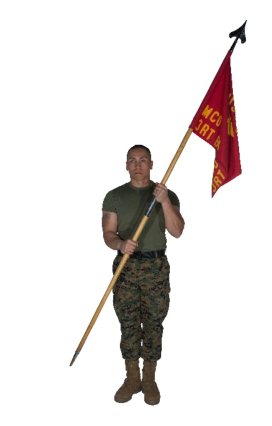
Guidon Port (Functional, Double Time)
- Staff carried fully across the body
- Designed to stabilize the guidon while running
- Expresses mobility, urgency, and maneuver
This position belongs exclusively to the guidon’s functional tradition. The above image is from MCO 5060.20.
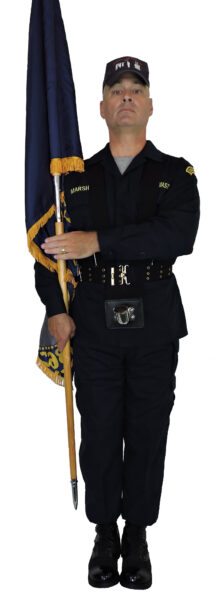
Flagstaff Port (Ceremonial Transport)
- Staff held upright and controlled near the body
- Used for marching or standing when normal Carry is impractical
- Maintains the highest possible ceremonial appearance under constraint
- Not used for running
This position reflects ceremonial control, not mobility. The above photo is of me at the USAF/USSF Port position with the left hand flared. The other services use the same position with the left hand grasping the staff, which I recommend if you do not have experience holding the staff with just the right hand.
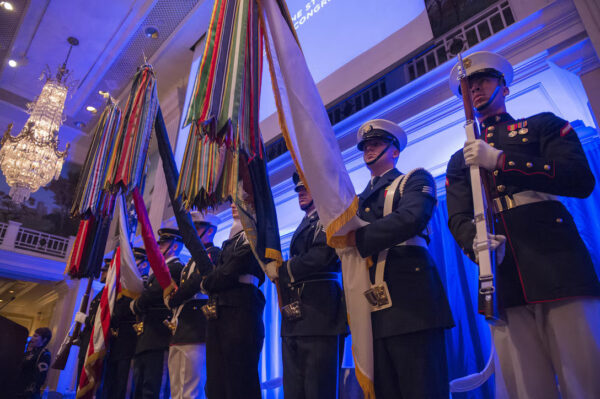
Angle Port (Protective Adaptation)
- Staff angled forward in the direction of travel
- Used when clearance is extremely limited
- Prevents contact between the colors and surrounding structure
- Employed for marching, standing
- May function as Present at Port when standard Present Arms (at Carry/Right Shoulder) is physically impossible
Angle Port represents greater protective concession, not reduced ceremony. The above image is of the Joint Armed Forces Color Guard presenting the colors indoors under a low ceiling. The colors are at Angle Port and the rifles at Present.
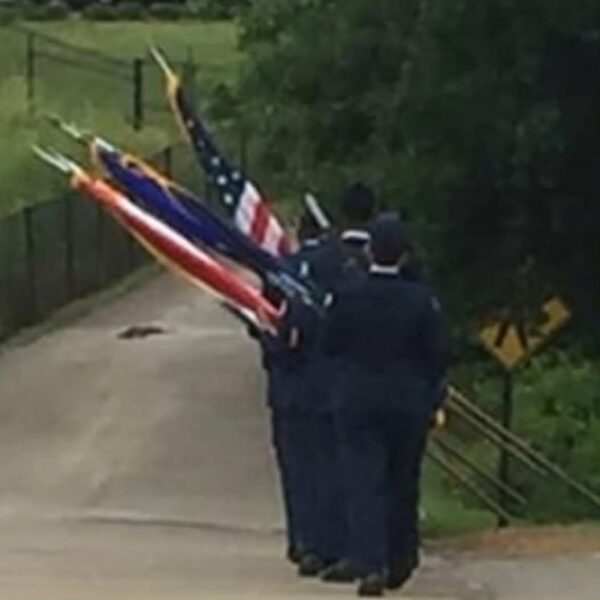
The Color at “Port”
The images below clearly show that the lines between both staff manuals have been completely burred- because we do not teach the “why” behind what we do, especially for a color guard. This carry technique is inappropriate and does not honor and respect our colors.

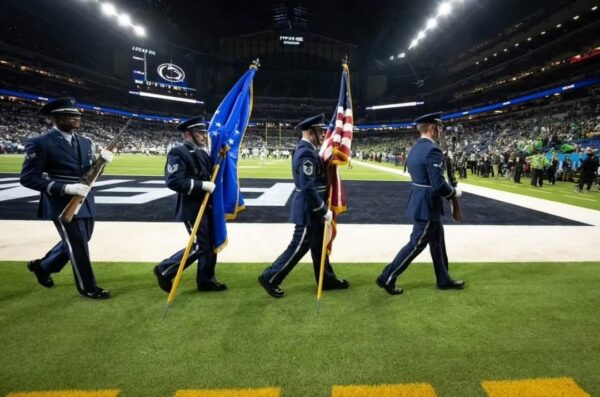
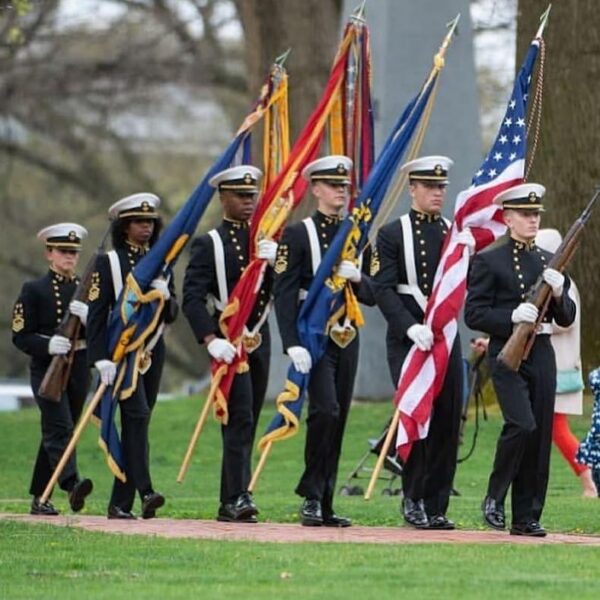
Clearance, Not Convenience, Governs Adaptation
The relationship among ceremonial positions is hierarchical:
Carry → Port → Angle Port
Each step occurs only when required by space,
never for speed, ease, or stylistic preference.
This principle preserves a critical distinction:
- Guidon Port enables movement.
- Flagstaff Port and Angle Port preserve dignity during movement.
Presenting the Colors in Confined Space
Real-world ceremonies sometimes occur in spaces where even standard Port is impossible.
In such environments, ceremonial guards may present the colors at Angle Port, rather than from traditional geometry.
This is not improvisation. It is controlled doctrinal adaptation guided by a single rule:
Ceremonial dignity must be preserved even when space prevents textbook execution.
Thus, ceremonial drill proves more flexible than Regulation Drill—yet never less reverent.
Why This Distinction Matters
This discussion is not about minor technical precision.
It is about preserving the visible boundary between:
- The unit (represented by the guidon)
- The nation (represented by the colors)
When guidon handling is transferred to the colors:
- Ceremony becomes athletics
- Sovereign symbolism becomes utility
- Meaning fades through repetition
Over time, confusion becomes culture.
Restoring Doctrinal Clarity
Doctrine already provides the solution.
Guidons
- Move with the unit
- Run at Double Time
- Express function and maneuver
National and Organizational Colors
- Move only in dignity
- Adapt ceremonially to space
- Express sovereignty and sacrifice
The manuals were never unclear.
Only our interpretation became blurred.
Final Thought
Two staffs may look identical in the hand. Two positions may appear similar at a glance.
But in military ceremony, appearance is not authority.
The flag is.
And once that truth is remembered, the difference between:
- Guidon Port
- Flagstaff Port
- Angle Port
—and between movement and meaning—
becomes unmistakably clear.