
Engineering Convenience, Symbolic Integrity, and the Fallacy of “Honor by Dishonor”
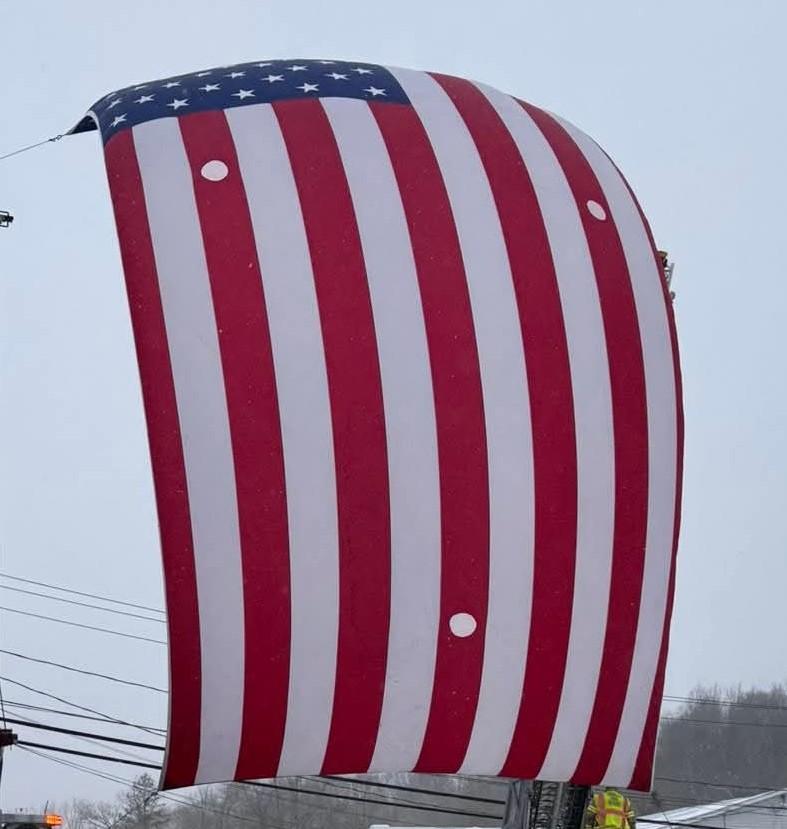
A recent public display featured an oversized United States flag modified with multiple circular openings cut directly through the fabric to reduce wind load and prevent structural failure.
At first glance, the display may appear patriotic.
Upon closer inspection, however, the physical alteration of the flag itself raises a far more serious concern—one not of engineering, but of meaning.
The issue is not the size of the flag.
The issue is not outdoor display.
The issue is cutting the national emblem to make it conform to the environment.
That distinction matters.
The Difference Between Display and Alteration
Large flags have long been displayed across the United States in stadiums, civic ceremonies, and memorial events.
When constructed and handled properly, scale does not diminish dignity.
But once the fabric of the flag is intentionally cut or pierced, the relationship changes.
The flag is no longer being displayed—it is being modified.
The U.S. Flag Code defines the flag as the national emblem of the United States and prescribes standards for its respectful treatment (4 U.S.C. § 1).
Further, the Code directs that the flag should never be used in a manner inconsistent with dignity or respect (4 U.S.C. § 8).
Intentional physical alteration for convenience or survivability stands in direct tension with that mandate of dignity.
This moves the object from the realm of symbol to the realm of material.
A symbol demands respect.
Material is adjusted for convenience.
Function Replacing Meaning
The circular cutouts visible in the altered flag are structural accommodations—engineering solutions designed to allow the display to survive wind stress.
In practical terms, the modification treats the flag as:
- a banner
- a stage element
- an engineered surface
rather than as a protected national emblem governed by standards of respectful treatment.
The Flag Code specifically cautions that the flag should never be used for advertising purposes nor treated as an article of temporary use and discard (4 U.S.C. § 8(i), § 8(j)).
When engineering function becomes the controlling factor in the flag’s construction, symbolic meaning is subordinated to utility.
Symbolism erodes not through open contempt, but through incremental normalization of alteration.
The Marketplace Problem
A deeper issue emerges when such alterations are requested from manufacturers.
If one flag company refuses to produce a modified flag because it violates the spirit—or letter—of the Flag Code, the customer can simply turn to another company willing to comply.
If reputable American manufacturers decline, overseas producers—unbound by civic or cultural restraint—stand ready to manufacture a cheaper imitation to satisfy demand.
Thus, an attempt to create a dramatic patriotic display establishes a commercial pathway that:
- Encourages doctrinal compromise
- Rewards non-compliance
- Accelerates symbolic degradation
What begins as an effort to honor the nation risks becoming a transaction that weakens the very emblem it seeks to celebrate.
Honor by Dishonor
This dynamic illustrates a recurring logical error that may be described as Honor by Dishonor.
The belief that violating the governing standards of a national symbol can somehow increase the honor shown to it.
Under this fallacy:
- Bigger is assumed to mean more respectful.
- More dramatic is assumed to mean more patriotic.
- Greater visibility is assumed to equal greater reverence.
Yet the Flag Code’s consistent theme is not spectacle, but dignity, restraint, and proper handling (4 U.S.C. § 8).
True honor does not require alteration. It requires conformity to standard.
The Quiet Shift from Symbol to Prop
In performance terminology, a prop is an object used to enhance visual impact.
Its purpose is functional, not symbolic.
When the flag is altered so that a display can succeed—rather than the display being designed to preserve the flag—the hierarchy reverses.
The flag begins serving the performance.
The performance no longer serves the flag.
At that moment, the national emblem risks becoming scenery—
not through malice, but through accommodation.
Precision as Respect
Respect for the flag has never been measured by size, spectacle, or engineering complexity.
It has always been measured in precision of treatment.
The Flag Code repeatedly frames respect in quiet, disciplined terms:
- proper display (4 U.S.C. § 6–7)
- dignified conduct (4 U.S.C. § 8)
- honorable retirement when unfit for display (4 U.S.C. § 8(k))
These are restrained forms of honor, yet they preserve meaning far more effectively than dramatic visual demonstrations.
Symbolic erosion rarely begins with open contempt.
It begins with well-intentioned compromise.
The Responsibility of Choice
Every generation inherits the flag.
Every generation also decides—through countless small choices—what the flag will represent in practice.
Will it remain a symbol governed by standards?
Or will it become material shaped by preference?
The answer is determined not in moments of crisis, but in ordinary decisions:
- what we permit to be manufactured
- what we choose to display
- what deviations we excuse
- what standards we defend
Conclusion
Cutting a flag so that it can survive the wind may appear practical.
But practicality alone cannot guide the treatment of a national symbol.
A flag altered for convenience is no longer being fully honored—no matter how large, visible, or dramatic the display.
Honor is not achieved through spectacle.
Honor is preserved through fidelity to standard.
And fidelity ultimately requires something simple:
The discipline to shape our displays around the flag—
rather than shaping the flag around our displays.