
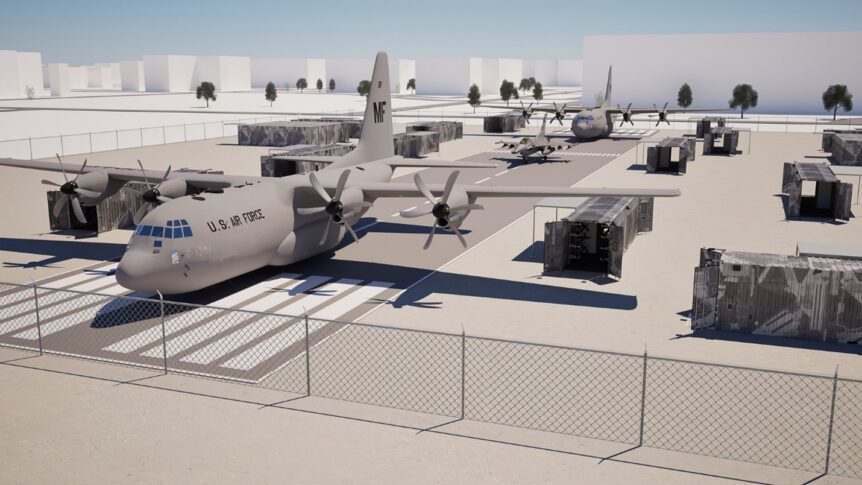
Senior Pentagon reporter Jeff Schogol recently published an excellent piece at Task & Purpose detailing the restructuring of U.S. Air Force Basic Military Training (BMT). The article focuses on modernization, but two particular aspects stand out because they directly reinforce something I have taught for years: drill and ceremonies are not cosmetic traditions — they are functional training tools with real-world application.
Before diving into those two aspects, a brief point of context for readers unfamiliar with the Air Force structure is helpful.
2nd Air Force is the numbered air force responsible for conducting BMT and technical training for enlisted personnel, non-flying officers, and support specialists. It falls under Air Education and Training Command (AETC) and is headquartered at Keesler Air Force Base, Mississippi. In short, this organization shapes how the next generation of Airmen enters the force.
First — Simulated Operational Environments
Air Base Training Ranges are expected to open this year as part of the latest overhaul of BMT, which is projected to begin in the spring. Maj. Gen. Wolfe Davidson, commander of 2nd Air Force, explained that for the first time, the training environment will simulate the operational Air Force.
One line in his statement deserves special attention:
“The simulated airstrips provide an immediate, realistic mission context that allows trainees to understand the ‘why’ behind their training. It allows them to see how the discipline and teamwork learned on the drill pad directly translate to generating airpower.”
That sentence is extraordinary. It is direct institutional acknowledgment of what many instructors and trainers have known intuitively for hundreds and even thousands of years but have struggled to articulate: the drill pad is not an isolated performance space — it is a laboratory for behavioral conditioning.
Discipline, synchronized response, spatial awareness, and controlled movement are not ceremonial decorations. They are neurological and psychological training mechanisms. The transfer from marching formation to mission execution is not metaphorical; it is procedural. Programs across education, athletics, and emergency services often begin with marching precisely because of its proven capacity to instill coordination, timing, and group cohesion. The Air Force is now explicitly codifying that connection.
Second — A Shift in Training Philosophy
Equally important is the philosophical shift represented by this change. For many years, Air Force culture — particularly during and after the Cold War — emphasized specialization. Airmen were trained for a primary duty and rarely exposed to broader operational frameworks unless a specific contingency demanded it.
My own experience illustrates the contrast. While serving at RAF Upper Heyford in England from 1985 to 1989 as Security Police and Law Enforcement Augmentee, I found that some of the most valuable lessons I relied on came not from Air Force schooling but from earlier Army squad-level tactics training at AROTC Basic Camp at Fort Knox (first level Army officer accession). That cross-discipline exposure proved instrumental during real-world inspections and operational pressures, including the period immediately following the Libya mission when NATO scrutiny intensified. Recognition I received at the time was less about individual skill and more about adaptability and composure under structured discipline.
The modernization of BMT now introduces that adaptability at the beginning of an Airman’s career rather than leaving it to chance or prior service background. This is not merely a curriculum update; it is a doctrinal correction.
Why This Revamp Matters
What is occurring is not the abandonment of tradition — it is the clarification of purpose. Drill and ceremonies are often dismissed by those who mistake visibility for superficiality. In reality, drill is foundational behavioral engineering. It trains timing, accountability, mutual awareness, and the ability to function as part of a coordinated system under pressure.
When leaders articulate that drill-pad discipline translates directly into operational capability, they are not romanticizing tradition; they are recognizing a training methodology that has always been effective but not always defended with the language of modern education and psychology.
This change signals something significant: education is returning to the forefront, not just training. Training teaches tasks. Education builds adaptable professionals who understand why the tasks matter. The Air Force’s restructuring of Basic Military Training demonstrates a renewed commitment to that distinction — and that distinction is where lasting excellence is formed.