
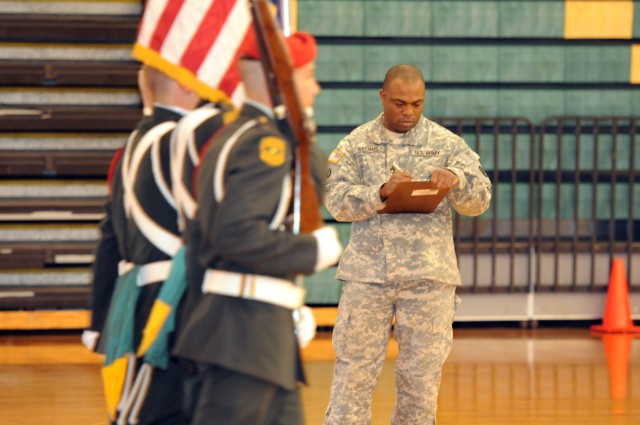
For decades, the military drill and ceremonies community has struggled with a persistent and often unspoken problem: who is actually qualified to judge drill and ceremonies.
The common answers are familiar.
- Anyone who at least graduates Basic Training or Boot Camp
- Honor guard members
- Drill instructors
- Anyone wearing a uniform
And yet, despite the prevalence of these assumptions, judging quality remains inconsistent, standards vary widely, and cadets routinely receive conflicting or poorly grounded evaluations.
The problem is not a lack of dedication or effort. It is a fundamental misunderstanding of authority—specifically, what kind of authority judging requires, and who actually possesses it.
Note: This article is also available as an expanded White Paper with an executive summary. Please download it here.
Authority Is Role-Specific, Not Universal
Authority is often treated as a single, transferable commodity. In reality, authority is bounded, contextual, and role-dependent.
A person may possess authority to:
- Participate
- Execute
- Instruct
- Enforce
Without possessing authority to evaluate.
Judging is not an extension of participation or instruction. It is a distinct professional function with its own competencies, limitations, and obligations.
Failing to recognize this distinction is the root cause of many judging failures.
Participation Does Not Confer Authority to Judge
Graduation from basic training or boot camp demonstrates one essential competency: the ability to follow prescribed drill standards under authority.
It does not demonstrate:
- Doctrinal depth
- Comparative judgment
- Evaluative discipline
- Understanding of adjudication frameworks
- Ability to judge without intervening
Basic training produces compliant members, not evaluators.
Being subject to authority is not the same as being trained to exercise it responsibly.
Honor Guard Service: Custodial Authority, Not Evaluative Authority
Honor guard service introduces solemnity, responsibility, and representational bearing. Members learn custody of symbols, ceremonial restraint, and protocol execution.
This experience is valuable—but limited in scope.
Honor guard members possess custodial authority:
- Responsibility for the colors
- Adherence to prescribed ceremonial actions
- Execution of established protocol
They are not, by default, trained to:
- Compare multiple units
- Apply graduated standards
- Distinguish correctness from excellence
- Evaluate across competitive contexts
Custodial authority strengthens foundational understanding.
It does not automatically translate into judging authority.
Instructional Authority Is Not Evaluative Authority
One of the most entrenched misconceptions is that instructional experience equals judging qualification.
Drill instructors, training instructors, and drill sergeants possess instructional authority, characterized by:
- Direct correction
- Immediate feedback
- Binary compliance
- Standardized outcomes
- Command-based environments
Judging requires the opposite posture.
Evaluative authority demands the ability to:
- Observe without correcting
- Compare rather than command
- Apply standards neutrally
- Accept multiple correct executions
- Rank and rate rather than teach and fix
- Articulate assessment without re-instruction
Instruction is upstream.
Judging is downstream.
Experience in instruction does not negate the need for evaluative training—it makes it more necessary.
The Problem With Symbols of Authority
Because formal judge development has historically been absent, systems have substituted proxies:
- Rank
- Uniform
- Time in service
- Instructor titles
These are symbols of authority, not evidence of authority literacy.
Authority literacy is the ability to:
- Recognize the limits of one’s authority
- Apply standards without personalization
- Operate strictly within jurisdiction
- Withhold intervention when evaluation—not correction—is required
Without authority literacy, experience becomes inconsistent rather than reliable.
The Judge Shortage—and Why It Persists
Judging shortages are often described as logistical problems. In reality, they are structural failures.
Judges are commonly sourced from:
- “Voluntold” local recruiters
- Senior ROTC cadets
- National Guard personnel
- Volunteers from nearby military bases
These individuals are usually well-intentioned and willing.
They are rarely trained judges.
Volunteerism has become a substitute for qualification.
“Training” That Is Not Training
At many competitions, judge preparation consists of:
- A brief morning-of briefing
- Distribution of score sheets
- Occasionally, viewing performance videos the night before
This is not judge training.
Exposure does not establish:
- Authority alignment
- Standards consistency
- Jurisdictional clarity
- Understanding of what must not be judged
- Differentiation between compliance confirmation and comparative evaluation
These practices provide orientation, not certification.
The Institutional Devaluation of Drill and Ceremonies
Since the 1990s, drill and ceremonies has been steadily pushed to the margins of military training culture.
Once foundational, D&C has increasingly been treated as:
- Ceremonial window dressing
- A relic rather than a developmental tool
- An expendable skill set
As a result, many modern leaders were never given the opportunity to:
- See drill used as a transformation tool
- Apply it as a cohesion mechanism
- Understand how marching converts individuals into units
The original purpose of initial training is not to produce finished members—it is to produce trainable members.
Drill and ceremonies was central to that process.
When its emphasis declined, so did appreciation for its rigor, discipline, and evaluative standards.
The Downstream Effect on Cadet Programs
This devaluation has consequences.
When leaders no longer believe in the developmental power of drill:
- Standards erode
- Training expectations lower
- Judging becomes casual
- Evaluation becomes symbolic rather than substantive
Cadets now invest hundreds of hours training for competition, only to be evaluated by individuals deemed “qualified” primarily because they wear a uniform.
Uniforms do not confer evaluative authority.
This mismatch is not only unfair—it undermines trust in the system.
The Absence of a Formal Adjudication Framework
For decades, drill competitions operated without a comprehensive, published adjudication system grounded in:
- Authority recognition
- Doctrinal alignment
- Evaluative discipline
- Role differentiation
Judging practices were inherited informally rather than taught formally.
The absence of structure is not a failure of individuals.
It is a systemic gap.
Authority Through Training, Not Assertion
Publishing a complete adjudication system does not elevate one person above others. It establishes something essential:
Trained authority.
Authority in judging comes from:
- Formal adjudication education
- Exposure to established judging systems
- Training under recognized evaluative bodies
- Years of applied judging experience
- Disciplined adherence to standards
Authority is not asserted.
It is developed.
Who Can Judge Drill and Ceremonies?
Judging drill does not require:
- Active-duty status
- Instructor background
- Honor guard service
It does require:
- Authority literacy
- Evaluative discipline
- Doctrinal understanding
- Certification within a defined system
- Willingness to operate within constraints
This is why veterans, law enforcement officers, firefighters, EMS personnel, and other professionals accustomed to delegated authority can become excellent judges—when properly trained and certified.
The common denominator is not uniform.
It is competence in exercising authority responsibly.
A Necessary Reframe
The issue is not who has served.
The issue is who has been trained to judge.
Authority to judge is not granted by participation, instruction, or rank. It is a distinct form of delegated authority that must be trained, bounded, and verified.
Until this is accepted, cadets will continue to be evaluated by assumed authority rather than qualified authority—and standards will continue to drift.
Closing Thought
Drill and ceremonies is not obsolete.
Its standards were simply allowed to atrophy.
Restoring credibility begins with restoring authority discipline in judging.
Cadets deserve nothing less.