

Common Responses to Flag Code Violations—Answered with Facts
Context
Large-scale flag displays at athletic events often generate the same recurring responses when standards are addressed. Rather than debate each one individually, here are the most common claims—paired with the relevant facts.
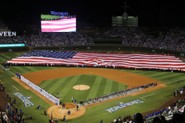

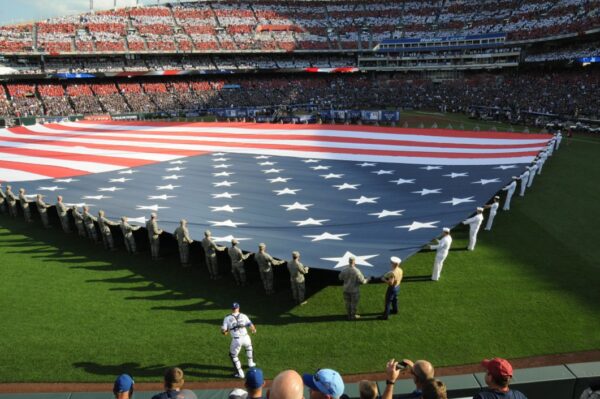
Claim 1: “Good luck telling that to MLB or major organizations.”
Fact: Major organizations are not the authority on flag standards.
The standard is established in 4 U.S.C. §§ 5–10 (U.S. Flag Code).
Institutional visibility does not equal correctness. It simply means the error is widely seen.
Claim 2: “The Flag Code is not law—it’s just a guideline.”
Fact: The Flag Code is a national standard of conduct, not a criminal statute.
It exists to define:
- Proper display
- Proper handling
- Prohibited uses
Many professional standards (including military ceremonial doctrine) are not enforced through penalties.
They are still binding within any organization that claims professionalism.
Claim 3: “The flag is just an object.”
Fact: Within U.S. doctrine, the flag is a protected national symbol with prescribed handling standards.
The Flag Code explicitly establishes:
- What the flag represents
- How it is to be treated
- What constitutes misuse
Treating it as a generic prop is a rejection of the standard—not a reinterpretation of it.
Claim 4: “There’s nothing wrong with these displays.”
Fact:
Common field-size presentations violate core provisions of the Flag Code:
- Distortion (4 U.S.C. §8(a))
The flag is reshaped into non-rectangular forms (e.g., geographic outlines) - Improper use as a surface (4 U.S.C. §8(b))
The flag is spread across and functions as a ground-level display
These are not subjective opinions—they are direct conflicts with established standards.
What This Actually Comes Down To
This discussion is not about preference. It is about which standard you choose to follow.
- If your standard is legality, then anything not punished is acceptable
- If your standard is professionalism, then you follow established doctrine
Summary
- The U.S. Flag Code defines the standard
- Visibility does not equal correctness
- Lack of penalties does not invalidate the standard
- The flag is not a neutral object within its defined context
- Distorted, surface-level displays are non-compliant
Final Position
You do not need to agree with the standard.
But rejecting it does not change what the standard is.