
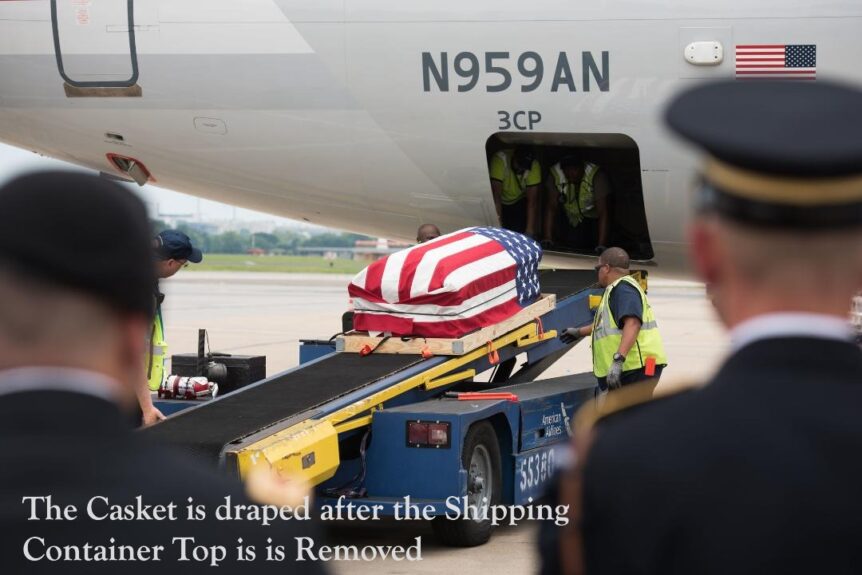
In the somber process of bringing home our fallen service members, every detail matters. The sight of a flag-draped casket signifies the highest honor a nation can bestow. However, a modern logistical trend is starting to violate the very protocols meant to protect that dignity: the practice of draping the interment flag over the shipping container holding the casket, rather than the casket itself.
I recently observed and documented an instance where a casket, secured inside a large, military-grade shipping container, was being loaded onto an aircraft—with the American Flag laid flat and fastened across the top of that container.
While logistics companies must use secure, durable means of transport, particularly for air freight, this substitution of the commercial container for the casket is a profound error in military honors protocol and a clear violation of the US Flag Code.
See also:
The Intent vs. The Interpretation
The use of an American Flag to cover a casket is one of the most sacred gestures in American military tradition. The flag symbolizes the service member’s ultimate sacrifice and is intended to touch and honor the coffin, physically representing the nation’s respect.
When the flag is placed over the sealed, outer shipping container, the following violations occur:
- First Violation of the Flag Code: 4 U.S. Code § 7 – Position and manner of display (n) “When the flag is used to cover a casket…” The flag covers a casket, not a shipping container. The container, despite its solemn contents, is a piece of logistical equipment.
- Second Violation of the Flag Code: 4 U.S. Code § 8 – Respect for flag “The flag should never be fastened, displayed, used, or stored in such a manner as to permit it to be easily torn, soiled, or damaged in any way.”
- Diminished Dignity: The spirit of the protocol is lost. The flag’s purpose is to honor the remains of the individual, not the method used to move them. Using the flag as a shipping tarp, even unintentionally, reduces a sacred symbol to a mere identification marker.

What the Protocol Requires
The flag should remain with the casket itself, whether the casket is removed from the container for the final stages of loading or if the protocol is adjusted to allow the flag to drape the casket before it is sealed within the secure container.
This is not simply about being pedantic about rules; it is about ensuring that those who died protecting our nation are given the uncompromising dignity they are owed, every single step of the way home. The logistics of military transfer must support, not undermine, the reverence of military honors.
Why Protocol Falters: Honor by Dishonor
The underlying cause of this recurrent violation is not malicious intent, but rather a gap between respect and detailed knowledge, which I call “Honor by Dishonor.” Read more here:
First, there is an understandable human instinct to “do more.” The desire to visually honor the transfer process leads individuals to place the flag on the large, visible object (the container) to ensure the fallen hero is recognized at every stage. This is a sincere act of reverence that is unfortunately misinformed, resulting in a violation rather than an increase in honor.
Second, the personnel, particularly the honor guard members involved in moving these containers, often suffer from severe deficits in detailed protocol training. They are trained to execute the physical task of moving the remains but often lack the deeper understanding of the “why” and the associated rules of the Flag Code and military manuals.
A Call for Immediate Correction
I urge all logistics providers, military contractors, airlines, and government agencies responsible for the movement of our fallen military to immediately review and correct their Standard Operating Procedures.
The flag is not merely an object; it is a symbol of sacrifice. We must ensure that our handling of it, especially in the context of interment, reflects the solemnity and honor due to the service member it covers. Let us commit to upholding the dignity of the transfer, ensuring the flag only rests where it is meant to: over the remains of an American hero.