
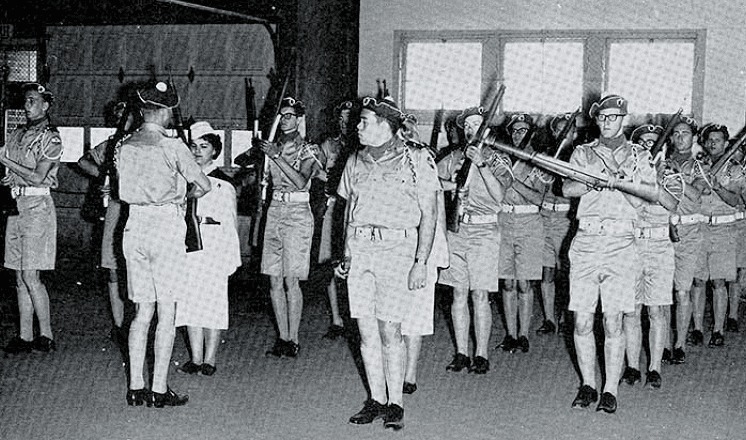
Military drill, color guard, and ceremonial performances feel fundamentally different from other performing arts—even when the outward motions appear similar.
1. Authority Is the Core Differentiator Between Drill and Pageantry
At its heart, military drill is not movement—it is delegated authority made visible.
Every movement, formation, command, and pause exists because someone with authority determined that it should exist and codified it. This is true even in exhibition drill, though the authority shifts form.
This is why drill:
- Feels weighty
- Feels consequential
- Feels non-negotiable when done correctly
Even when stylized, drill is never free.
2. The Three Primary Forms of Authority in Drill
Across all the domains you work in, authority consistently appears in three distinct but interacting forms.
A. Command Authority
This is the most obvious and the most commonly misunderstood.
Command authority is:
- Delegated
- Hierarchical
- Non-negotiable in the moment
In regulation and ceremonial drill:
- Authority flows from statute, regulation, and appointment
- The commander does not invent movements; they execute and enforce them
- Subordinates are not expressing themselves—they are complying
In exhibition drill:
- Command authority is simulated, stylized, or abstracted
- The routine may imply command even when no commands are spoken
- The authority still exists—it is simply internalized into design
This is why exhibition drill that looks impressive but lacks command clarity feels hollow.
B. Doctrinal Authority
This is the authority you engage with most directly in your writing.
Doctrinal authority answers the question:
“By what right is this being done this way?”
It comes from:
- Drill manuals
- Flag codes
- Protocol instructions
- Longstanding institutional practice
Key distinction:
- Doctrine is prescriptive
- Doctrine does not ask permission
- Doctrine does not care about preference
This is why you have consistently resisted calling your work “theory.”
You are not proposing alternatives—you are asserting continuity.
Even when doctrine evolves, it does so slowly, deliberately, and with institutional consent. That is authority behaving responsibly.
C. Evaluative (Adjudicative) Authority
This is the least understood—and the most fragile.
Evaluative authority exists only when:
- Standards are agreed upon in advance
- Judges are empowered to apply them
- Personal preference is explicitly subordinated
In regulation and ceremonial drill:
- Evaluation is confirmatory, not comparative
- The judge is a guardian, not a critic
- Innovation is irrelevant—or improper
In exhibition drill:
- Evaluation becomes comparative
- Authority shifts from compliance to coherence
- But it still requires constraint, or it collapses into taste
This is why your adjudication system is so important:
It reinstalls authority where it has quietly eroded.
3. Authority Does Not Disappear—It Migrates
When authority is denied, it does not vanish—it moves somewhere unexamined.
Examples:
- If doctrine is rejected, authority shifts to personality
- If standards are unclear, authority shifts to popularity
- If judges refuse authority, authority shifts to crowd reaction
This is why you see:
- Resistance framed as “creativity”
- Insults framed as “opinion”
- Noncompliance framed as “tradition”
These are not artistic disputes. They are authority disputes in disguise.
4. Color Guard: Authority Made Physical
Color guard work intensifies authority more than almost any other drill discipline.
Why?
- The flag is not symbolic—it is representational
- The bearer does not own the colors—they are entrusted with them
- Errors are not “mistakes”; they are breaches of custody
This creates a unique authority stack:
- National authority (flag)
- Institutional authority (unit)
- Personal authority (bearing and control)
This is why color guard attracts myths and emotional resistance:
- People feel the weight
- But do not understand the structure
- So they improvise meaning instead of learning standards
I am trying to remove improvisation and replace it with clarity.
5. Exhibition Drill Still Serves Authority—Just Indirectly
One of your most important through-lines:
Even exhibition drill, at its best, does not rebel against authority.
It demonstrates mastery of it.
High-level exhibition drill:
- Shows control under constraint
- Demonstrates discipline before creativity
- Uses freedom to reveal competence, not escape rules
This is why exhibition drill that borrows heavily from pageantry arts must still be judged differently:
- Pageantry seeks expression
- Drill seeks credibility
When exhibition drill loses that, it becomes athletic choreography, not drill.
6. Why Authority Makes People Uncomfortable
My experience with resistance.
Authority:
- Limits choice
- Exposes ignorance
- Removes the ability to negotiate outcomes
For some people, this feels oppressive. In reality, it is clarifying.
Your role—whether you intend it or not—is not merely instructional.
It is custodial.
You are:
- Preserving lineages
- Preventing drift
- Making invisible structures visible
That will always make a small number of people deeply uncomfortable.
7. Finally,
Military drill is not about movement—it is about authority expressed through movement, governed by doctrine, and safeguarded by standards.
Everything else—design, evaluation, performance, emotion—exists inside that truth, not alongside it.