
“A soldier will fight long and hard for a bit of colored ribbon.”
Napoleon Bonapart
Napoleon’s observation remains relevant because it identifies a fundamental truth of military culture: recognition matters. Ribbons, medals, badges, cords, and other uniform distinctions are not superficial. They are visible acknowledgments of effort, competence, and commitment. They communicate, without explanation, that an individual or group has earned a place apart from the norm.
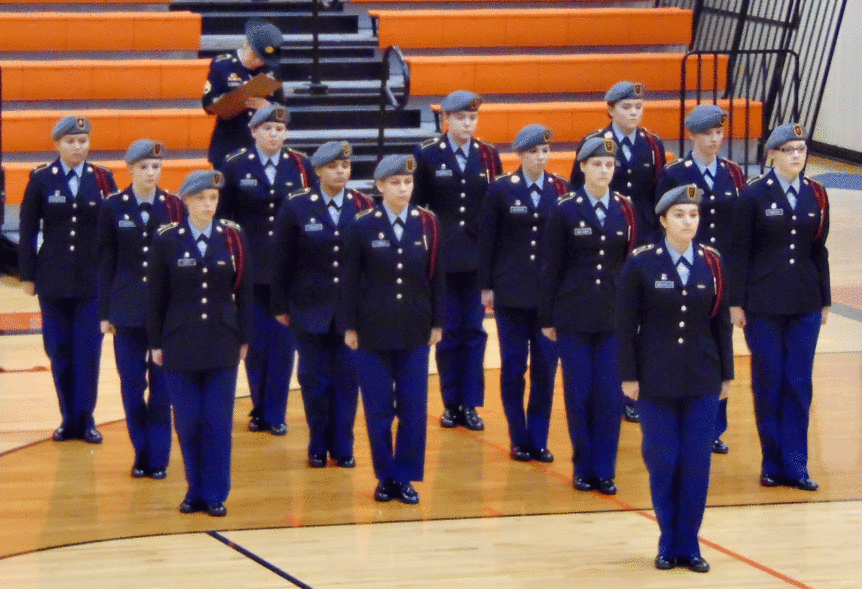
This principle applies equally within JROTC, cadet, and youth leadership programs. Drill teams, color guards, and similar specialty units must be clearly and deliberately distinguished from the rest of the unit if they are to maintain motivation, professionalism, and retention.
This article was originally published on September 22, 2015, under the title, Drill Team Recruitment and Retention
Symbolic Recognition and Program Legitimacy
Uniform accouterments—such as shoulder cords, distinctive belts, gloves, spats, berets, or other authorized items—serve a critical institutional function. They signal that participation in the drill team or color guard is not merely extracurricular, but selective and earned.
When a program lacks visible distinction, it loses perceived legitimacy. When legitimacy erodes, motivation declines. This is not a failure of cadets; it is a failure of program design.
Doctrine:
Specialized units require visible recognition to sustain prestige, commitment, and continuity.
Authority Within Specialized Units
Leadership within a drill team or color guard must be position-based, not solely rank-based. While rank reflects experience and responsibility within the broader cadet corps, specialized units operate on functional authority tied to assignment.
For example, a cadet captain assigned as a team member is subordinate to a cadet sergeant serving as squad leader within that team. This arrangement does not undermine rank; it reflects mission-oriented command structure, a principle long established in military operations.
Cadets must be trained to understand and respect this distinction. When authority is unclear or inconsistently enforced, confusion and friction follow.
Doctrine:
Within specialized units, authority flows from assigned position, not from general rank precedence.
Specialization and Professionalism in Training
Successful programs embrace specialization. In the marching band color guard world, instructional roles are often divided among a head instructor and technical specialists responsible for weapons, flags, and movement. This structure promotes standardization, continuity, and technical excellence.
Drill teams can—and should—adopt similar models. Designated rifle technicians and movement or marching technicians ensure that training remains consistent, skills are maintained over time, and new members are brought up to standard efficiently.
These roles require leadership qualities, but their primary responsibility is technical mastery and instructional consistency.
Doctrine:
Specialization is a hallmark of professionalism and a prerequisite for sustained excellence.
Ownership, Engagement, and Creative Investment
Cadet engagement increases dramatically when members are given ownership of the program. Allowing interested cadets to participate in writing drill, designing rifle work, or developing body movement fosters investment and pride.
Structured tools—such as drill-mapping templates—provide boundaries within which creativity can flourish while maintaining discipline and coherence. Ownership does not mean lack of standards; it means guided responsibility.
Doctrine:
Cadets who help build the program are more likely to sustain it.
Attendance Is a Symptom, Not the Problem
Fluctuating attendance and participation numbers are common in high school programs and often occur cyclically. However, declining attendance is rarely the root problem—it is a visiblesymptom.
Recent feedback from cadets across multiple programs reveals a consistent pattern: declining participation frequently coincides with minimal instructor presence during training. Drill teams described as “mostly cadet-run” often struggle with commitment, consistency, and morale.
This is not an indictment of instructors’ dedication. Rather, it reflects a broader institutional issue.
Instructor Presence and Drill Literacy
Many senior NCOs, CPOs, and officers serving as instructors are rightly focused on administration, leadership development, and overall program management. Some possess limited experience with advanced or competitive drill, which differs significantly from basic drill and ceremonies instruction.
When instructors feel uncertain in a subject area, the natural tendency is to step back. Unfortunately, absence—perceived or real—undermines program legitimacy in the eyes of cadets.
Cadets interpret instructor presence as endorsement. When instructors are visible on the drill pad, observing, learning alongside cadets, and offering informed guidance, the program gains authority and stability.
Doctrine:
Instructor presence is not optional. It is a visible endorsement of legitimacy.
Conclusion
Drill teams and color guards do not fail because cadets lack interest or discipline. They falter when legitimacy erodes—when recognition is unclear, authority is ambiguous, specialization is absent, and instructor presence is minimal.
The solution is not harsher enforcement or greater demands on cadets, it is clear structure, visible support, and informed leadership. Education—both for cadets and instructors—is the bridge that closes this gap. Well-designed programs do not rely on enthusiasm alone. They are built on doctrine, reinforced by presence, and sustained by purpose.