Every functioning system—from a military unit to a multinational corporation—is ultimately challenged by actions that defy logic: actions taken by stupid people causing loss with no rational benefit to anyone.
This article lays the groundwork for understanding this challenge by synthesizing two powerful pieces of information. First, we look at economic historian Carlo M. Cipolla’s explanation of his five laws of stupid people and four-quadrant matrix which define this destructive behavior in analytical, economic terms.
Last, we look at the Gospel of Matthew, which provides the critical distinction for separating the destructive action from the inherent human worth of the actor. By establishing both the analytical and ethical boundaries, we create the essential foundation for truly defining, identifying, and ultimately responding to the threat of irrational, “stupid” behavior.
Tomorrow, we look at the shields we can use as leaders to deal with stupid people.
The Five Laws
Law 1: The Inevitability of Stupidity
Always and inevitably, everyone underestimates the number of stupid individuals in circulation.
Cipolla argues that no matter how many stupid people we believe we know, we will always be surprised by the true quantity. This prevents us from adequately preparing for the problems they cause.
Law 2: The Universality of Stupidity
The probability that a given person is stupid is independent of any other characteristic of that person.
This means that stupidity is found equally in all demographics, classes, educational levels, and professions. A certain percentage of university professors, world leaders, laborers, and CEOs are stupid, and that percentage is roughly the same across all groups.
Law 3: The Defining Action of Stupidity (The Golden Law)
A stupid person is a person who causes losses to another person or to a group of people while himself deriving no gain and even possibly incurring losses.
This is the central definition. A person’s actions are stupid if they harm others and don’t help the actor and may even harm the actor. This differentiates a stupid person from a Bandit (who gains while others lose) or an Intelligent person (who gains and helps others gain).
Law 4: The Power of Stupidity
Non-stupid people always underestimate the damaging power of stupid individuals.
Intelligent people constantly fail to grasp how much damage a stupid person can inflict because they can’t rationalize the stupid person’s motivation (the lack of gain). This is why the stupid person is so dangerous—their actions are unpredictable and illogical, making them difficult to defend against.
Law 5: The Ultimate Danger
The stupid person is the most dangerous type of person there is.
Cipolla concludes that stupid individuals are more dangerous than bandits because, while a bandit creates a transfer of wealth (he gains, society loses), the stupid person simply causes net loss to society with no corresponding gain for anyone. This constant, pervasive, and non-rational erosion of well-being is what threatens the stability of any society.
The Cipolla Matrix: Four Categories of Behavior
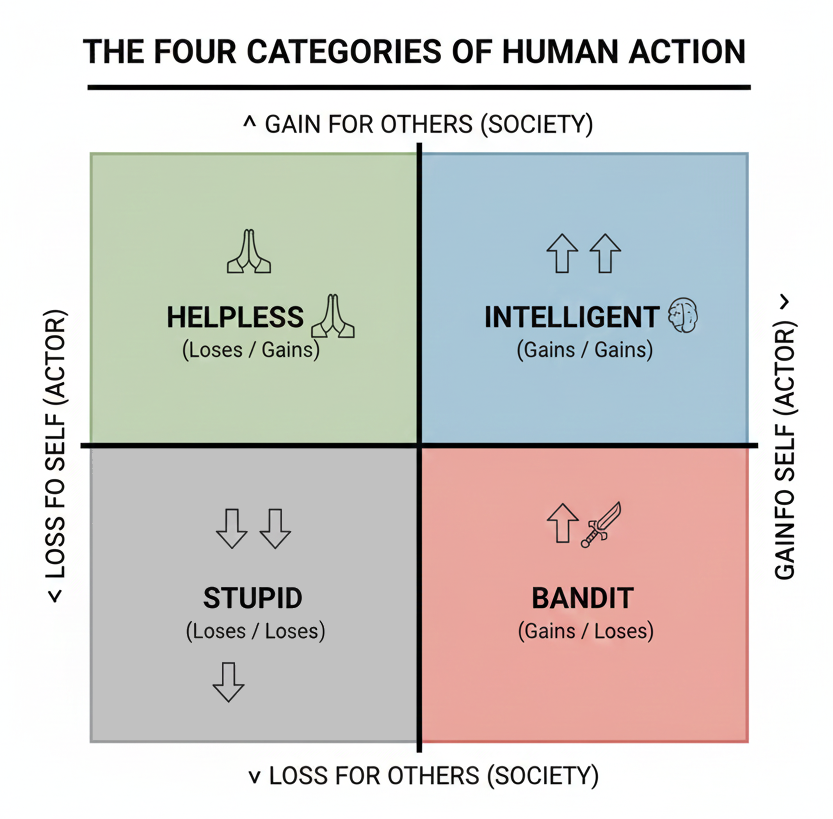
Cipolla’s system classifies people (based on their actions) according to the net consequences of those actions for two groups:
- The Actor (Self-Interest): Does the person gain or lose from their action?
- Others (Societal Interest): Do other people or the group gain or lose from the action?
This creates four distinct categories:
1. Top Right – Intelligent
- Self: Gains
- Others: Gains
- Description: Actions that bring mutual benefit.
- Result: Gain for Self AND Gain for Others.
- Description: The person acts in a way that benefits both themselves and the community/other individuals. These actions are beneficial for the development and prosperity of any society.
2. Top Left – Helpless (or Naïve)
- Self: Loses
- Others: Gains
- Description: Actions that benefit others at the actor’s own expense.
- Result: Loss for Self AND Gain for Others.
- Description: The person’s actions benefit the community or others, but they suffer a loss or disadvantage themselves. These people are often exploited by bandits and, sometimes, even by the intelligent. They are essential to a thriving society but are personally vulnerable.
3. Bottom Right – Bandit (or Predatory)
- Self: Gains
- Others: Loses
- Description: Actions that benefit the actor by causing loss to others.
- Result: Gain for Self AND Loss for Others.
- Description: The person acts to maximize their own gain at the expense of others. While bandits are harmful, their actions are rational and predictable (driven by profit). They cause a transfer of wealth, which is a loss, but not a total destruction of wealth.
4. Bottom Left – Stupid (The Most Dangerous)
- Self: Loses
- Others: Loses
- Description: Actions that cause net loss to everyone, including the actor.
- Result: Loss for Self AND Loss for Others.
- Description: The person’s actions cause damage and loss to others, but they derive no personal gain from the act; in fact, they may suffer harm themselves. This is the definition of irrationality in Cipolla’s system, resulting in a constant, unpredictable netloss for the entire social system.
Summary of the Danger
Cipolla viewed society’s biggest threat not as the Bandit (who simply redistributes resources), but the Stupid person, because their actions erode the total pool of wealth and well-being without any compensating benefit to anyone.
Gradations and Fluidity within the Quadrants
Carlo M. Cipolla’s quadrant model is intentionally presented as a two-dimensional, categorical model for simplicity and satirical impact. In reality, there are gradations within each quadrant, and I asked Gemini to theorize this for me. This means that, just because one is in a quadrant, one is not necessarily “solidly there” permanently.
1. Gradations: Degrees of Impact
The location within a quadrant indicates the magnitude of the gain or loss. The further a person’s action is from the central axes, the greater its impact.
- Intelligent Quadrant: An action closer to the center might be a simple, mutually beneficial exchange (e.g., buying a coffee). An action far out in the corner is a massive win for both parties (e.g., a philanthropic invention that saves millions of lives and makes the inventor wealthy).
- Bandit Quadrant: A minor bandit (closer to the center) might engage in petty theft. A major bandit (far out) would be a corporate fraudster causing catastrophic economic damage while reaping huge personal profits.
- Stupid Quadrant: A person near the center might cause a small, avoidable delay (minor loss for no gain). A person far out represents the devastating, large-scale bureaucratic or strategic error that costs the organization billions and ruins their own career.
The chart is actually a plane of coordinates, where the specific location (x, y) represents the precise amount of gain/loss to self (x) and others (y).
2. Fluidity: Movement Between Quadrants
People are not permanently fixed in a quadrant; their placement depends on the outcome of their specific actions.
- Intelligent < – > Stupid: An Intelligent person can perform a Stupid Action (Law 3) if they are tired, distracted, or operating with Ignorance of Fact (e.g., the skilled scientist accidentally contaminating a sample). This is a temporary slip into the Stupid quadrant.
- Helpless < – > Intelligent: A Helpless person (who is too altruistic or naive) can become Intelligent if they learn to better protect their own interests while still benefiting others.
- The Systemic Threat: Cipolla’s concern, however, is not the occasional mistake, but the individuals who seem to reside systemically in the Stupid quadrant—those whose repeated, pattern-based actions consistently cause net loss. For a leader, this pattern requires intervention, as the person is effectively “solidly” there until their behavior changes.
Therefore, while the model is categorical, a sophisticated understanding recognizes that most people exist close to the axes or move fluidly between the Intelligent and Helpless/Stupid quadrants based on specific circumstances.
A Serious Scholar’s Satirical Side Project
- Initial Publication: Cipolla wrote “The Basic Laws of Human Stupidity” in the 1970s. It was initially a short, private pamphlet meant to entertain his friends and colleagues during a dinner party. It was a lighthearted, yet intellectually rigorous, diversion from his heavy academic work.
- The Tone: The essay is written with the meticulous structure and serious, detached tone of a scientific treatise (defining terms, proving laws, showing their impact on the system). This academic parody is part of what makes it so humorous and effective.
- Official Release: Due to popular demand among those who saw the original pamphlet, the essay was later published for a wider audience in 1976. Cipolla also wrote a related essay, “The Economic Significance of the Size of the Total Population of Italy,” which similarly used academic methodology to arrive at humorous conclusions about social behavior.
It’s often cited as one of the best examples of paradoxical reasoning—using rigorous, formal analysis to explore an inherently messy and emotional topic like human irrationality. It gained its fame precisely because the satirical, formal approach revealed a truth about social dynamics that everyday conversations often miss.
Cipolla’s Theory and the Warning in Scripture
1. The Core Focus
| Cipolla’s Theory | Scriptural Warning |
| Focus: The Action and its Economic Impact | Focus: The Heart and the Moral Status of the Speaker |
| Defines Stupidity as an unprofitable transaction (Net Loss for all). | Defines Condemnation as an internal state of anger, malice, and contempt. |
| The goal is to analyze and manage risk (Law 4: “avoiding stupid people is a costly mistake”). | The goal is to purify the heart and uphold the dignity of every human being. |
2. The Terms Used
“But I say to you that everyone who is angry with his brother will be liable to judgment; whoever insults his brother will be liable to the council; and whoever says, ‘You fool!’ will be liable to the hell of fire.” (ESV)
The warning in Matthew 5:22 escalates the offense:
| Term in Scripture | Aramaic/Greek Meaning | The Spiritual Offense |
| Angry with a brother | Orgizō (Internal wrath) | Equated with the initial intent to murder (hating a person). |
| Raca | Reqā (Empty-headed, worthless) | Denoting a person as intellectually empty or valueless, worthy of utter contempt. This insult is a complete denial of their dignity. |
| Thou Fool | Mōrós (Morally senseless, impious) | Denoting a person as morally and spiritually reprobate—a complete rejection of their soul’s value. This is the most serious form of condemnation. |
3. Key Comparison
A. Cipolla: Observation, Not Judgment
Cipolla’s laws are an analytic framework. He is not instructing people to use the word “stupid” as an insult; he is providing a technical definition for a specific class of behavior: the action that results in loss to others and no gain (or loss) to the self.
- He separates the act from the person’s worth. Cipolla says that you must identify the existence of “stupid people” (those who consistently perform stupid actions) to protect your society, just as an epidemiologist must identify the existence of a pathogen to protect public health. The analysis is cool and dispassionate.
B. Scripture: The Sin is Contempt
The scriptural warning is about the sin of contempt and devaluing a human life. The words “Raca” and “Fool” are condemned because they are spoken from a place of anger and malicious judgment, equating a person’s life as worthless.
- The prohibition is against the internal attitude that strips a person of their inherent dignity, which is seen as the moral root of murder. It condemns the intention to condemn, not the simple recognition of poor decision-making.
In essence:
- Cipolla gives you the tools to identify an unprofitable, destructive action (a “stupid” one) to protect your resources and society.
- Scripture gives you the imperative to love and honor your neighbor (not to be contemptuous) to protect your soul and your community.
You can fully accept Cipolla’s framework (identifying the destructive non-rational behavior) while strictly adhering to the spiritual command (refraining from contemptuous name-calling).